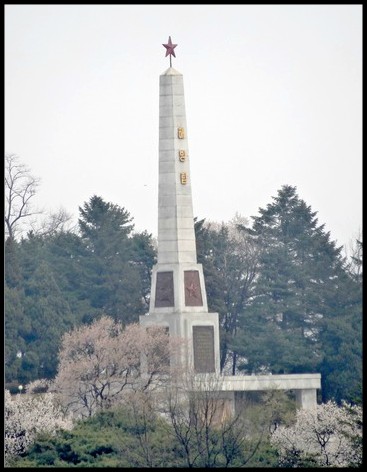
This is one of Pyongyang’s older modern age monuments having being built in 1947 (refurbished 1985). It stands at a height of 30 metres on Moran Hill close to the large bronze statues of Kim Il-sung and Kim Jong-il (Mansudae Grand Monument) – the location from which I saw it.
The monument is dedicated to the Soviet Union troops (hence the red star) who assisted in the liberation of Korea from Japanese rule in the later part of World War II (August 1945) and the resultant friendship between North Korea and the Soviet Union since that date, shaky though it has been at times.
The two Russian/ Korean inscriptions on the monument read:
“The great Soviet people defeated the Japanese imperialists and liberated the people of Korea. The blood shed by Soviet soldiers during the liberation of Korea has served to strengthen the bonds of friendship binding the Korean and the Soviet peoples. This monument was erected to signify the gratitude of the Korean people. August 15, 1945”
and
“Eternal glory to the great Soviet Army, which unyoked Korean people from Japanese imperialists and showed them the way to liberty and independence! August 15, 1945”
Given the above, it is interesting to note that typically little or no mention is made of assistance received from the Soviet Union when North Koreans refer to Kim Il-sung’s, almost single handed, removal of the Japanese from Korea.
At the base of the monument (indiscernible in my picture) is a brass Soviet Union Flag.
At the end of World War II, following an agreement between the United States and the Soviet Union the Korean Peninsula was divided, roughly in half, along the 38th parallel north. The northern part came under the administration of the Soviet Union while the southern part was administered by the United States. In 1948, on the creation of the Democratic People’s Republic of Korea (DPRK) and the Republic of Korea (ROK) the 38th parallel north became the de facto international border between two new countries.
While two independent countries were created each continued to rely on its former administrator. Until the collapse of the Soviet Union, it remained a major sponsor and benefactor of North Korea. Since the Soviet Union’s demise China has poured significant sums of money and resources into North Korea.
Like many other monuments, this one is a popular photo spot for newly weds.
This blog entry is one of a group (loop) of entries on The Rambling Wombat’s trip to Pyongyang, North Korea which I recommend you read in a particular order. I suggest you continue with my next entry – Chollima Statue. If necessary, go to my Pyongyang introduction entry – Pyongyang – A Capital City Unlike any Other – to start this loop at the beginning.
 The Rambling Wombat