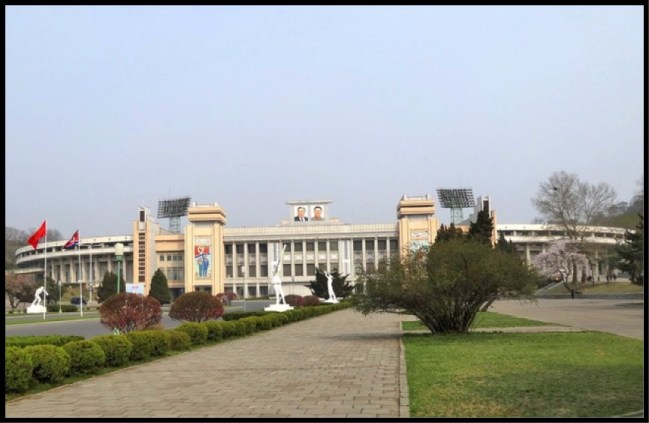
During our time in Pyongyang we were to visit or pass by the Kim Il-sung Stadium on a number of occasions, related, in particular, to the fact that it was the start and finish point for the Pyongyang Marathon which we attended, but more about that in another entry.
The Kim Il-sung Stadium started its life as the Kirimri Stadium built in 1926 by the occupying Japanese and was used for football (soccer) matches until the mid 1940s. I am not sure if it was deliberate or accidental that the square outside the Japanese stadium was the spot chosen to introduce Kim Il-sung as leader of the Korean people in October 1945, following the defeat of Japan and their ousting from Korea after 35 years of occupation. More details on this in my ‘Welcome Home Kim Il-sung’ review.
The Kirimri Stadium was transformed into the Moranbong (it is located at the foot of the Moran Hill) Stadium in 1954 and enlarged in 1969 when it assumed its current dimensions. In 1982 it was renamed the Kim Il-sung Stadium.
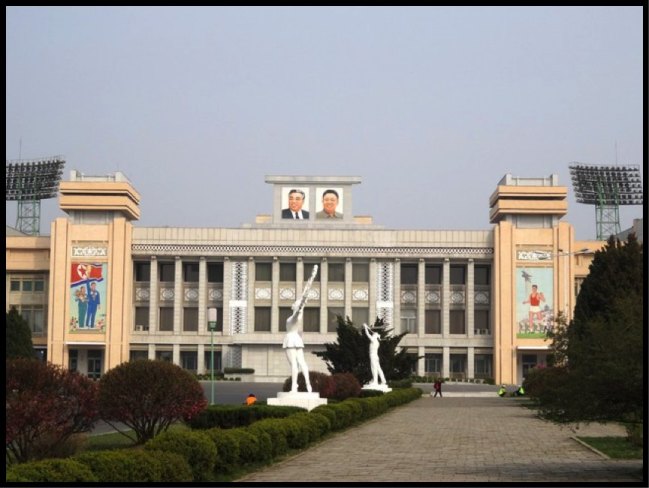
The stadium has 43 tiers of seating. When wooden benches were used for seating its capacity was said to be 100,000. Nowadays with its plastic seating it is thought to hold around 50,000 people.

In addition to being used for soccer (apparently it is one of only two FIFA – International Football Federation – accredited stadium with artificial turf, the other being in Moscow) it is also used for athletics and, as intimated above, is the start and finish point for the annual Pyongyang Marathon. Prior to the opening of the massive Rungnado May Day Stadium it was best known outside North Korea as the venue of the Mass Games – an amazing mass gymnastics cum propaganda display which I would dearly love to see some day.
Kim Il-sung Stadium is the home ground for the North Korea national football team but, alas, matches with South Korea cannot take place here for political rather than sporting reasons. In 2008, two 2010 World Cup qualifying matches between North and South Korea had to be moved to Shanghai when Northern authorities refused to allow the South Korean national anthem to be played or the flag of South Korea to be flown in the stadium.
Outside the stadium you can see various sculptures of athletes and a couple of interesting mosaics on the building itself together with the standard images of Kim Il-sung and Kim Jong-il keeping a watchful eye on proceedings from above the main entrance. Readers of my Chollima Statue review will understand the significance of the mural on the right hand side facing the stadium as depicted below, right.


We visited the exterior of the stadium (as part of a reconnoitre of the marathon route for runners within our tour group) the day before the 2014 Marathon took place. On that day, and no other, the taking of photographs was prohibited. This was probably due to the fact that preparations for the marathon were underway and everything wasn’t yet perfectly positioned, etc for foreign eyes. Everything looked fine to me! Worthy of note here (just because it’s North Korea) is that we arrived at the stadium via the Pyongyang Metro – a real highlight of my visit to Pyongyang – rather than out trusty tour bus.
This blog entry is one of a group (loop) of entries on The Rambling Wombat’s trip to Pyongyang, North Korea which I recommend you read in a particular order. I suggest you continue with my next entry –Rungnado May Day Stadium – Mass Games. If necessary, go to my Pyongyang introduction entry – Pyongyang – A Capital City Unlike any Other – to start this loop at the beginning.
 The Rambling Wombat
Ahaa, its nice dialogue regarding this piece of writing here at this
weblog, I have read all that, so now me also commenting at this
place.
LikeLike