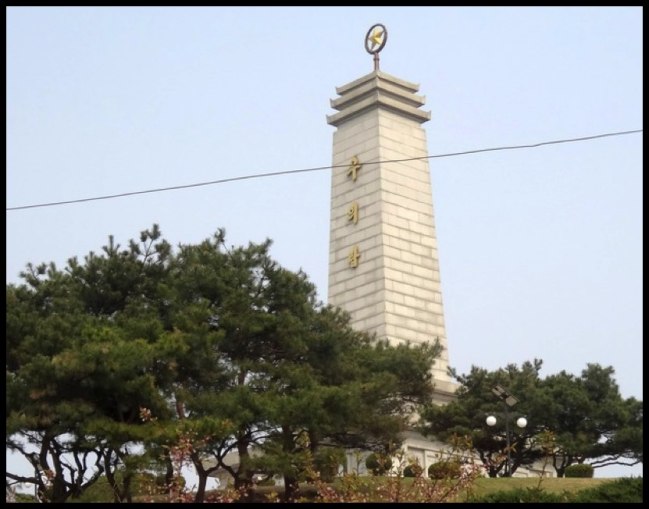
This monument, close the Kim Il-sung Stadium and the Pyongyang Television Tower serves two purposes.
Firstly it is a memorial, dedicated to Chinese martyrs of the Korean War, 1950 -1953 – or the Fatherland Liberation War as it is known in North Korea. Inside the 30 metre high granite memorial are the names of 22,700 fallen Chinese solders including that of Mao Anying. Mao Anying, Mao Zedong’s eldest son was killed in Korea on 25 November 1950, aged 28, from a napalm bomb dropped by a South African fighter plane.

Mao Anying was buried in the Cemetery for the Heroes of the Chinese People’s Volunteer Army in the west of Pyongyang. Some claim that his body was later returned to Beijing.
The memorial is constructed from 1025 blocks of granite and marble – 1025 being symbolic of the 25 October, the day on which Chinese volunteers entered the Korean War.
In addition to being a memorial the tower celebrates China and North Korea’s future friendship – the continuity of Sino-Korean friendships across generations – as it is often referred to as. How strong that friendship remains today is a matter of conjecture and is a debate better held outside this blog.

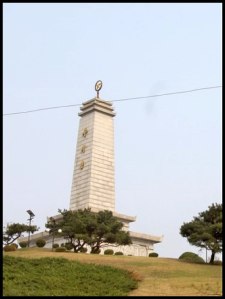
The inscription on the front of the memorial holds no punches (as is common on North Korean monuments) and reads:
“The martyrs of the Chinese People’s Volunteers who defeated our common enemy together with us under the banner of “Resist America, Aid Korea, Protect Family and Defend the Country”: Your eternal honour and the international friendship between the people of Korea and the people of China forged in blood shall shine over this country and this land forever.”
Note the reference to the defeat of the common enemy which refers to the United States. While it is generally held in the west that Korean War hostilities ended in a stalemate, in North Korea there is no doubt – the US was defeated and while they still occupy the southern part of the peninsula this is a temporary state of affairs.
While barely visible in my pictures around the base of the tower are murals depicting Chinese volunteers fighting in in Korea during the Korean War.
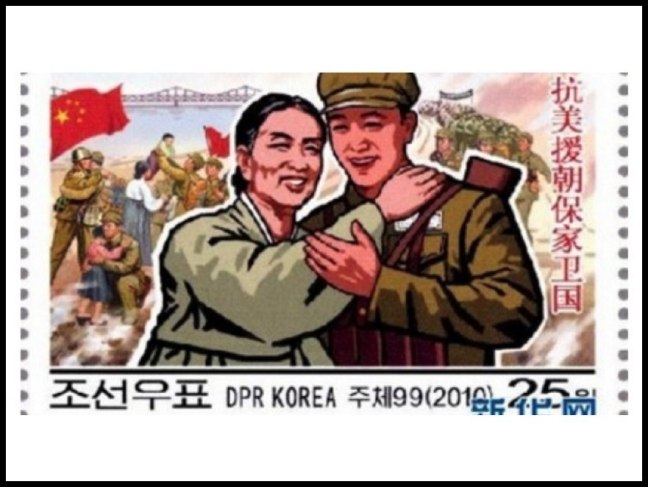
Picture 2 (Chairman Mao with his son Mao Anying) and picture 5 (A 2010 North Korean postage stamp in celebration of the 60th anniversary of the arrival of Chinese Volunteers in Korea) are from the Nautilus Institute (http://nautilus.org).
This blog entry is one of a group (loop) of entries on The Rambling Wombat’s trip to Pyongyang, North Korea which I recommend you read in a particular order. I suggest you continue with my next entry –Kim Il-sung Stadium. If necessary, go to my Pyongyang introduction entry – Pyongyang – A Capital City Unlike any Other – to start this loop at the beginning.
 The Rambling Wombat