

This is the third of a series of five reviews on the Victorious Fatherland Liberation War Museum Complex. If you have not already done so, please read my introductory Complex review before continuing.
While unrelated to the Fatherland Liberation (Korean) War, this captured United States spy ship is moored on the river just behind the display of captured and wrecked US military hardware from the Korean War. This Cold War relic is, in terms of war trophies, North Korea’s number one.
The USS Pueblo was captured, accused of spying, on 23 January 1968 off the east coast of North Korea, near Wonsan. One US officer was killed during the capture and 82 men, including Commdr. Lloyd M Bucher were taken prisoner. The fact that only a small percentage of the classified material aboard the ship was destroyed probably saved the lives of the crew.
Our guide explained what happened next. The US demanded the return of the crew and ship and backed this demand up with mobilisation of the US Seventh Fleet on North Korea’s shoreline. This audacious and provocative action was countered with the announcement by Kim Il-sung on 8 February that North Korea would fight and the army had been mobilised with this in mind. The US withdrew in silence. Unlike Krushchev, during the Cuban missile crisis, Kim Il-sung did not yield to blackmail and would go on to win the day.
Little North Korea had brought the mighty US to its knees, something, with all its power and might, the Soviet Union had not been able to do.
The North Koreans scored a massive propaganda coup on 23 December 1968 when the US Government admitted the violation of North Korea’s territorial waters and published a written apology in exchange for the return of the 82 prisoners and the remains of the dead officer.

North Korea refused to return the ship and has retained it as a war trophy to this day while it officially remains a commissioned vessel of the United States Navy.
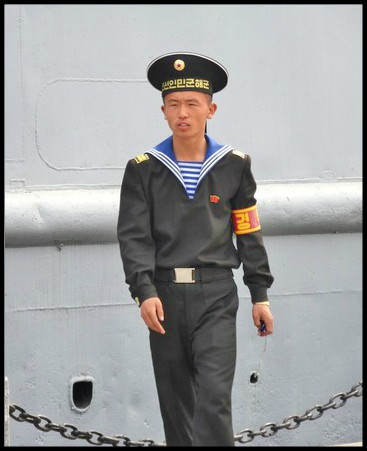
Our visit to the USS Pueblo began with an admittedly very biased documentary on the incident. This was followed with a tour of the ship where the guide pointed out bullet holes at the spot where the US officer was killed and showed us the espionage and radio equipment, US Army manuals and maps that the US had used to enter and spy on the country in this unforgivable violation of North Korean sovereignty.


This is not the first US ship to have been lost to the North Koreans. In 1866 US warship, the General Sherman, was destroyed and all its crew killed after it sailed up the Taedong River seeking to engage in trade and land missionaries in the country, against the expressed wishes of the Korean imperial court.
The US account of the Pueblo Incident, as it is often called, not surprisingly, differs from the above and is readily available online for those who wish to read it.
Having been reminded once again (though now nearly half way through our tour of North Korea no-one had forgotten due to constant reminding) of the evils of the US on board the USS Pueblo it was time to admire a series of sculptures making up the Monument to Victorious Fatherland Liberation War (the Korean War).
This blog entry is one of a group (loop) of entries on The Rambling Wombat’s trip to Pyongyang, North Korea which I recommend you read in a particular order. I suggest you continue with my next entry – Monument to Victorious Fatherland Liberation War. If necessary, go to my Pyongyang introduction entry – Pyongyang – A Capital City Unlike any Other – to start this loop at the beginning.
 The Rambling Wombat