
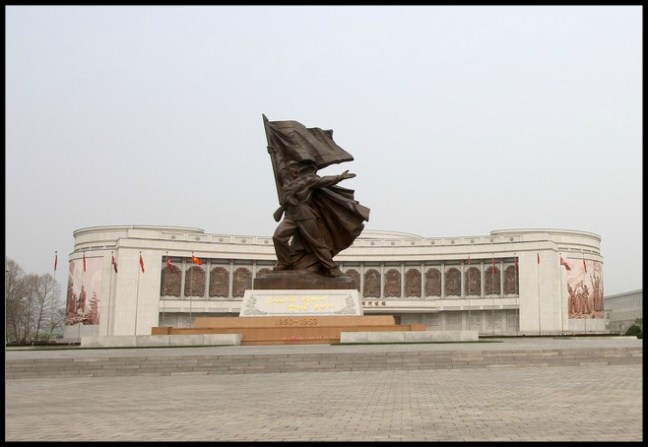
This is the final of a series of five reviews on the Victorious Fatherland Liberation War Museum Complex. If you have not already done so, please read my introductory Complex review before continuing.
This impressive museum displays the history of the Victorious Fatherland Liberation (Korean) War through the eyes of the DPRK and pulls no punches in doing so. Do not expect a balanced picture, you will not get it. This museum is all about glorifying the Great Kim Il-sung and berating North Korea’s imperialistic enemies, the United States and Japan.
It is a vast building with around 30 exhibition halls and over 80 showrooms.
While I felt that the Monument to Victorious Fatherland Liberation War and the exterior of the building (just look at those murals) were both amazing in terms of making statements I can only describe the scene on entering the doors of this museum as jaw dropping. It’s like entering a totally different world (where, alas, photography is strictly prohibited). Inside the doors I was met with sheer opulence and grandeur on a scale I have seen nowhere before. One steps into the most grand entry hall of beautiful marble, sweeping staircases, columns, carved balconies and a low drop chandelier, all of which are outshone (if that is possible) by a massive illuminated wax figure of a youthful Kim Il-sung, in the spitting image of the current Leader, his grandson, Kim Jong-un. Having been let take the scene in, our guide’s first words was to let us know that the wax figure was Kim Il-sung and not Kim Jong-un. Everyone gets its wrong apparently.
Once we had paid our respects to the Great Leader by bowing, our guide explained that we would only have time to see a very small part of this large museum. As such, we would concentrate on the Fatherland Liberation (Korean) War and on Kim Il-sung’s guidance, counsel and leadership which lead to the defeat of the US and North Korea’s victory in that war. We did not have time to look at that part of the museum devoted to the period of Japanese occupation and Kim Il-sung’s successful and heroic struggle to relieve Korea of that awful yoke.
Heading up one of the sweeping staircases to the display areas afforded us even more amazing views back down onto the entrance area and the Great Leader’s wax figure.
Setting aside the content of what was on show, the museum is world class in every way. It is very professionally laid out utilising all methods of modern display. No expense has been spared in delivering the DPRK’s version of the truth to visitors. For me, the most amazing and interesting displays were the seemly endless dioramas (life-like models) of battle scenes, battle terrains and the like. They ranged from small scale models to life-size reproductions. One of the latter enabled us to walk through a steamy jungle and an arctic like mountain terrain reminding us of the harsh conditions in which heroic and loyal North Koreans had fought against imperialist enemies.
Despite the fact that there is little or no English labelling within the museum, I veered away from the guide (though still within an acceptable range!) and perused the displays without interpretation. Having been in North Korea for a number of days at this stage I had already amassed enough patriotic, revolutionary and Kim glorifying language such that I could have guided the group through the museum myself so our guide from the Korean People’s Army wasn’t going to add anything we had not already heard and I assume she didn’t.
Without doubt, the most impressive exhibit in the museum (after we had stopped for a rather tasteless ice-cream in the small museum snack bar) is the huge revolving, hand painted 360 degree battle diorama /panorama depicting the Battle of Taejon – an early battle (July 1950) of the War in which North Korea claims to have routed the United States. You enter the dome containing the panorama from below and sit in the centre while the panorama revolves around you. The area (many metres) between where you sit and the painted back walk is filled with three dimensional models and more artwork such that the whole display, including the back wall, appears in the most amazing 3D giving you what appears to be kilometres of depth of vision. This, already amazing landscape, is further brought to life by a light and sound display which includes flashing bombs and artificial smoke. No, it is not at all tacky, it is amazingly well done.
While photography is not permitted in the museum, an authorised 360 degree panoramic tour of part of the building (including the entrance and the Taejon Battle Panorama) is available at – http://www.dprk360.com/360/victorious_fatherland_liberation_war_museum/. A look at this will make up for my inadequate descriptions above. Also on this site are various other interesting 360 degree panoramic tours and photos of North Korea. I strongly recommend you have a look.
For the information of readers who might have previously visited the former museum, all the captured/wrecked US military hardware displayed in the basement of that museum such that ‘It would never see the light of day again’ is now displayed outside, very much ‘in the light of day’ along either side of the grand walkway up to the entrance of the new museum.
While some of the claims made here are a little outlandish, and some hideously so, my visit to this museum was one of the highlights of my visit to North Korea.
This blog entry is one of a group (loop) of entries on The Rambling Wombat’s trip to Pyongyang, North Korea which I recommend you read in a particular order. I suggest you continue with my next entry – Pyongyang’s White Elephant. If necessary, go to my Pyongyang introduction entry – Pyongyang – A Capital City Unlike any Other – to start this loop at the beginning.
 The Rambling Wombat