

My Reader will be aware (if only from my earlier review – Famous Visitors and Napoleon) that following his defeat at the Battle of Waterloo in 1815, Napoleon was exiled to St Helena.
The Governor of St Helena was advised of Napoleon’s exile to the Island when he was already en route. Where was his uninvited guest going to stay? HM Prison, St Helena was not appropriate – this was not a common criminal – and a more salubrious abode had to be found. It was decided that Longwood House was appropriately isolated on this, one of the most isolated islands in the world. Longwood, however, would take some time to be readied to receive Napoleon.
Napoleon arrived on St Helena on 17 October 1815 and spent his first night in Porteous House (no longer in existence) in Jamestown and on the following day was moved to Briar’s Pavilion on the hillside just outside of Jamestown. Here he would stay until 10 December 1815 while Longwood House was refurbished.


Briar’s was a garden pavilion on the estate of the Balcombe family, a small one-room pavilion which today has been restored to its original neo-Classical style, with imperial green walls and period furniture.
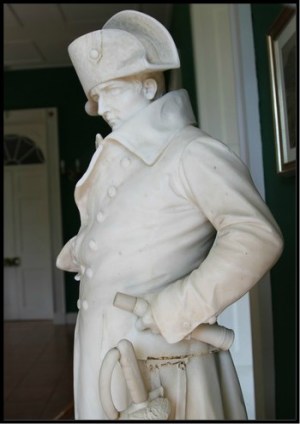
While here, Napoleon developed a very close relationship with William Balcombe’s 13 year old daughter, Betsy who could speak French. This plutonic friendship, and friendship with the family in general, lasted until 1818. The Governor (Lowe) did not like Napoleon (or General Napoleon Bonaparte as he was referred to) and took the view that the Balcombes were acting as intermediary, between Napoleon and France – no doubt plotting for the General’s escape. Balcombe, a purveyor in the East India Company, was removed from the island in 1818 (and eventually ended up in Australia – another story).

By coincidence, it happened that the Duke of Wellington had spent at least some part of his time at Briar’s during his 1805 visit (the owners of the Wellington House Hotel claim he stayed there. Perhaps he stayed a little at both – one wouldn’t want to spoil two good stories). After Napoleon had departed France and during the occupation of Paris by the allied troops Wellington occupied Napoleon’s palace. This gave rise to the following rather amusing letter from Wellington to Admiral Malcolm the newly appointed Commander on St. Helena.
PARIS, April 3, 1816.
MY DEAR MALCOLM,
I am very much obliged to you for Mr. Simpson’s book, which I will read when I shall have a moment’s leisure. I am glad you have taken the command at St. Helena, upon which I congratulate you. “We must never be idle if we can avoid it.” You may tell “Bony” that I find his apartments at the Elisee Bourbon very convenient, and that I hope he likes mine at Mr. Balcom’s. It is a droll sequel enough to the affairs of Europe that we should change places of residence.
I am yours most sincerely,
(Signed) WELLINGTON.
If the dairy kept by the Comte de Las Cases, who accompanied Napoleon into exile, also reflected the view of Napoleon then he didn’t especially enjoy his time with the Blacom(be)s at Briar’s. The Comte wrote thus:
“The Emperor Napoleon, who lately possessed such boundless power and disposed of so many crowns, now occupies a wretched hovel, a few feet square, which is perched upon a rock, unprovided with furniture, and without either shutters or curtains to the windows. This place must serve him for bedchamber, dressing room, dining room, study, and sitting room; and he is obliged to go out when it is necessary to have this one apartment cleaned. His meals, consisting of a few wretched dishes, are brought to him from a distance, as though he were a criminal in a dungeon. He is absolutely in want of the necessaries of life: the bread and wine are not only not such as he has been accustomed to, but are so bad that we loathe to touch them; water, coffee, butter, oil, and other articles are either not to be procured or are scarcely fit for use…”
The Comte’s description hardly matches the condition of the Pavilion as it stands today but then again Briar’s, then or now, certainly does not match Napoleon’s former Parisian Palace.
Briar’s Pavilion is located about three kilometres outside Jamestown (take to road to Longwood) and can be visited by way of a free guided tour at 10.00 am Monday – Friday. Inquire at the tourist office in Jamestown – things are flexible on St Helena.
This blog entry is one of a group (loop) of entries on my trip to St Helena. I suggest you continue with my next entry – Longwood House – Napoleon’s Pad in the Tropics – or to start the loop at the beginning go to my St Helena Introduction entry.
 The Rambling Wombat
I had forgotten about Wellington’s letter to Admiral Malcolm. It is indeed quite amusing.
LikeLiked by 1 person