
It is very easy to think of places like St Helena as idyllic little tropical backwaters of Empire where nothing much happens and all the people are jolly happy chappies. Indeed this often holds true but Her Majesty’s Government doesn’t pump millions into places like with no expectations of future return or sense of repayment for past favours.
St Helena like many others of Britain’s remaining and past possessions was acquired for strategic purposes – for the defence of Britain and/or the advancement of British trade. St Helena served both purposes.
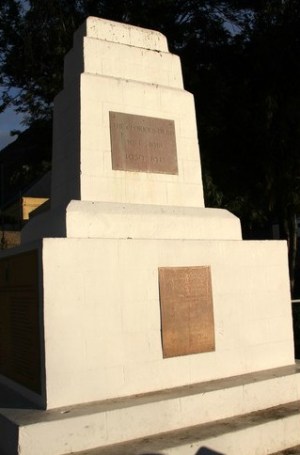
And so it was, when Britain went to war, St Helena went to war. Loyal Saints (as the locals are called) answered the call to arms in both World Wars and this memorial on the waterfront commemorates those who lost their lives in World War I and World War II. Six Saints paid the ultimate price in each war.
On the land side of the War Memorial is an additional plaque dedicated to the memory of the 41 crew members who were lost when the Royal Fleet Auxiliary (RFA) Darkdale, the station tanker supporting ships using the Cape Convoy Routes to South East Asia, was torpedoed and sunk by the German (U-boat) submarine U-68 in the early hours of 22 October 1941 while she lay at anchor in Jamestown Harbour. The Darkdale was the first British ship to be sunk south of the Equator during World War II. War had come to within a hundred metres of St Helena. Thankfully, this was as close as it got.
Of the 41 killed (six crew including the Captain and the Chief Engineer were ashore and survived) the majority were from the United Kingdom with one member from each of Ireland, Jamaica, New Zealand and India. The ship and the waters of the South Atlantic remains their grave.
The lost crew of the RFA Darkdale is also remembered on the Tower Hill Memorial in London which commemorates those from the Merchant Navy and fishing fleets who died during both World Wars and have “no grave but the sea”.
U-68 was sunk on the 10 April 1944 in the North Atlantic north west of Maderia by aircraft from USS Guadalcanal. 56 of its crew died, 1 survived.
Every year, on the 11 November, St Helena joins many parts of the world in a traditional two minute silence and the laying of wreaths in remembrance of the war dead.
His Excellency, the Governor of St Helena, Ascension and Tristan da Cunha, who resides on St Helena, lays a wreath on behalf of St Helena while the French Consul lays a wreath for the Republic of France. Those readers who have read, or go on to read, my Napoleon reviews will understand why there is a French Consul on St Helena.
This blog entry is one of a group (loop) of entries on my trip to St Helena. I suggest you continue with my next entry – Anne’s Place: “Nautical Ambiance” – or to start the loop at the beginning go to my St Helena Introduction entry.
 The Rambling Wombat