
Most people know that Tiananmen Square, named after Tiananmen (the gate), in the heart of Beijing, is large but it is not until you visit it that you can truly appreciate how large it is. At 850m by 550m the ‘rectangular square’ is the largest public square in the world by a long shot.
The square in its current concrete slab form is a 1950s Communist Party creation. In earlier times it was very different.
In the picture below the red line outlines the square as it is today. The Ming/Qing square referred to below is outlined in blue.

Traditionally every Chinese home had a small courtyard out front and the royal palace was no different. Under the Ming and Qing rulers, the area outside the imperial city was a T-shaped walled courtyard outside of which were found rows of offices belonging to various ministries, the military, and other government agencies. This T-shaped square ran from Tiananmen (the gate) to the ceremonial Great Ming Gate (renamed the Great Qing Gate and then again renamed to Gate of China and today the location of Mao Zedong’s Mausoleum) a distance of some 1000 steps, hence references to the square as the “Thousand Step Long Walkway”.
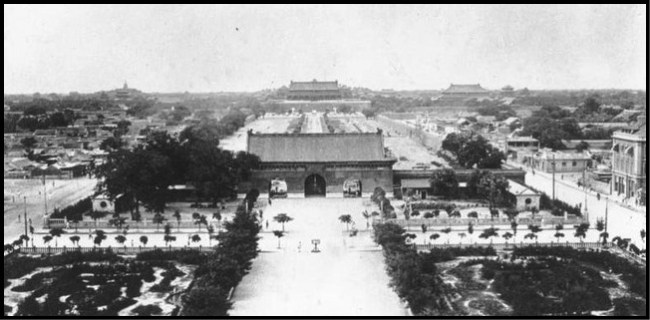
When the emperor went to the Temple of Heaven to offer sacrifices to the gods and to pray for a good harvest, he and his entourage left the palace via Tiananmen (the gate) and proceeded south along the ‘Thousand Step Long Walkway’ before exiting the Imperial City by the Great Ming (or Qing) Gate. From there the procession proceeded through Zhengyangmen and on to the Temple of Heaven about another kilometre or so to the south. Picture below is an early 1900s image of the route looking back from Zhengyangmen with the then Great Qing Gate in the centre and Tiananmen (the gate) to the rear.
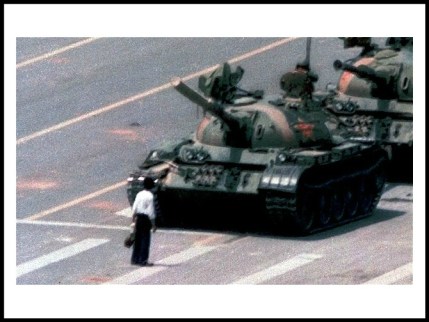
From the Second Opium War in 1860 when British and French troops entered the square and considered burning down the entire Forbidden City (they changed their minds and burned the Emperor’s Old Summer Palace on the outskirts of Beijing instead) Tiananmen Square became a focal point for important political events and protests, the most infamous of which has been the 1989 student pro-democracy protests in which an unknown number (some say thousands) of protesters were killed when the government decided to clear the square. Readers recalling this event will undoubtedly have vivid memories of photographs (photo below – source unknown) and television footage of the man standing in front of a moving tank and refusing to move.
Going back to 1949, following the foundation of People’s Republic of China, major renovation work began at Tiananmen Square. Via this and three subsequent renovation projects in 1958, 1976 and 1981 the ministry, military and other government buildings and walls I referred to earlier were demolished (the Gate of China was removed in 1954) to create the massive square you see today. Today the square can comfortably accommodate over half a million people, with each person having the best part of 1 metre square. At a pinch it can accommodate one million people.
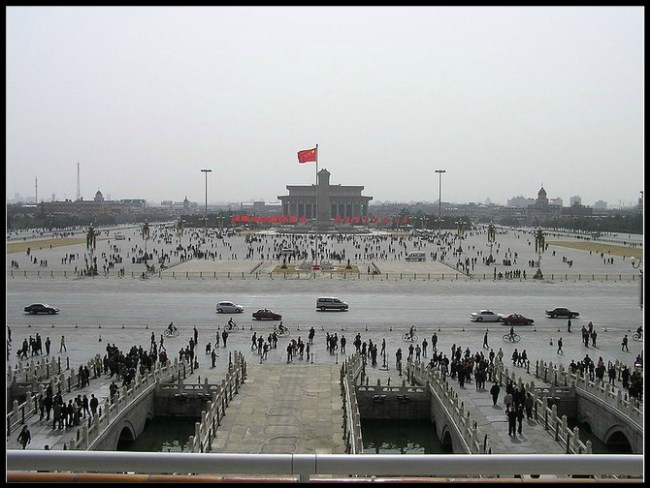
Today, for security reasons you can only enter the square, the most emotionally and historically charged urban space in China (having gone through a security check), at one of the four corners or half way up the east and west sides of the square. Since the 1989 pro-democracy protests authorities, not wanting a repeat, have been on edge in this part of the city and more recently the fear of protest/violence by separatist or religious fundamentalist groups has lead to even greater overt security and, without doubt, under cover surveillance in the square. Notwithstanding, or perhaps because of, this high security the square is perfectly safe to visit and unless you come with the intent of engaging in protest, or the like, you will have no problems.
While the square lacks any form of vegetation (outside occasional banks of potted plants) or seating, it is a popular place for local people and tourists to ‘hang out’ and, besides sightseeing, a common pastime here is flying kites. On my most recent visit (2014) I noted a significant decline in hawkers and touts, though visitors wishing to avail of the services of sweet young ladies wishing to practice their English over a cup of tea can still do so. Off course the apparent friendliness of these young ladies is a front to rip you off and their services, however appealing, should be declined. Should you forget your camera there are lots of photographers in the square to ensure that you don’t have to go home without that all important photo of you in front of Tiananmen gate with Mao in the background – bargain hard.
While the square is an attraction in itself, it also contains a number of Beijing’s most popular attractions and is surrounded by even more of them. I have prepared separate reviews on things I recommend you see within the square and immediately around it:
*Tiananmen – Gate of Heavenly Peace not forgetting the Huabiao (used by the majority of visitors to gain access to the Forbidden City, a short distance through the gate)
*The Flag raising/lowering ceremony
*The rather ghastly and out of place Tiananmen Square LED Screens
*The Monument to the People’s Heroes
*The Chairman Mao Memorial Hall which, notwithstanding the queue, I recommend you go inside, in addition to admiring it from the outside
*Zhengyangmen (Zhengyang Gate) – Gatehouse and Watchtower not missing China’s Zero Point by the Gatehouse
and, on the east and west side of the square, respectively:
*The National Museum of China, and
*The Great Hall of the People.
This blog entry is one of a group (loop) of entries based on a number of trips to Beijing. I suggest you continue with my next entry – Tiananmen – Gate of Heavenly Peace – or to start the loop at the beginning go to my Beijing Introduction.
 The Rambling Wombat