

Wandering around the exterior of the Old Royal Naval College (a naval hospital until 1873 and now the University of Greenwich) and a look at the grandness of the buildings in a setting next to none will leave the visitor with little doubt that this was no ordinary hospital for convalescing seamen in the late 1700s. Enter some of the buildings and most notably the Chapel or the Painted Hall (dining room) and you will be in no doubt. These buildings were built in the days when Britain ruled the waves – the days of Rule Britannia, when the navy was the premier service and money was no object (though I will come back to that latter comment about money).
This review relates to the Old Royal Naval College Chapel dedicated to St Peter and St Paul, both of whom had nautical connections.
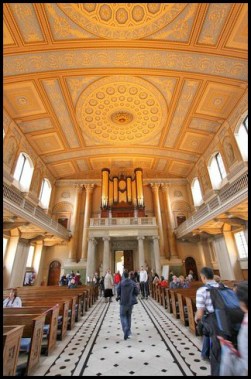
The original, much plainer, chapel was designed by Sir Christopher Wren and built by Thomas Ripley in 1751. On 2 January 1779 its was reduced to a shell by a horrific fire thought to have started in an adjoining tailors shop. The current chapel was designed by James “Athenian” Stuart, Surveyor at the Royal Hospital for Seamen, assisted by his clearly very talented Clerks of Works – Robert Mylne and William Newton, in a neoclassical Greek revival style. The beauty of the chapel is in very sharp contrast to the greyness and drabness of the college buildings (though they are not without class or grandness in their own right – they are just grey) and certainly an eye opener when you walk in.
The intricate Wedgewood look plasterwork on the ceiling and other areas created by master plasterer John Papworth in a neo-classical design of squares and octagons will probably be the first thing to draw your attention. The central ornaments were carved, and not casts.
The giant altar painting, some 7.5 metres high, is by American-born artist, Benjamin West and depicts the story of St Paul’s shipwreck on the island of Malta where he miraculously survived a viper’s bite. The painting was specially commissioned for the chapel c1785.
The Organ is the creation of the leading organ builder of the day, Samuel Green and was installed here in 1789. Its case is of Spanish mahogany. Look at how beautifully it blends in with the ceiling and how wonderful it sits atop six fluted marble columns.
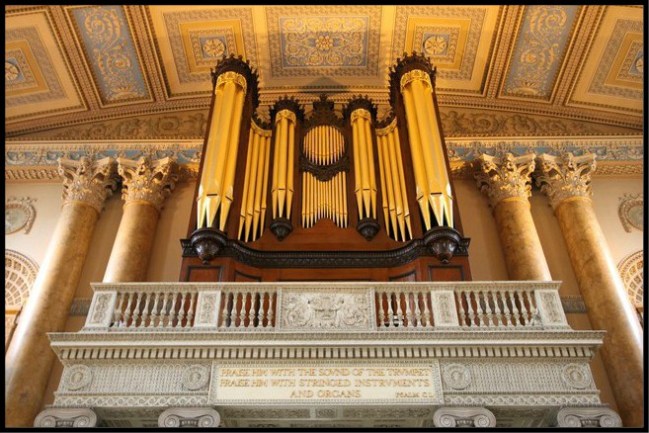
The text beneath the organ exhorts us to :
“Praise him (god) with the sound of the trumpet
Praise him with stringed instruments
and organs” – (Psalm 150)


Having a particular interest in fine furniture I found the James Arrow carved oak, mahogany and lime wood pulpit especially beautiful, simple and elegant. I have a particular liking for oak and mahogany so the pulpit and organ tick all the boxes for me.
By this stage you might be wondering why I suggested that the Chapel was not all it seems to be in the title of my review. Well, even in those days while the navy and its kindred organisations were not poor, at least at the “brassier” end, costs still had to be kept in check.
Have a look at the two sets of beautiful marble Corinthian columns at either end of the chapel – they are not marble but rather scagliola, a mixture of plaster chips coloured with pigment, and mixed with animal glue. And perhaps more striking are the life size figures of evangelists and apostles in niches around the balcony. Take a second and closer look and you will see that these are in fact paintings (by Biaggio Rebecca) which very cunningly and cleverly rely on the use of shadow and contrast to create their lifelike appearance – wonderful examples of trompe-l’œils for my more learned readers and who among my readers are not that? You will also note that Wren’s dome which you see outside does not feature inside the chapel. So, as you see all is not as it seems in the chapel.
Just in case you are wondering the marble columns holding up the organ are real marble.
While the chapel underwent a major restoration in the 1950s the restoration was very strongly focused on restoring the chapel to its 1781 condition. All in all, a beautiful place to have a look around. On a previous visit there was a service in progress and while I couldn’t have a look around that time the singing was beautiful, helped by the wonderful acoustic properties of the curved ceiling.
Opening Hours
Mon-Sat – 10am – 5pm
Sunday – Church Service (which you can attend) 11.30am and open to visitors 12.30pm – 5pm
Closed December 24 -26 inclusive with restrictions on other specific days – see website.
Entrance Fee: Free
Guided tours of the chapel and other College buildings (some free, some not) are offered. See website for further details (https://www.ornc.org/). As I didn’t take a tour I cannot comment on them.
This blog entry is one of a group (loop) of entries based on many trips to London. I suggest you continue with my next entry – Greenwich Market – or to start the loop at the beginning go to my introductory entry – London…as much of life as the world can show.
 The Rambling Wombat