

If you have seen my introductory London entry and you have any knowledge of the Knights Templar, even if it be via Dan Brown’s novel, the Da Vinci Code, you will have recognised the main picture there as being the symbol of the Knights Templar – a horse carrying two knights. This symbol is situated atop a column outside the Temple Church.
Let me digress with a much abbreviated history lesson…….
The Knights Templar or to give them their full name the Poor Fellow-Soldiers of Christ and of the Temple of Solomon were a religious order of crusading Knights established in the early 1100s to provide safe passage for pilgrims to and from the Holy Land during the twelfth century Crusades.
Some two hundred years later the Order disappeared as quickly as it appeared following the loss of the Holy Land and it becoming a victim of its own success. The Order had amassed a vast fortune protecting pilgrims – a fact not lost on the almost destitute King of France. In 1307 many of the Order’s members were arrested, tortured and burned at the stake on the orders of French king, Philip IV and in 1312 under pressure from Philip, Pope Clement V disbanded the Order.
The vast fortunes didn’t eventuate for the French throne and the Order’s disappearance gave rise to speculation and legends, which have kept the “Templar” name alive ever since. Fascinating and a personal interest of mine but out of scope for this review.
Back to London and the Temple Church
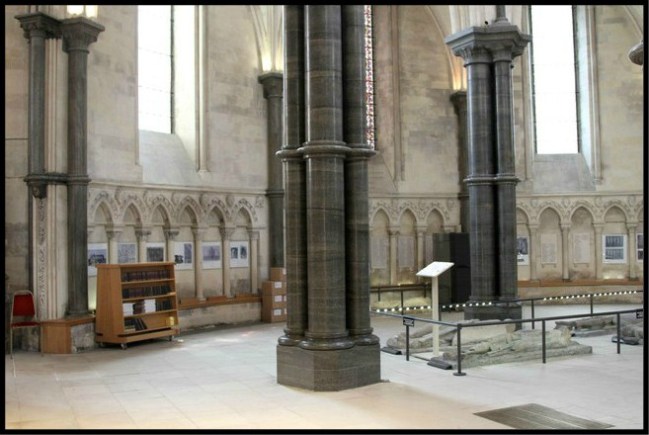
The Temple Church, constructed by the Knights Templar, is one of the oldest structures in London and features one of the few circular naves still in existence and modelled on that of the Church of the Holy Sepulchre in Jerusalem. This key part of the church, the Round Church, was consecrated in 1185 by Heraclius, Patriarch of Jerusalem, with Henry II believed to have been in attendance (evidence of the Templar’s power and importance at the time).

The now main section of the church – the chancel was added in 1240. This Templar church/headquarters replaced a smaller one at High Holborn which had been established by Hughes de Payens on the site of a Roman temple.
With the suppression of the Templars in 1307, the Order’s property was passed by Edward II to the Knights Hospitallers, another religious order of the day, which rented the Temple to two colleges of lawyers which later evolved into the Inner and Middle Temples, two of the four London Inns of Court.
When Henry VIII took over the Church in 1540 following his suppression of the monasteries he appointed a new priest under the tile “Master of the Temple” ( a title still used by the Temple priest to this day) and the lawyers remained as tenants. In 1608, James I gifted by Royal Charter, in perpetuity, the total locale to the Inner and Middle Temple Inns with the proviso that they take responsibility for the Temple Church – a responsibility which they still assume. Interestingly a King James Authorised Version of the bible can still be found on every pew.
In the 1580s, the church was the scene of the Battle of the Pulpits, a theological conflict between Calvinists and supporters of the Church of England – the “C of E” triumphed. It also features in Shakespeare’s play Henry VI, Part 1 where it and the Temple garden are the setting for the fictional scene of the plucking of two roses and the start of the 15th century Wars of the Roses. In 2002 new white and red roses were planted in the modern gardens to commemorate this.
 The most interesting and indeed peculiar inclusion in the church and its greatest draw-card from a visitor perspective are nine marble effigies of medieval knights located on the floor of the Round Church. Among the knights buried in the Round is William the Marshal, Earl of Pembroke (died 1219), adviser to King John and regent to Henry III.
Outside looking at the effigies, do give yourself an hour or two to explore what is a real treasure trove when it comes to the history of the Templars and the legal profession in the City. Look up too and admire (or recoil at) the grotesque heads placed at just above head height around the walls of the church and higher up the stunning vaulted ceiling. All in all a very beautiful church and somewhat out of the ordinary in terms of both looks and history.

While it escaped the Fire of London unscathed, the church and effigies were badly damaged in WWII when it also lost its original seventeenth century pipe organ (a Wren addition). Today the whole church has been beautifully restored and while I didn’t get to attend a choral performance or an organ recital (the current organ was under repair), I am told they are not to be missed. Something for next time.
Entry to the church used to be free and the opening hours were rather erratic and unpredictable. An entrance fee is now charged (GBP4) and the opening hours – while still limited – appear to have stabilised – so you can reasonably expect to gain entry if you arrive during the prescribed hours. The introduction of an entrance fee hasn’t made finding the church in the first place any easier though.
For both the exact location of the church and opening times (which still vary) visit the churches very information rich website – http://www.templechurch.com/. I wont attempt to cover either here.
This blog entry is one of a group (loop) of entries based on many trips to London. I suggest you continue with my next entry – London’s Telephone Boxes – A Dying Breed – or to start the loop at the beginning go to my introductory entry – London…as much of life as the world can show.
 The Rambling Wombat
Great post!
LikeLiked by 1 person
Thank you for visiting and for your feedback.
LikeLike