
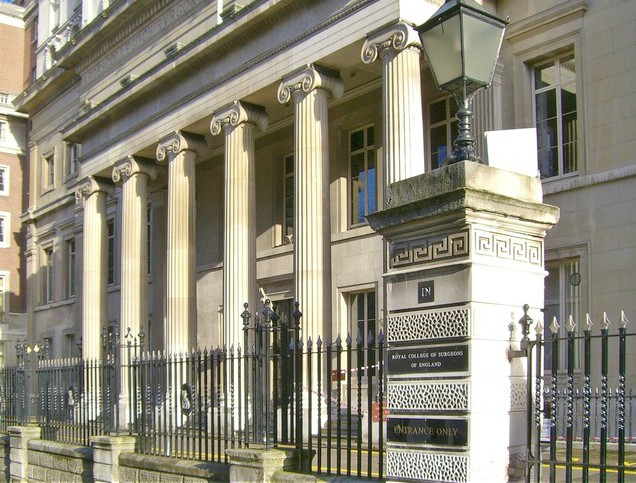
I thoroughly enjoyed my visit to this rather unorthodox museum and highly recommend a visit if interested in the subject matter. While it is not without its controversy the museum is not in the slightest macabre, disrespectful, commercialised, freakish, sensationalist or tacky (adjectives often used in referring to it).
The Hunterian Museum is an anatomy and surgery museum so it should come as no surprise that it is full of anatomical exhibits and pathology specimens (human and non-human). So, yes there are human fetuses (multiple and at all stages of development); human genitalia; mutilated, diseased and deformed body parts; medical oddities; skeletons; surgical instruments which today one would imagine to be more at home in a torture chamber; etc. Exhibits are typically in formaldehyde filled glass jars for preservation purposes. This is what you except to see in a museum of this nature and if that is not your thing please do not visit. Contrary to most peoples expectations, the majority of anatomical exhibits in the museum are non-human. Also in the museum you will find an interesting art gallery and Winston Churchill´s false teeth!

The major part of the anatomical collection was collected and put together in the 1700s by eminent surgeon John Hunter (1728-1793) who was, in 1776, appointed as surgeon to King George III and, in March 1790, was made British Surgeon General by the then Prime Minister, William Pitt.
While some of Hunter’s collection techniques have been questioned he was no amateur or freak. Hunter was a dedicated researcher, scientist and anatomist and unquestionably contributed much to the advancement of medicine and medical training.Hunter is, today, remembered as a founder of `scientific surgery’.
Did he acquire specimens in a manner that would not be acceptable to-day? Without doubt he did, but this was the way of the 1700s. People didn’t carry organ donation cards. It was common practice that the bodies of executed criminals were handed over for medical purposes and also not uncommon that bodies were purchased from sources unknown which would have included grave snatchers or worse, on a no questions asked basis.
The most controversial exhibit in the museum is the skeleton of Irish giant, Charles Byrne. I have prepared a separate review on Byrne, ‘The Irish Giant at the Hunterian Museum‘, and another one based on the skeleton of Jonathan Wild – ‘Thief Taker General of Great Britain and Ireland‘ – also on display in the museum.
In 1799 the government purchased Hunter’s collection and presented it to the Royal College of Surgeons which has added to it and maintained it ever since – though a significant portion of the collection was lost in a WWII bombing. The display is professionally and clinically organised in a matter of fact manner with no attempt whatsoever to sensationalise, shock or titillate the visitor – they leave that to the London Dungeon and the like!
While the museum does, undoubtedly, attract a certain clientele seeking some form of titillation this type of person will quickly become bored with the sobriety and matter of factness of the museum. That said, the exhibits are well explained and context is provided. While the museum is free to visit I do thoroughly recommend you pick-up an audio guide from the reception – well worth the small cost. There is a free curator led, guided tour every Wednesday at 1pm and outside this, private tours can be arranged but they are rather expensive.
Presumably in the interests of not sensationalising the museum, it enforces a strict no photography policy. Sketches are permitted.
Opening Hours
Tuesday to Saturday from 10am to 5pm.
Closed Good Friday, Easter Saturday and from Christmas Eve to New Years Day inclusive, reopening on the first working day.
Admission
Free – though I do recommend the optional audio guide for a small cost.
This blog entry is one of a group (loop) of entries based on many trips to London. I suggest you continue with my next entry – The Irish Giant at the Hunterian Museum – or to start the loop at the beginning go to my introductory entry – London…as much of life as the world can show.
 The Rambling Wombat