

As you enter the Hunterian Museum, in a niche just past the reception desk, you will be confronted with the skeleton of Jonathan Wild one of London’s most notorious criminals.
Wild, hailing from Wolverhampton arrived in London in 1708 and soon (1710) landed himself in jail for a debt offence. While in prison Wild really began his short life of crime and befriended both other petty criminals and his warders who (the warders that is!) awarded him with “the liberty of the gate”, meaning that he was allowed out at night to aid in the arrest of thieves. Off course this award was of mutual benefit to warders and Wild.
On release in 1712, and using contacts made in prison, Wild became a pimp and a ‘collector” of stolen goods – stolen by himself and his accomplices (he ran gangs of thieves) – which he would then return to their owners for a fee or offered rewards. Wild never sold stolen goods as there were high penalties for this. He was very happy with the rewards available for “recovering” stolen goods and returning them to their owners.
He was also not averse to turning in his fellow criminals, especially those who challenged his right to retain the majority of the rewards/fees for the recovery and return of stolen goods to their rightful owners. Turning in criminals was a highly profitable business – he would receive a reward from corrupt City officials he had befriended. Indeed, some of those he turned in, he later bribed other officials to have them released again so they could continue working for him. Presumably the bribe for getting them out was less than the £40 reward for turning them in!
Initially this role of turning in criminals and thieves – as thief-taker – won him much public acclaim in a then crime ridden London with a totally ineffective police force. This public affection helped Wild evade prosecution himself and earned him the dubious honour of being referred to as “Thief Taker General of Britain and Ireland” – though I think that title was self proclaimed. In 1720, Wild’s fame was such that the Privy Council consulted with him on methods of controlling crime. Wild’s recommendation was that rewards for evidence against thieves be raised and indeed the £40 reward for capturing a thief was increased to £140!
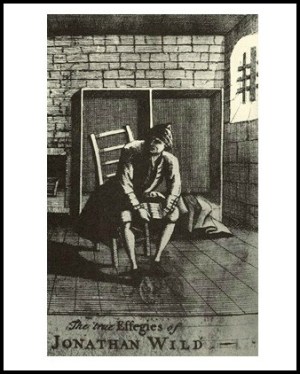 His good fortune ran out in 1724 when he turned informer on Jack Sheppard and Joseph “Blueskin” Blake, two of the City’s most famous criminals. Both were hanged and Wild became a marked man, for his duplicity, among the criminal fraternity. The following year he was arrested and tried at the Old Bailey for being ‘a receiver and a confederate of thieves’; for having ‘form’d a kind of Corporation of Thieves’; and for having ‘often sold human blood, by procuring false Evidence’. He was sentenced to hang at Tyburn prison near the current day Marble Arch.
En route to Tyburn (when the entourage was not stopped in a pub to let Wild have a drink – a common and accepted practice at the time for those en route to the gallows) he was pelted with stones, mud, faeces and decomposing cat and dog corpses by an angry crowd which was only placated when the Sheriff promised that his body would be given to the Surgeons (the Company of Barber Surgeons) for dissection.
Wild’s hanging on 24 May 1725 was a festive affair attracting a massive crowd. Tickets were sold in advance for the best vantage points (see my main picture). Interestingly the ticket appeals “To all the thieves, whores, pick-pockets, family fellons &c in Great Britain and Ireland” to attend Wild’s execution – so really an invite to all his friends!
The Sheriff did not keep his word and Wild was buried in St Pancras’ church yard but within days the grave was empty. Newspapers reported that unnamed surgeons had removed his skeleton and discarded the flesh and skin which was later found in the Thames and identified as Wild’s by its hairy chest!
Nothing more was heard of Wild’s skeleton until 1797 when it was identified as in the possession of a surgeon called Peter Rambin who later passed it to Frederick Fowler who presented it to the Royal College of Surgeons in 1847 which now has it on display in the Hunterian Museum.
Wild’s fate is typical of hundreds of executed criminals whose bodies were taken from Tyburn to be dissected by the surgeons.
While there are many pictures of Wild’s skeleton online, I complied with the no photography requirements of the Hunterian Museum.
Fuller details on the Hunterian Museum are included in my main and general review on the Museum – The Hunterian Museum. I highly recommend a visit.
This blog entry is one of a group (loop) of entries based on many trips to London. I suggest you continue with my next entry – The Wellcome Collection – or to start the loop at the beginning go to my introductory entry – London…as much of life as the world can show.
 The Rambling Wombat