

Time to contemplate or speculate.
Getting to Panmunjom, the Demilitarised Zone (DMZ) and the border with South Korea requires a 175 kilometre trip from Pyongyang along the Reunification Highway (also called the Pyongyang-Kaesong Motorway). While the highway continues on a further 70 kilometres to Seoul it is closed at the border and a through journey in either direction is not possible.
The journey from Pyongyang to the DMZ takes about three hours though we spent a night in Kaesong some ten kilometres short of the DMZ prior to our visit to the DMZ the following day.
The highway was built between 1987 and 1992 and comprises four lanes in each direction. Rather an overkill if you subscribe to the view that the highway was built for civilian traffic or that civilian traffic was even a consideration in its construction. Traffic is extremely light on the highway and many times we travelled for five minutes or more without sighting anything more than a soldier or farmer on a bicycle.
Our guides assured us that the highway was built in the expectation that reunification was imminent and such a highway was entirely appropriate for the anticipated increase in traffic and trade that would result from that reunification. Indeed that might be so but the more cynical visitor might observe how suited such a wide and generally straight highway might be to the mass movement of troops and military equipment. Such a cynical visitor would undoubtedly also note that the central reservation between the two four lane roads is absent for 3-4 kilometres at regular intervals and might conclude that substantial aircraft could land on and take off from the highway.
The rather cracked and rough surface of the highway, while very noticeable and making for a rather uncomfortable journey by bus as the driver weaves from one side of the road to the other to avoid the worst of the unevenness, would present very little impediment to the military use.
The highway is punctuated with army checkpoints though we drove unhindered through most of these. I read somewhere that local people need clearance to use the highway but I think it is more accurate to say that locals need permission to move around within the country rather than to actually use the highway. Our guide certainly confirmed that access to Pyongyang was controlled though she emphasised that this was so that authorities were aware of who was in Pyongyang rather than any desire to restrict people from entering the capital.
At about the midpoint between Pyongyang and the DMZ we stopped for a leg stretch at what appeared to be the only comfort stop along the route and certainly the only place I have heard of tourists stopping along the highway.
As we approached the DMZ the number of checkpoints increased and with it the army presence though the existence of both was well less than I anticipated. This army presence, here and elsewhere, brought back memories of growing up in Northern Ireland through the worst of the “Troubles” in the 1970s and early 1980s and didn’t really phase on me after a day or two.
Something I did see in North Korea, especially as we approached the border, which we didn’t have in Northern Ireland was tank traps and other devices which could be used to disable the highway in the event of an incursion from the South.
Large concrete pillars along the roadside (I didn’t get a picture) supposedly contain sufficient explosives to blow them up and consequentially close the road if necessary without unduly damaging the road itself. We passed these pillars/traps at regular intervals. Personally I would have though that it would have been much easier to take the road out with a few bombs dropped from an aircraft should the need arise than maintain a series of these pillars/traps on an ongoing basis but then again I imagine the pillars could be detonated more quickly by local military than it would take to scramble aircraft. I would also imagine that, should all out war break out, each side would have plans in place to disable land communication systems of the enemy at a very early stage of conflict.
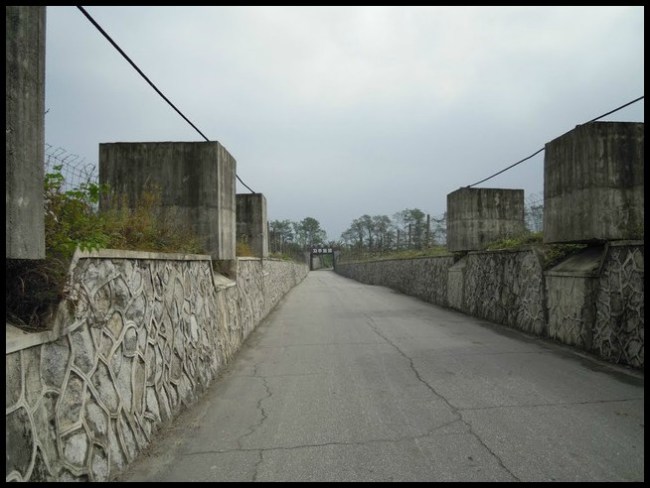
Defenses within the DMZ and at the actual border (picture 2 courtesy of Association D’amitié Franco-Coréenne) are probably of more immediate use especially in the case of a surprise attack. The large concrete cubes pictured could be fairly easily dropped down to block the road – especially if supported by a small explosives charge. Incidentally this picture is of the actual entry road into the DMZ from the Visitor Centre. I would not have been game to take it!
I digress.
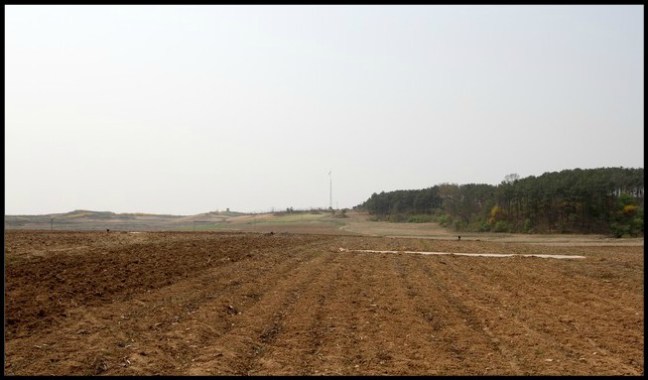
In addition to contemplating the military implications of the Reunification Highway do take time to view day to day life along the highway. All along the highway is basically arable land (picture 3 – actually within the DMZ) and farmers were readying themselves to transplant the rice crop from growing beds into the already prepared fields. This is a major annual job and our guide explained how office workers (including tour guides!) from the cities and the army ‘volunteered’ and assisted the farmers with this work. While there was certainly evidence of mechanised farming techniques such mechanisation appeared basic and manual labour remains the key input into agricultural output. I noticed little or no livestock along the highway.
This blog entry is one of a group (loop) of entries based on my visit to Panmunjom (DMZ), North Korea. I suggest you continue with my next entry – Dining al fresco en route to the DMZ – or to start this loop at the beginning go to my introductory entry – If war resumes leave the area as soon as possible!
 The Rambling Wombat