
The castle complex consists of a number of buildings including the Keep (main castle), the Watergate, a magazine, various barracks buildings and a reception area. The reception area, which houses the Fermanagh County Museum, opened in 1992-3.
The first castle, or forerunner of the current castle
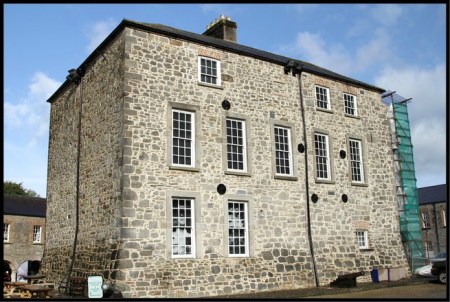
was built pre 1428 by Hugh (the Hospitable) Maguire. While nearby Lisnaskea was the primary seat of the Maguire clan, securing Enniskillen – a gateway into Ulster from the south was an important strategic and defensive imperative. The castle helped defend Fermanagh from attack, particularly from the neighbouring O’Rourke and O’Donnell clans. While not often talked about, the Irish were quite happy to fight amongst themselves long before the English joined in!
Water ditches on the land side of the castle at this time were subsequently filled in and the current large windows added well after the Maguires vacated.
Following the Flight of the Earls in 1607, or taking advantage there-of, depending on your perspective, William Cole from Devon, England, received the island of Enniskillen in the Plantation of Ulster and rebuilt and enlarged the castle in 1612. This was the most important of a number of Plantation castles built around Country Fermanagh to secure the Planters tenure. I have written separate reviews on many of these castles including – Portora, Monea, Tully, Crevenish and Castle Balfour.
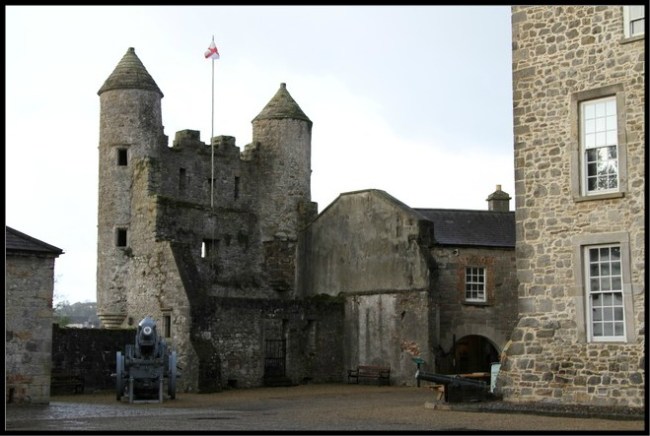
The Watergate, the best known and most photographed part of the castle complex, is not in fact a gate at all, but rather a Scottish style adornment which was added in 1614 while the Coles were in residence. It was important that locals admire their island residence.
Look up and you will see the flag of St George flying over the Watergate. This tradition dates back to the 17th century when soldiers from the two Inniskilling Regiments fought with William of Orange (William III) against James II. The Watergate was subsequently adopted as an emblem of both Regiments.
A fire gutted the Castle in 1710 at which stage the Coles moved to Portora Castle and thence to Florence Court House. The castle then lay in ruins until 1796 when it was rebuilt as a military barracks. The curved building following the line of the River Erne was constructed between 1806 and 1830 as stables with quarters above for cavalrymen. Later the upstairs area was used by artillerymen and at one stage was used as a military hospital. The barracks building on the northern edge of the site was constructed in 1829.


The complex remained a military barracks until 1926 though the Territorial Army were also based here from 1947 to 1958. Today the Keep houses the Inniskillings Museum and the County Museum’s history of the Maguires.
The Inniskillings Museum
This museum, in the Keep or main castle building (along with a section on the Maguires) and former castle stables houses artefacts from the two army regiments raised in the town. This is a great museum if you are interested in military history.
Enniskillen is the only town in the British Isles to have raised two army regiments bearing the town’s name, in one of its alternative spellings. These were the Royal Inniskilling Fusiliers and the 5th Royal Inniskilling Dragoon Guards.


Both Regiments (one infantry and the other cavalry) trace their roots back to 1688 when local soldiers sided with Protestant William III in his successful quest to defeat, and take the throne of England from, Catholic King James II. Originally raised to defend Enniskillen from Jacobite forces, both Regiments were soon incorporated in William’s army with the Fusiliers going on to fight with William at the Battle of the Boyne in 1690.
Both regiments continued to flourish and were, and are, most respected units of the British Army and have achieved great fame in numerous theatres of war across the globe. Just outside the Castle Complex you will see the Boer War Memorial which commemorates the Inniskilling Regiments losses in the Boer War.
The Regiment’s names have varied over the years and today the Royal Inniskilling Fusiliers form part of the Royal Irish Regiment and the Inniskilling Dragoon Guards form part of the Royal Dragoon Guards.
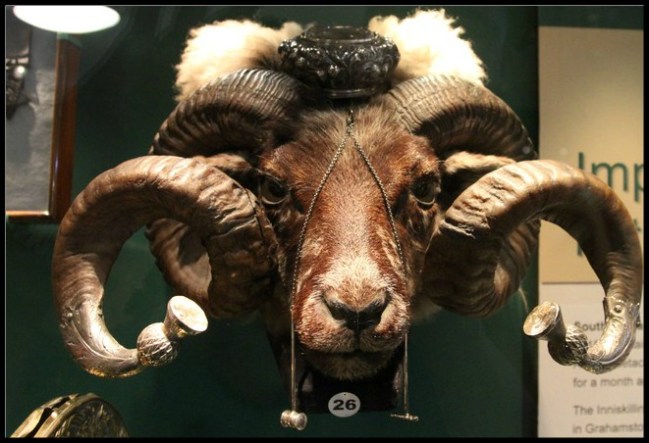
The museum’s exhibits include regimental uniforms, weapons, standards, badges, medals, engravings and photographs. In pride of place is the bugle sounded at the charge of the regiment in the Battle of the Somme in 1916. I failed to get a photograph of this so here is a picture of a regimental sporran, in its stead.


The Regimental Chapel for the Inniskilling Regiments is within, the nearby, St Macartin’s Cathedral. It houses various regimental colours and other items of interest to those with an interest in the Regiments.
The Howitzer Gun , close to the Watergate, was captured from the German Army in WWI and was presented to the family of Lieutenant Otto Brooke of Brookborough to commemorate his being awarded the Victoria Cross.
Fermanagh County Museum
This is a local museum with the comples concentrating on the (mainly non military) history, archaeology, natural history, local art and culture of County Fermanagh. The museum also hosts temporary exhibitions from time to time.
The museum started out life in 1976 in the Castle Keep but moved to its current specially built building in 1992-3 apart from a section of the museum relating to the Maguires which is still housed in the Keep.
A Couple of things to look out for in the museum:
– Abstract artwork by the internationally renowned local artist, William Scott (1913 – 1989)
– Window fragment from a late medieval church (main picture below).


To be honest, for me, County Museum part of the complex is only worthy a look as you walk through it to see the much more impressive Enniskillen Castle buildings and the Inniskillings Museum. There might be something that attracts you for a few minutes.
Castle Complex Opening Hours: Given the variation in opening hours throughout the year and on different days of the week I am not going to try and include them here but rather I direct you to the website – http://www.enniskillencastle.co.uk/visiting-us/opening-hours/
Entrance Fee (2015):
Entry to all buildings in the Enniskillen Castle complex is included in one ticket – purchased in the Fermanagh County Museum, which serves as the entrance to the complex.
Adult £4.00
Child £3.00
Student & Senior Citizen £3.00
Family Rate (2 adults and 3 children under 16 years) £11.00
There is, regrettably, no coffee shop on site – just a vending machine
Other
Address: Wellington Road, Enniskillen
Directions: Within easy walking distance of the town centre and the Ulsterbus station.
Phone: 028 66 325000
Website: http://www.enniskillencastle.co.uk
This blog entry is one of a group (loop) of entries based on many trips to Enniskillen. I suggest you continue with my next entry – Boer War Memorial – or to start the loop at the beginning go to my introductory entry – “Fare thee well Enniskillen, ………..”
 The Rambling Wombat