
This is the place to come for a potted history of early Irish Christianity – from the 5th to 17th century. This history is relayed via life-sized carvings of Celtic Saints, missionaries, scholars and more accompanied by very informative labeling and information boards. Additionally, you can pick up an excellent information booklet as you enter the Garden. If there are no booklets in the unmanned Garden I understand a copy can be obtained in Mahon’s Hotel in the centre of the town, a short distance away.
The carvings, all hand done in native Irish oak, are distributed among six small stone buildings (houses) in a small pine forest beside the Sacred Heart Church. Each house covers a different period/aspect of Irish Christian history.
In terms of Irish saints you will encounter, among others, Saints Patrick, Brigid, Columcille, Columbanus, Gall, Kilian and Molaise.
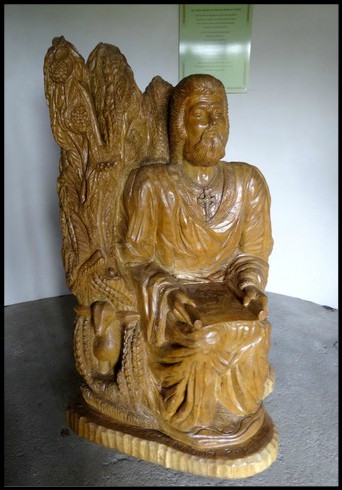
Of course the best known of these is St Patrick (picture 2) who first came to Ireland as a shepherd boy and later returned, in the second half of the 5th century, as a missionary converting the pagan Irish to Christianity. He is also credited with banishing snakes and other nasties from Ireland.
St Patrick, as most readers will be aware, is Ireland’s patron saint and St Patrick’s Day (17th March) is celebrated as a religious and cultural holiday (more the latter these days!) not only in Ireland but around the world. It is the one day of the year when anyone can claim to be Irish, dress up in green and drink Guinness or green beer.

In addition to St Patrick the first house within the Garden contains a number of other carvings depicting various early Christian/Pagan legends and mysteries. For instance you will notice a number of swans (picture 3). These depict one of Ireland’s best known legends – the Children of Lir who were turned into swans by their jealous step-mother and had to travel over the country for 900 years until they heard the sound of a Christian bell and could become human again and receive the Christian faith. Based on this legend, no one in Ireland will harm a swan lest they be denying a child its conversion to Christianity.


Following hot on the heals of St Patrick, a host of Irish converts began establishing monasteries all over the island and by the 6th century Ireland was pretty much fully converted to Christianity and was already being referred to as the land of saints and scholars. The second house covers the establishment of these monasteries during what was Ireland’s Golden Age. In this house are carvings of monastery building Saints Brigid, Columcille and Molaise (who founded the monastery on nearby Devenish Island).


The third house in the Garden of Celtic Saints introduces the visitor to missionaries, Saints Columbanus (picture 6), Gall and Kilian who brought the Gospel to Europe, helping to pull it out of the dark ages following its regression on the fall of the Roman Empire. This house reminded me of a book, by Thomas Cahill – ‘How the Irish Saved Civilization: The Untold Story of Ireland’s Heroic Role From the Fall of Rome to the Rise of Medieval Europe’. While admittedly a ‘bit’ exaggerated in part, it tells of how St Patrick “instilled a sense of literacy and learning that would create the conditions that allowed Ireland to become “the isle of saints and scholars” — and thus preserve Western culture while Europe was being overrun by barbarians.” – http://thomascahill.com/books/how-the-irish-saved-civilization-tr
The monasteries and the church preserved the tradition of learning, instilled in the Irish by St Patrick, for the next millennium. House four reflects on Ireland as a land of scholars and accordingly contains carvings of great County Fermanagh scholars including Cathal Óg MacManus, compiler of The Annals of Ulster and Giolla Brighde Ó hEoghusa, a Franciscan Friar and Gaelic-Irish poet (picture 7).


The fifth house – the house of the Celtic Cross – is dedicated to Celtic or High Crosses, found all over Ireland at old monastic sites. These ornate crosses first appeared around the 9th century and generally featured biblical scenes like the one in this house. Without doubt this is my favourite carving within the Garden due to the exquisite detail thereon as depicted in pictures 8 and 9 attached. As I write this review I am reminded of a wonderful example of a Celtic Cross in Rookwood Necropolis in Sydney, Australia.

The final house in the Garden depicts Mary, Joseph and the baby Jesus, perhaps oddly, in the setting of a traditional Irish kitchen (picture 10).
All the carvings in the Garden are the work of Jonas Raiskas, a Lithuanian who came to Irvinestown in 2007.
The Garden is open 24/7 year round and I understand guided tours are available at 12.00pm and 2.00pm. As I didn’t partake of a tour I cannot comment on them. Should you be interested in a tour call the number below for further details.
Entry fee – Free though donations are appreciated.
Address: Sacred Heart Church, Lisnarick Road, Irvinestown
Directions: To the rear of the church
Phone: 028 6862 8600
This blog entry is one of a group (loop) of entries based on many trips to Enniskillen. I suggest you continue with my next entry – Sacred Heart Church – Irvinestown – or to start the loop at the beginning go to my introductory entry – “Fare thee well Enniskillen, ………..”
 The Rambling Wombat