
It is generally accepted that during the ten years, 1841 to 1851, Country Fermanagh lost over 40,000 people or 25% of her people due to a potato blight which lead to the famine (1845 to 1850) which reeked havoc throughout the island of Ireland. What is less clear is how many of the 40,000 died as a result of hunger or disease and how many emigrated. Of course thousands who might happily have emigrated perished, as they could not afford to leave their home areas.
Back in 1838, in an attempt to alleviate poverty, a Poor Law was enacted setting up 130 Workhouses across Ireland. Three of these were located in County Fermanagh, one in Enniskillen, one in Lisnaskea and one in Irvinestown.

The Irvinestown Workhouse opened in October 1845 (to accommodate 400 inmates) on a five acre site to the west of the town – now Reihill Park. During the worst days of the famine, in 1848, it housed up to 800 inmates, in the most dreadful of conditions. As early as 1847 it was described by Dr. Phelan, the medical inspector to the Poor Law Commissioners, as the “worst” he had seen in the north of Ireland.
 Due to the large number of inmates dying, a mass burial ground (referred to as “The Paupers” for the next 150 years) was opened next to the Workhouse.
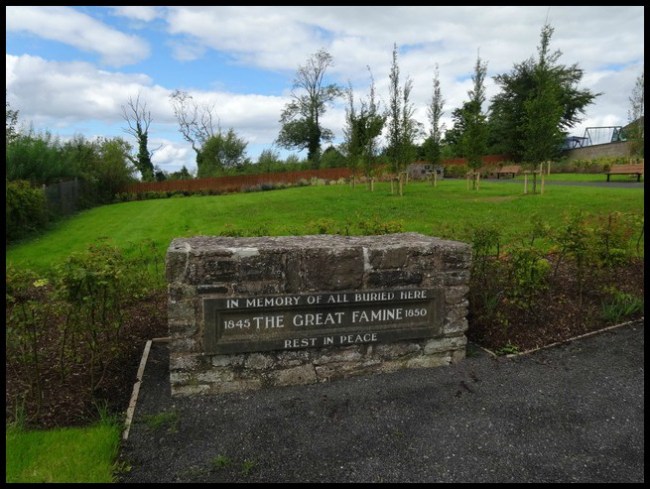
While nothing of the Workhouse remains to-day the graveyard does remain. It was officially renamed as the Famine Graveyard and a memorial stone unveiled on 4th October 1997 by direct descendants of a local family which had drowned in a shipwreck in 1847 whilst emigrating to America.
The memorial stone inscription reads:
In Memory of All Buried Here
1845 · The Great Famine · 1850
Rest in Peace
There are no records to indicate how many (some suggest 1,500), or who, were buried in this mass grave. What is known is that, in addition to those buried here, more local famine victims are buried in the Ardess Famine Pit – the subject of a separate review in this blog.

In mid 2015 the graveyard was refurbished (now accessible to wheelchair users) and a new memorial stone or ‘Wall of Reflection’ by stonemason Adrian McGovern was added.

The new memorial stone (pictured above) records the names of the County towns in which there was a workhouse and famine graveyard, together with Ardess – the location of the famine pit (referred to above).
The ‘famine ship’ depicted on the memorial represents those who sailed away in search of a better life outside Ireland.
Address: Reihill Park, Irvinestown
This blog entry is one of a group (loop) of entries based on many trips to Enniskillen. I suggest you continue with my next entry – The Famine Pit and the Hanging Tree – or to start the loop at the beginning go to my introductory entry – “Fare thee well Enniskillen, ………..”
 The Rambling Wombat