
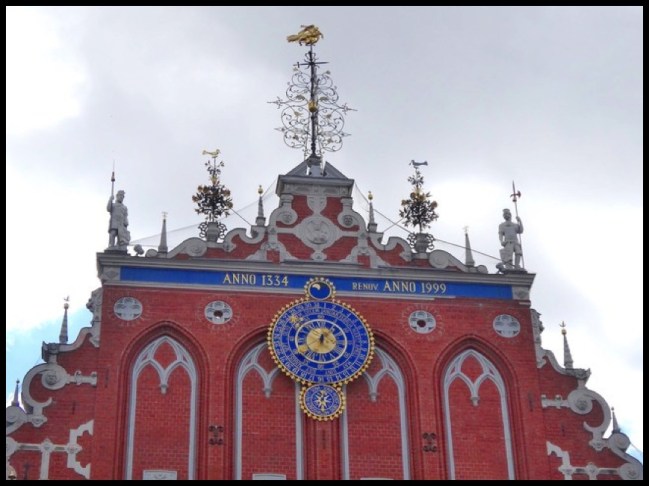
Without doubt the colourful House of Blackheads, a Gothic building with a Dutch Renaissance façade, is the greatest crowd puller and most photographed building in Riga.
The current reincarnation of the building, in the Town Hall Square (Rātslaukums) was built in 1999 and is a very faithful copy of how it looked prior to its bombing, by Germany, in 1941 and the subsequent removal of what remained by the occupying Soviets in 1948. Unsurprisingly, as a German merchant association, the Brotherhood of Blackheads also disappeared of the Riga scene with Soviet occupation of Latvia post World War II.
Unlike other buildings in Riga, such as the nearby St Peter’s Church, which were also rebuilt post World War II damage and look old, the House of Blackhead’s doesn’t look old – it is way to bright and new looking for my liking. That said, it is great that it has been rebuilt as it retains and passes on an important part of Riga’s history.
Added to the need, or desire, to preserve history there was another thing that demanded that the House of Blackheads be rebuilt and this was an engraved medieval text on the building which specifically spoke of the rebirth of the House of Blackheads should that be necessary:
“Should I ever crumble to dust, rebuild my walls you must”
The original building on this site dates from 1344 and was built as a meeting place and a place for festivals and parties for the members of early craftsmen and tradesmen’s guilds. To use that most tacky of terms, New House, as it was originally called, was medieval Riga’s ‘party central’.
One of the early guilds in Riga (and elsewhere) was the Brotherhood of Blackheads – a guild of unmarried, mainly, German merchants and seafarers. These guys worked hard and played hard and were well respected in the community with many going on to become pillars of society over the years. They were not all about ostentatious lifestyles and self-promotion but were also actively involved in community events. Indeed, the Brotherhood is generally accepted as being responsible for erecting the world’s first decorated Christmas tree right here in Riga and much of the ornamentation of Riga’s older churches can be attributed to the generosity of the Brotherhood or individual Blackheads.
The Brotherhood bought the building from the city in 1713 and from that time it has been known as the House of Blackheads. The building was renovated, enhanced and extended many times between 1344 and the late 1800s.
The Brotherhood’s rather notable name comes from its patron, St Maurice. Cutting to the chase, St Maurice was black. A nice depiction of him, in his knights regalia, adorns the pillar to the right of the building’s main door (pictured below left).


St Maurice is only one of the many adornments and features on the façade that makes the building famous today. Hopefully my photos attached, in some measure, portray the beauty of the House of Blackheads.
While the inclusion of an astronomical clock, various weather vanes, lions and coats of arms (of Riga, Bremen, Lubeck and Hamburg) is not surprising given the origin and occupation of the Blackheads there are couple of adornments which surprised me and needed further explanation, at least for me.
The statue of St George slaying a dragon (pictured above right) is intended to remind us of the courage of the Blackheads as they went about their business of foreign trade while having to ward of pirates and other robbers. While you won’t be able to make it out from my picture, the large weather vane (picture 2) features an engraved and gilded sculpture of St George on horseback.
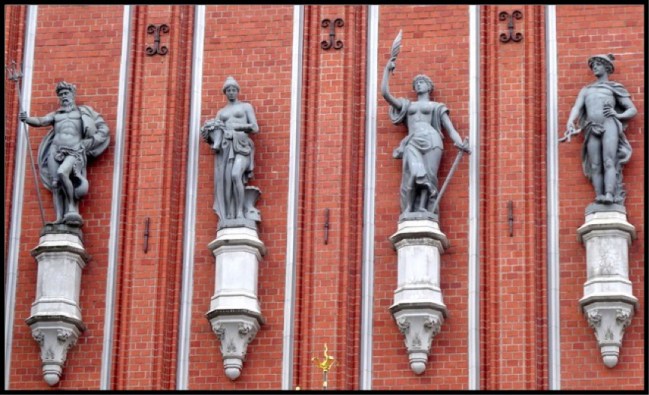
Halfway up the main part of the building are four allegorical sculptures embodying the values of the Brotherhood of Blackheads as a trading organisation (picture 5). From the left to right are the images of Neptune, Unity, Peace and Mercury. The sculptures are intended to show that trade can only flourish when peace and unity prevail.
Internally the building is, by all accounts, very ornate and I would love to have had the opportunity to have a look. Sadly, the Latvian President moved into the House of Blackhead’s, temporarily, in 2012 while Riga Castle, the usual presidential abode was being renovated. At the time of my visit in 2015 renovations of the castle were ongoing with the result that the House of Blackheads remained closed to public access.
This blog entry is one of a group (loop) of entries on the Old City area of Riga. I suggest you continue with my next entry – Riga Town Hall – or to start the loop at the beginning go to my first entry – SamaraH Hotel Metropole – Riga.
 The Rambling Wombat