

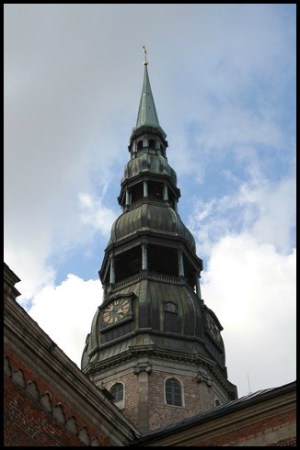
The thing that amazed me most about St Peter’s Church was how old the church looked. This was particularly true when I came around from the rear of the building and was confronted by the beautiful Baroque western façade of the church. I knew Riga had been founded in the early 1200s though I would have placed the church as Medieval – somewhere in the 1400s.
The original church on this site was constructed in 1209 though today very little of that remains, apart from some side walls and a few small internal pillars. In the intervening years numerous renovations and extensions have taken place. Some of these were to restore the church after fire or storm damage, some to repair wounds suffered in various wars and conflicts and some were planned extensions to increase the size of, or enhance, the church. Given all this work at various times over hundreds of years it is no surprise that a mishmash of architectural styles are represented – Gothic, Romanesque and Baroque.


However, and this surprises most people as it did me, the majority of what you see today was actually built in the 1960s and 1970s, albeit a faithful representation of how the church looked prior to being damaged during World War II, right down to adding Rooster Number 7 to the churches spire. See my separate review on St Peter’s Roosters – Cock-a-doodle-do.
 While it is generally accepted that the 1941 damage was caused by German mortar fire some sources suggest that the church was deliberately set on fire by retreating Soviet troops as a propaganda move to blame the Germans for its destruction.
If you look carefully at the spire’s clock you will notice that it has just one hand – the hour hand. This is not a mistake and the minute hand has not fallen off, as St Peter’s roosters are accustomed do doing. Rather, it is a tradition dating back to the first of many church spires erected over the years. Today the clock chimes play a Latvian folk song – “Riga dimd’ five times per day while ringing bells mark each hour.
Post World War II, while under Soviet control, St Peter’s ceased being an active house of worship. On 29 June 1991 – within days of Latvian Independence, religious services resumed and today it is, in addition to a being a beautiful church (not currently used for church services), a museum, an art gallery and a concert venue.
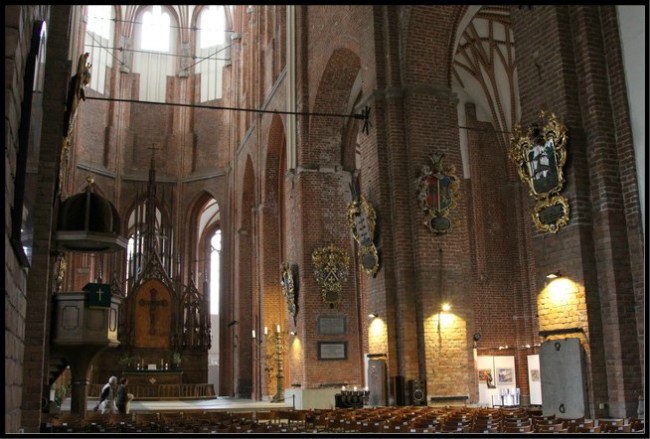
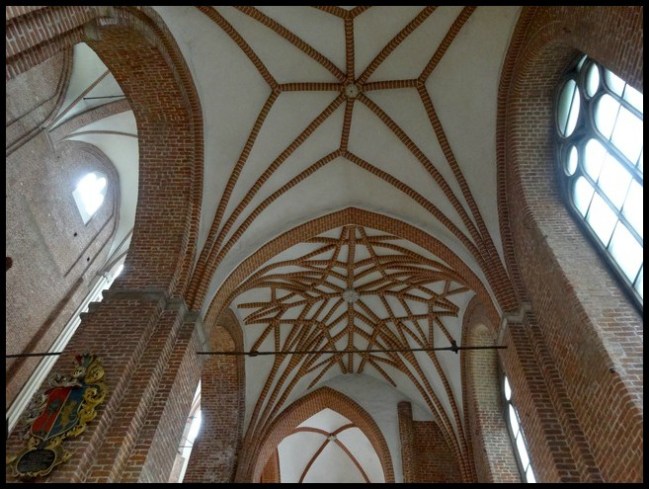
St Peter’s started life as a Catholic Church in 1209. In 1523, during the Reformation, it became Lutheran. This conversion (if you like) to Lutheranism explains the rather plain and austere interior, though, that said, I really like the exposed brickwork and the use of brick in the ceiling decoration.
Of particular interest as you walk around the church are the Blue Guard Chapel (replete it its own – not to friendly – ghost), the very ornate and beautifully carved wooden altars, numerous renovated stone and wooden epitaphs, a massive bronze candelabra and the City’s original statue of Roland which dates back to 1896. A copy of Roland can be seen in the nearby Town Hall Square (Ratslaukums). See my separate review, Roland – A Symbol of Justice. In that review you can read more about Roland.
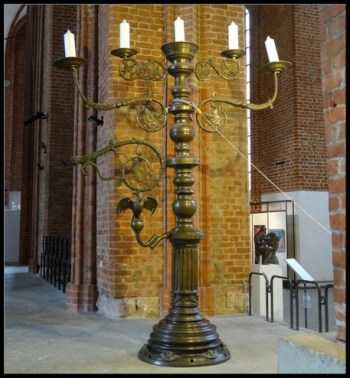 I found the candelabra, which dates back to 1596, to be quite amazing – principally due to its size. This beautiful locally produced piece measures 3.1 metres high and is 3.78 metres wide and is certainly the biggest candelabra I have ever seen. By the end of WWII the menorah had found its way to Poland where it was publicly displayed in Vloclavek Cathedral. It was returned to St Peter’s in 2012.
Also in the church is the sixth rooster weather vane to have been mounted on the spire of the church. You will find a picture of this in my separate review on the roosters – Cock-a-doodle-do.
The art exhibition, which changes regularly, had a few interesting pieces, the detail of which I need not trouble you with as it will have changed by now.


I did not go up the church’s 123 metres high spire, the tallest in Riga – you can go up to the second gallery at 72 metres. There is a lift. Having since seen pictures of the magnificent views from the viewing platform I regret not having done so and suggest you do not make the same mistake I did.
Entry to the church and spire:
Opening hours
Tue- Sat : 10.00 to 18.00 (to 19.00 May-August)
Sun : 12.00 to 18.00 (to 19.00 May-August)
Mon : Closed
Admission charge (2015)
Including access to the tower: Euro 9 (with discount for Students/Children)
Access to Art Exhibitions (Church only): Euro 3 (with discount for Students/Children).
Website: http://peterbaznica.riga.lv/en/news/
This blog entry is one of a group (loop) of entries on the Old City area of Riga. I suggest you continue with my next entry – Cock-a-doodle-do – or to start the loop at the beginning go to my first entry – SamaraH Hotel Metropole – Riga.
 The Rambling Wombat