
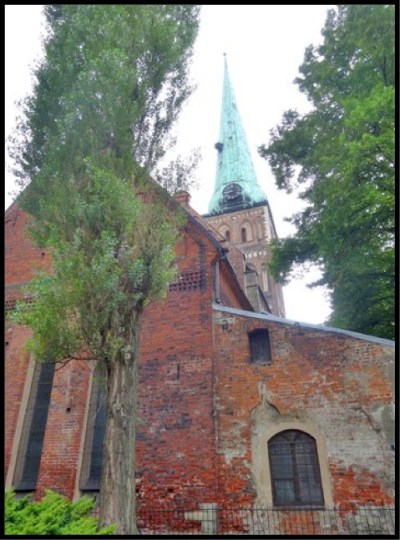
The earliest reference to The Metropolitan Cathedral Basilica of Saint James the Greater, more commonly referred to as St James’ or St Jacob’s, is 1225 though it was probably built a bit earlier than this, being one of the four churches established by Bishop Albert who is credited with founding Riga in 1201.
Like the other churches established at the time, St Peter’s, St John’s and Riga Cathedral (Lutheran), St Jacob’s has been added to and renovated many times since its original construction in the early Gothic style though that style has been maintained in the lower part of the tower. The upper part of the tower and the spire were added in the 1500s.
 The church started out Catholic but in 1522 it became the first Church in Riga to hold a Lutheran Service making it the first Reformation church in the country. In 1582 it briefly returned to the Catholic fold during the Counter Reformation when the Polish-Lithuanian Commonwealth occupied the country. When the Swedes arrived in 1621 the Jesuits departed and the Church was rededicated as the Lutheran church of the Swedish Garrison.
In 1710 the Russians took over and it wasn’t until 1922 that that Catholics regained the church which now became to the city’s Roman Catholic Cathedral.


Internally, though a little on the dark side, I quite liked this church which retains a few medieval tombstones including one belonging to Matthias Forbes dating from 1641 (picture 5 attached). Forbes, a Scotsman, was a colonel in Sweden’s occupying army.
Well worth a visit but, if I may, a word of caution to my female reader prior to their deciding whether to do so or not.
Should you have been unfaithful to your beloved I caution you not to visit or get to close to St Jacob’s, as the cathedral bell is, so the story goes, sure to spontaneously ring and expose your indiscretion to all around. If you have been naughty and the bells tolls then, in the words of the poet, John Dunne, ‘Ask not for whom the bell tolls, it tolls for thee’!
While my female reader is deciding if it safe to approach St Jacob’s, let me tell you that in addition to being able to detect infidelity, there are a number of other interesting facts or stories related to the bell of St Jacob’s.
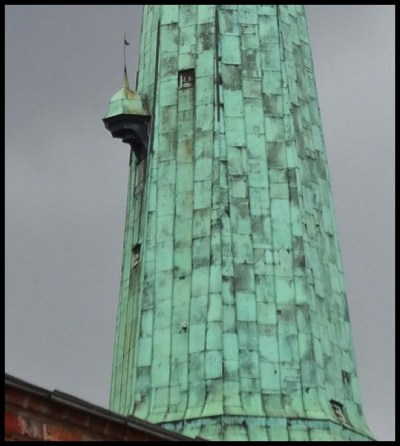
The first thing I noticed when admiring the narrow though elegant copper plated spire, as I approached the Cathedral, was that its bell was attached to the outside of the spire as opposed to being enclosed within or within the tower below. I have not seen this before, nor since.
I also read that at one stage the bell bore the inscription “God please save us from Russians, Floods and Plagues.” I can only presume it did not bear this inscription during either of the periods Latvia was under Russian or Soviet control.
Further, in medieval times the bell was known as the “Bell of Poor Sinners” as it was rung to invite the public to attend beheadings in the Rātslaukums or Town Hall Square.
One bell you don’t want to hear ringing, perhaps.
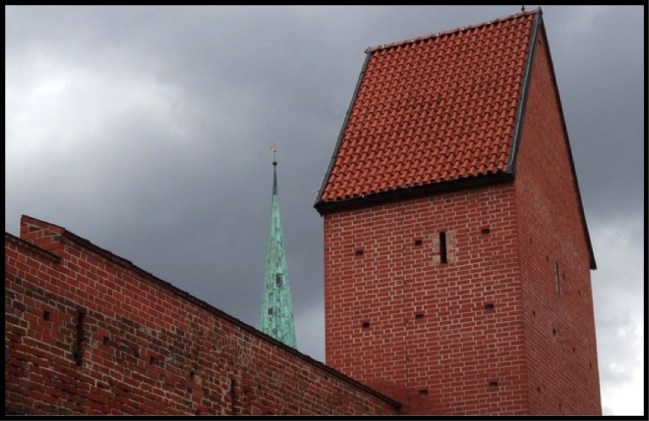
Even if you feel unable to visit St Jacob’s I do encourage you to have a look at the church and its elegant spire from a distance though I am unable to advise as to what a safe distance might be.
Opening Hours:
07:00 – 19:00 Daily (outside services).
Entrance Fee:
Free though donations appreciated.
This blog entry is one of a group (loop) of entries on the Old City area of Riga. I suggest you continue with my next entry – Livu Laukums – Full of Colour – or to start the loop at the beginning go to my first entry – SamaraH Hotel Metropole – Riga.
 The Rambling Wombat