

On 4 May, 1990 Latvia announced its independence from the USSR. This was not recognised by the USSR. Agitation for independence had begun in 1987, spurred on by the Soviet policy of perestroika, introduced by President, Michael Gorbachev.
Soviet troops, in civilian attire, in Riga at the time tried to storm the new Supreme Council (the Latvian Parliament – picture 3 attached) while it met on the 15 May 1990. 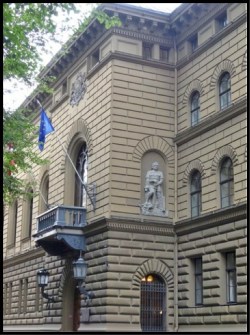 This was thwarted by the Soviet OMON (Otryad Mobilny Osobogo Naznacheniya – a special police task force). This was presumably on the direction of Moscow which, due to international monitoring of what was going in the USSR and satellite countries at the time, was reluctant to move in, in force, to put down Latvian resistance.
In the autumn and winter of 1990 Soviet reaction to Latvia’s resistance and its declaration of independence became more pronounced – though a repeat of what happened in Hungary in 1956 and Czechoslovakia in 1968 was not going to happen in the Baltics. Local Soviet troop movements and shows of strength became more regular as did the limited use of force, provocation and intimidation.
By September 1990 the OMON had sided with local Communists/Russians and Soviet sympathisers who had mustered together under the All-Latvian Public Rescue Committee and the Committee soon sent a plea to USSR President Gorbachev to introduce direct presidential rule in Latvia.
While this didn’t happen, in January 1991 the Soviet army moved to restore its influence in the Baltics resulting in the death of 14 and injury of over 100 civilians in Vilnius, Lithuania on 12-13 January.
On 13 January around 500,000 people, organised by the Popular Front of Latvia, gathered to demonstrate on the banks of the Daugava River in Riga. They erected barricades at various strategic locations around the city, particularly in the Old City area, wanting to show the world they ready to defend the independence of Latvia, earlier declared.
While the Soviet army could have moved in and removed protesters (albeit, at its own admission, with heavy casualties), it didn’t and Gorbachev and Boris Yeltsin, then Chairman of the Supreme Council of the Russian Soviet Federative Socialist Republic, gave assurances that force would not be used against civilians. Notwithstanding that the US and other Western powers were busy with the Gulf War they still had an eye on the USSR.
On the night of 20 January 1991 forces loyal to the Soviet Union, in Latvia, stormed the barricades and broke into the Ministry of the Interior building. Though five civilians were killed, resistance was minimal. The attackers had hoped for a stronger resistance than they met, anticipating that it would force a change of heart in Moscow and Soviet forces would be moved in to quash independence aspirations once and for all. There was no change of heart in Moscow. Immediate pressure off, the barricades started coming down.
 This memorial, entitled Barricades (Latvian: Barikades), was unveiled in 2007 and commemorates those who died during the confrontations, known as The Barricades, between Latvian and Soviet forces in January 1991. The names of those who died, eight including the five killed on the 20 January, are inscribed on one side of the memorial.
The independence of Latvia was accepted by the USSR on 6 September, 1991.
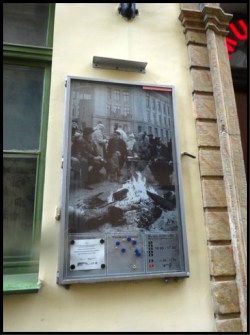
Nearby at Krāmu Street 3 is a small museum on the barricades – the Museum of the Barricades. While admission is free I, unfortunately, did not have time to go in for a look. Picture 4 attached is of the Museum information board which indicates that it is open Monday – Friday 10:00 to 17:00 and Saturday 11:00 to 17:00. The museum is closed on Sunday.

Pictured above is a 1 Lats coin commemorating the Barricades, issued in 2006. The Lats was replaced, as the official currency of Latvia, with the Euro in 2014.
This blog entry is one of a group (loop) of entries on the Old City area of Riga. I suggest you continue with my next entry – Ask not for whom the bell tolls -St Jacob’s – or to start the loop at the beginning go to my first entry – SamaraH Hotel Metropole – Riga.
 The Rambling Wombat
I seem to have missed this on both my Riga visits 😦
LikeLiked by 1 person
One for the next time .. 🙂
LikeLike