
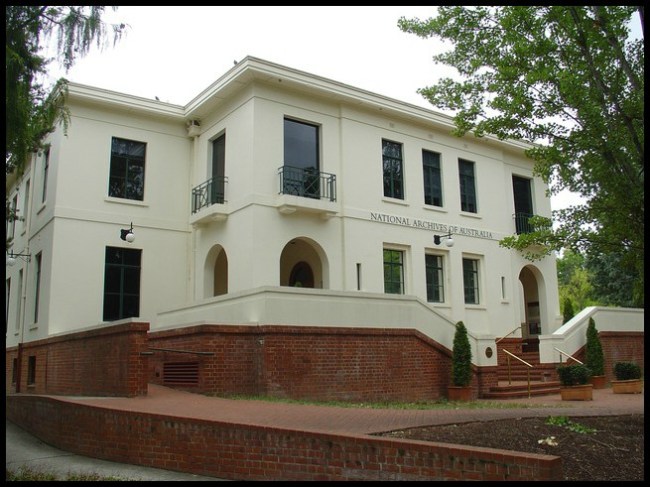
The National Archives is custodian of all significant government/public service documents in Australia. No documents are of more significance than those which created The Commonwealth of Australia (to give it its full name) – affectionately known as the country’s birth certificates.
(My separate and main review on the National Archives can be found HERE.)
The Federation Gallery contains just seven items which together are probably the most significant public documents in Australia. These documents are:
1. Commonwealth of Australia Act (UK) 1990
Passed by the British Parliament in 1990 to set out the blueprint for the new nation of Australia. The Constitution (which established the legal and political structures that continue to shape the lives of all Australians) is included as section nine of the Act
2. Royal Commission of Assent
The actual document signed by Queen Victoria on 9 July 1900 which brought the Bill for the Commonwealth of Australia into law thus creating the Commonwealth of Australia and enacting the Australian Constitution
3. Letters Patent constituting the office of Governor-General 29 October 1900 (UK)
Signed by Queen Victoria on 29 October 1900 establishing the office of the Governor-General
4. Royal Proclamation of Inauguration Day, 17 September 1900 (UK)
This proclamation, signed by Queen Victoria on 17 September 1900, set the date on which the Commonwealth of Australia was to be inaugurated – 1 January 1901. The delay between Royal Assent on 9 July 1900 and 1 January 1901 was to give West Australia time to decide if it wished to be part of the federation
5. Statute of Westminster Adoption Act 1942 (Cth)
In 1931 the British Parliament passed the Statute of Westminster to clarify its relationship with a number of former colonies (now acting very independent of Britain. This Australian Act in 1942 adopted relevant provisions of that Statute declared the Australian Parliament as free and equal in status to the government of Britain
6. Constitutional Alteration (Aboriginals) Act 1967
On 27 May 1967 Australians voted overwhelmingly to change the Constitution by removing certain phrases that discriminated against Aboriginal people. This Act altered the Constitution accordingly
7. Australia Act 1986 (Cth)
The Australia Act removed the possibility that British laws could be made to apply to Australia. It also abolished appeals from Australian courts to the Privy Council in London. A complementary Act was passed in London and Australia was now a “sovereign, independent and federal nation”.
Opening hours
Given the fragile nature of these documents they are only on public display at at limited times. As of May 2017 they are on display on Fridays 12noon to 2pm and selected additional days such as Australia. Check the website for details. If these documents are on display during your visit I would consider them a must see.
http://www.naa.gov.au/visit-us/exhibitions/index.aspx
If you are otherwise interested in seeing copies of the documents you can see them here: http://www.naa.gov.au/visit-us/exhibitions/federation-gallery/index.aspx
Entrance fee: Free
Photography is not permitted.
Address: National Archives,Queen Victoria Terrance, Parkes.
Directions: Close to Old Parliament House
Phone: (02) 6212 3600
Website: http://www.naa.gov.au/visit-us/exhibitions/federation-gallery/index.aspx
For my next CANBERRA – PARLIAMENTARY TRIANGLE SOUTH OF THE LAKE review click HERE.
For other Canberra reviews click HERE.
 The Rambling Wombat