
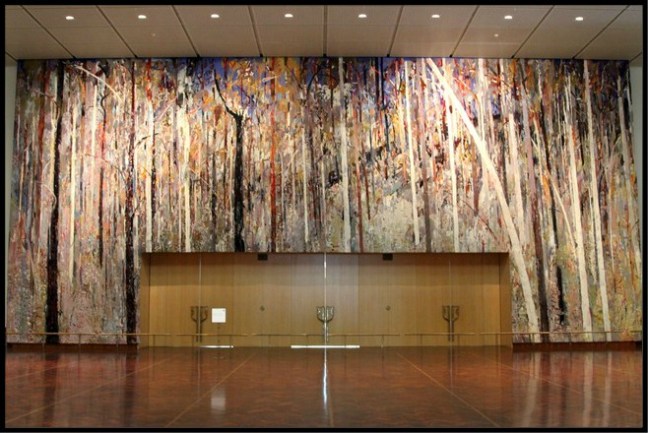
When you enter the Great Hall at Parliament House your eyes will be immediately drawn, hopefully not in the “Oh my god, what’s that” sort of way, to the massive tapestry covering most of the back wall of the Hall.
The tapestry measuring some 20m by 9m and thus one of the largest in the world is based on a painting by renowned Australian artist Arthur Boyd.
Boyd’s painting (below) is on permanent display upstairs just before you come to the House of Representative entrance.
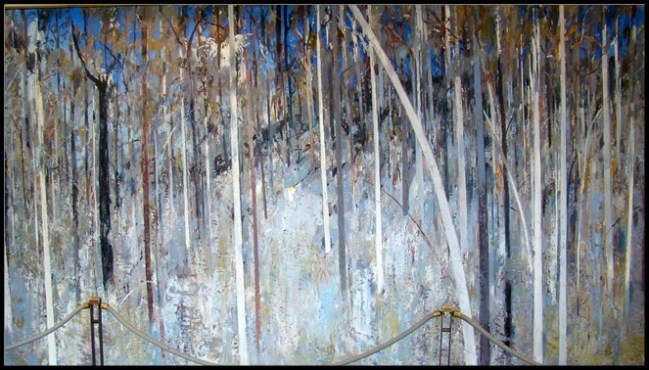
Boyd’s painting and the resultant tapestry depicts a dense forest of eucalypts in the Shoalhaven River valley, in south-eastern New South Wales of the type which features in many of Boyd’s works.
The architectural vision for the Great Hall is outlined on the Parliament house website as being:
“that it would convey a sense of the Australian land, emphasising the importance of the physical environment in shaping Australian values. Boyd’s subject matter complements the native timbers used throughout the Hall. His design also emphasises the immensity of the landscape, with the horizon obscured and the trees continuing both above and below the canvas, and to each side. The tapestry surrounds the southern doorway of the Great Hall, giving people passing beneath a sense of moving through the landscape.”
While I believe this vision has been captured and I understand the concept of passing through the landscape to the southern doorway I cannot help believing that it would have been much better to have covered the doors of the southern exit with tapestry too. Every time I look at the tapestry my eye is distracted and drawn to what I consider the “missing bit”.


Notwithstanding my concern the Great Hall, also known as the room of the land, certainly conveys a sense of how the physical environment has shaped Australia.
The Tapestry was woven in four pieces in Melbourne and took the equivalent of 14 full time weavers two years to complete. The likeness with the original painting is striking though there is one significant if not glaringly obvious difference. When the tapestry was being woven Haley’s comet was visible from Australia and if you look carefully you will see it has been depicted in the final tapestry. Can you spot the comet and the cockatoo amongst all the trees? To give you a head start on the comet ———->

Entry to Parliament House is free.
Rather then repeat all the opening hours and other practical details associated with visiting Parliament House please refer to my separate entry where all this detail is provided. Alternatively visit the Parliament House website as provided below.
Address: Capital Hill
Phone: 02 6277 5399
Website: http://www.aph.gov.au/
For my next CANBERRA – PARLIAMENTARY TRIANGLE SOUTH OF THE LAKE review click HERE.
For other Canberra reviews click HERE.
 The Rambling Wombat
What brilliant work the tapestries are.
LikeLiked by 1 person