
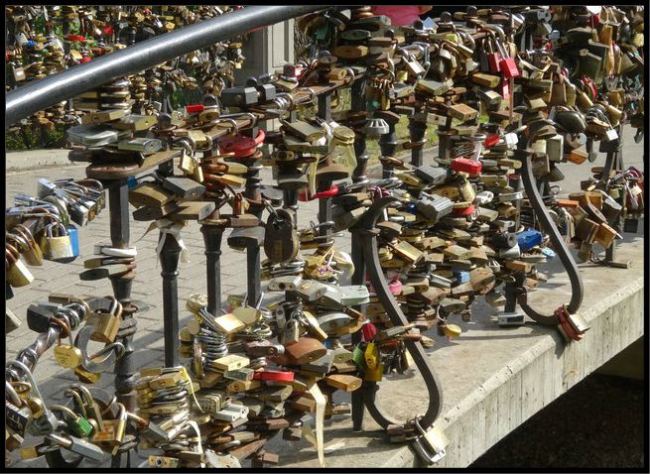
‘Love locks’ – padlocks which sweethearts lock to a bridge or similar public structure to symbolise their love for each other – are thought to date back, in one form or another, to an old Chinese tradition.
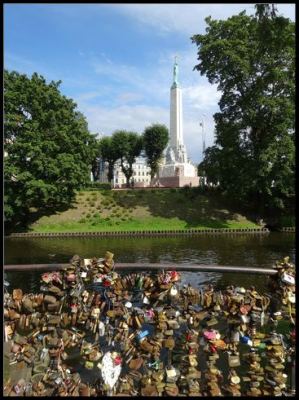 In Europe the tradition dates back to WWI and the Serbian spa town of Vrnjačka Banja. Here a local schoolmistress fell in love with a Serbian officer who subsequently went to war in Greece and fell in love with a local woman there, never to return. Nada, the schoolmistress never got over this and died of a broken heart.
To ensure this never happened again the young ladies of Vrnjačka Banja started writing their and their sweethearts name on a padlock and locking them to the railings of the bridge, and symbolically throwing the keys into the river, where Nada and her not so gentleman officer used to meet – now the renowned Bridge of Love (Most ljubavi) in Vrnjačka Banja.
In the early 2000s for reasons unknown, though spurred on in 2006 by Federico Moccia’s book, ‘I Want You’, adapted to a movie in 2007, love padlocks started appearing on bridges across Europe. Not long after, bridges starting being declared as unstable due to the weight of locks attached thereto and my reader may recall how a section of the mesh railing of the Pont des Arts, in the City of Love, Paris, actually collapsed under the weight of love locks.


Given the number of locks on Riga’s ‘Bridge of Love’ (which is periodically cleared of the locks), in Bastejkalns Park, one is bound to surmise that Rigans are either a very romantic or untrusting lot.
This is one in a group (loop) of reviews exploring beyond the Old City area of Riga. Continue to my next entry. Alternatively to start at the beginning of the loop click here.
 The Rambling Wombat
Yeah we know the ones on the Brooklyn bridge were removed and there is a stiff fine for those who puts a lock on the bridge!
LikeLiked by 1 person
Most places seem to ban it nowadays.
LikeLiked by 1 person