

While very few tourists use it to enter Koyasan, most entering via Koyasan Train Station, the Daimon, or Great Gate, is the sacred main entrance to Mount Koya. Like many day-trip visitors today, this was our last stop in Koyasan before heading back to Osaka, after a rather late lunch in a small local restaurant close to the Daimon.
The original torii entrance gate was constructed in the eleventh century, in the Tsuzuraori Valley. It was moved to its present location in the 12th century to mark the entrance to the city established by Kobo Daishi back in 816.
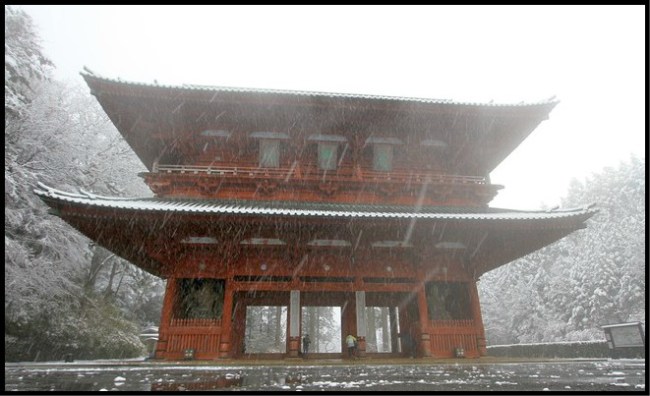
The present incarnation of the gate, some 25 metres high, dates from 1705. Its three entrance ways are flanked by two massive Kongo Rikishi (guardian deity) figures – Kongorikishi (Ungyo) and Shukongoshin (Agyo), the work of Edo period sculptors.


An inscription on the gate advises that Kobo Daishi who lies in Okunoin Cemetery, not dead but in a state of eternal meditation awaiting the Future Buddha, appears here each morning offering salvation to his followers.
To the right of Daimon (approaching it from the town centre) is the entrance to Bentendake Mountain where Dake-no-benzaiten is enshrined. Had not the weather been so miserable when we visited we had planned on taking the short trek to the summit of Bentendake Mountain and from there continuing on to Nyonindo en route to Koyonsan Train Station for our return trip to Osaka. Prior to 1872 females were not permitted to enter the town and had to worship elsewhere – Nyoindo is the only remaining temple specifically created for women.
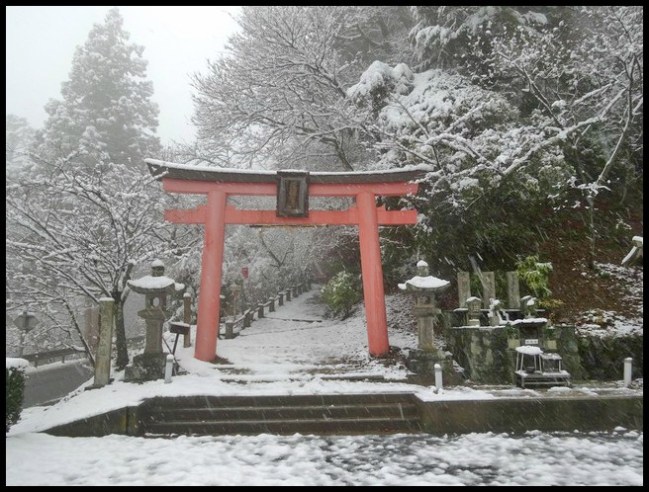
I read that the view from the Daimon Gate, which on a clear day can extend to the Seto Inland Sea, is magnificent, as are the sunsets. As would be evident from the attached photos the view was not so magnificent on the day I visited. A large digital thermometer at the site reminded us that it was unseasonably cold at below zero degrees centigrade on the late spring early afternoon we visited – as if the thermometer were needed for that – my ageing bones had already reminded me.
Address: West Koyasan, Koyasan
Getting to the Daimon Gate: From Koyasan Train Station, you can catch a bus directly to the gate or do as we did and return from Daimon directly to the station. Otherwise, it is an easy 15 minutes (less than 1 kilometre) walk or 5 minutes bus ride from the town centre/tourist information centre.
On this cold and shivery note you have come to the end of my Koyasan reviews. I trust you have enjoyed reading about my visit and invite you to partake of another of the loops on my “Travel Loop” page, by clicking HERE.
 The Rambling Wombat
I’ve never heard of the place in Japan. I know the weather must have been miserable, but you got some amazing pictures! Thanks for sharing this post. 🙂
LikeLiked by 1 person
Thank you – despite the weather I really enjoyied our short visit to Koyasan. If you have the opportunity to visit it I strongly suggest you do so.
LikeLiked by 1 person
I love the drama of these great gates, especially the guardian deities, and as with your other Koyasan photos, the snow only adds to the atmosphere and, in this case, to the drama 🙂
LikeLiked by 1 person
That’s one impressive gate (these pages appeared on VT did they not?)
LikeLiked by 1 person
Thank for looking in Malc. They did indeed appear on VT .. I have now transferred 71% of my stuff from VT to here. It has been a mammoth job which I look forward to finishing so that I can write some new stuff… so much in the pipeline!!!!! PS I actually recognised the church on your FB page — just couldn’t, for the life of me, remember the name.
LikeLike
Gate is certainly bigger than that found on your typical Devon cottage 🙂
LikeLike
It looks very pretty in the snow, but at the same time cold and unforgiving.
LikeLiked by 2 people
Beautifully summed up. Thank you for reading .
LikeLiked by 1 person