Canberra, with due cause, is often referred to as the Bush Capital. Parks, leafy suburbs and gardens abound. Most of these contain native Australia flora, with an overlay of European or more exotic species here and there.
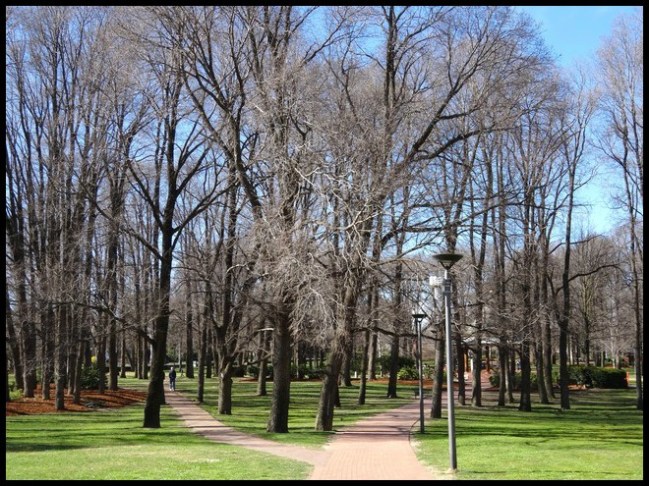
Glebe Park, right in the city centre (Civic), is the city’s most European, indeed English, park with lovely well cared for green lawns and beautiful trees. While English elms and oaks predominate, small stands of poplars and willows can be seen in the more boggy southern part of the small park. Around 80% of the trees here are English Elms and unlike their counterparts in the northern hemisphere they do not succumb to the fatal Dutch Elm disease which, to date, has not been recorded in Australia.


While the park itself didn’t formally come into existence until 1983, and didn’t open to the public until 1989, its history dates back to the European settlement of the Limestone Plain (well before the existence of Canberra) when it formed part of Robert Campbell’s Duntroon estate. Campbell was granted the estate, in 1825, by the Government as compensation for the loss of his ship, which the Government had chartered to bring provisions to the then new colony of New South Wales from India. In the 1840s, George Campbell gave 47 hectares of his estate to the rector of the nearby St John the Baptist’s Church for use as a ‘glebe’. The park takes its name from this Middle English term meaning cultivated land and comprises 10% (4.7 hectares) of the original grant to St Johns. Most of the remainder is now Commonwealth Park or is under Lake Burley Griffin, Canberra’s central man-made lake dating from the mid 1960s.
St John’s rectory, later a boarding school and guest house before it was demolished in 1957, was built in what became the park in 1873 with its first and longest occupant being the Reverend Pierce Galliard Smith, a Scot, who occupied it until 1906. It was during Smith’s tenure that the English elms and oaks, together with poplars and willows, were planted (as a windbreak) in the park. Cuttings and seeds from these trees have been used widely in the region since.
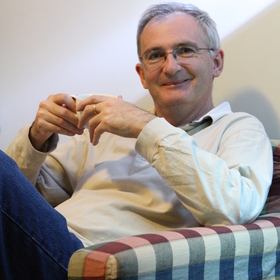
Today the park is a tranquil lunchtime retreat for local office workers and offers a pleasant sojourn for the weary traveller. Many come here for a picnic, informal ball games and other forms of exercise, including tai chi. The rather bewildered looking gent, in my final attached picture, didn’t join in!


In addition to its pleasant ambience the park offers a children’s playground, public conveniences and an eclectic mix of statutory and public art, the latter of which are the subject of my separate review – ‘Gee where can we install that, without causing offence?’
My attached pictures were taken during the winter. In spring and summer the elms provide a very welcome shady canopy while in autumn their leaves turn yellow, or as the tourist information more eloquently puts it, ‘they glow like molten gold’. So, a great spot to linger at any time of year.
Located next to the Casino, the park might be a good place to contemplate life should you leave there with a sore head, an empty wallet or, more probably, both.
Opening Hours
7am -10pm during daylight saving and until 8pm during other months. As there are no gates, I think these times refer to the toilets therein as opposed to the park itself.
Entry Fee
Free
Address: Intersection Bunda St and Akuna Street There are other entrances too, Canberra
Directions: Less than 5 minutes walk from Civic – via Bunda Street
For my next CANBERRA – INNER NORTH review click HERE.
For other Canberra reviews click HERE.
 The Rambling Wombat