
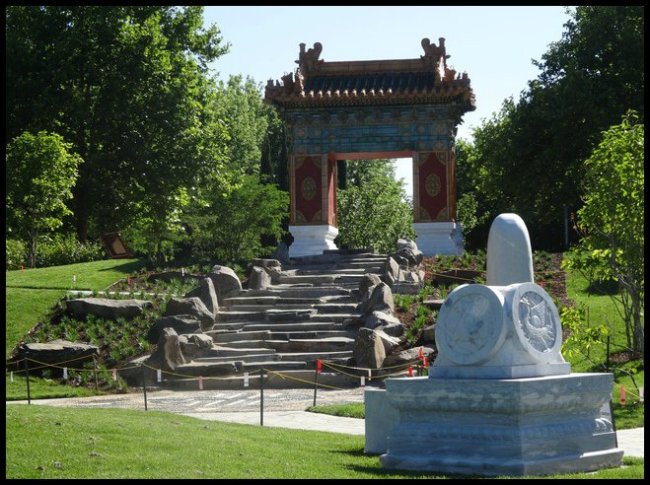
While small and easily viewable in ten or fifteen minutes, the Canberra Beijing Garden which opened in 2014, is a lovely spot on the banks of Lake Burley Griffin to sit and meditate or just relax and enjoy the serenity. So take your time and sit for a while.


The garden is a gift from Beijing to mark Canberra’s 100th anniversary and the 14th anniversary of the signing of the sister city agreement between Canberra and Beijing. The garden comprises an ornate traditional entrance gate, a pavilion, various sculptures and a rock garden, all brought together with tasteful landscaping and paths.
The garden, designed in the imperial Chinese garden style of the Qing Dynasty (1642-1912), was constructed by a team of Chinese artisans (working in both China and Canberra), using traditional Chinese materials and building techniques with some adaptation for the local environment. I could, cynically, add that this adaptation was to bring the construction into line with local Canberra planning and building laws!
The main entrance gate, depicted above, is especially beautiful, with its guardian lions, and is detailed with glazed tile work and colours so reminiscent of what I have seen on my visits to the Forbidden City (and numerous other sites) in Beijing. Moving down into the garden through the very small rock garden which incorporates a set of steps (of uneven size so be careful), over to your left you will see the garden’s Crane Observation Pavilion in off-white and green marble and of similar design to the entrance gate though not as colourful. While the marble work is of high quality and intricately carved, it would be nice to see the interior of the roof painted in the way of similar pavilions one finds in China.


Looking out from the Crane Observation Pavilion one sees what one might expect to see – cranes!
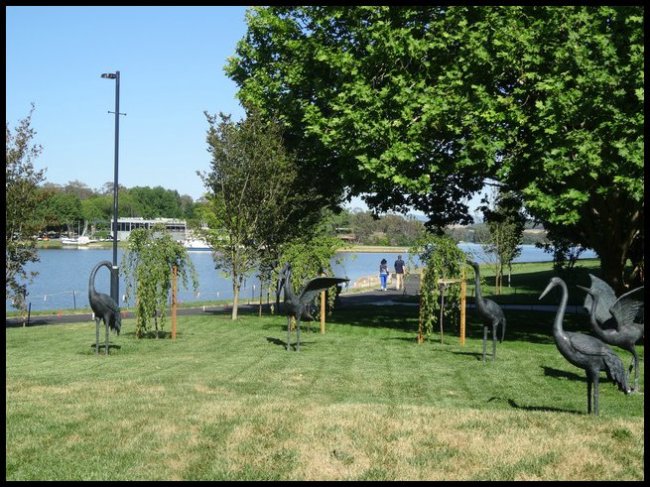
Individual garden sculptures (all copies) within the Garden each depict an aspect of Chinese culture and heritage typically portrayed in traditional Qing Dynasty gardens.
The most prominent of these is a sculpture of the “four celestial symbols” which date from 770 to 220 BC.
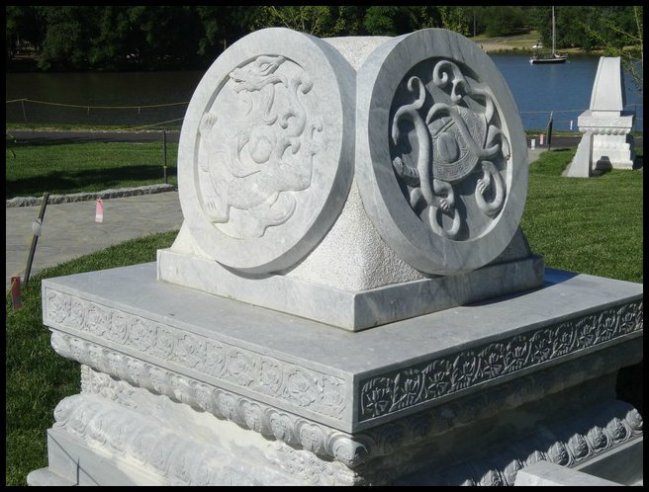
The symbols, creatures from Chinese mythology, are revered as deities with each representing a celestial constellation, a season and one of the cardinal points. So, on this sculpture you can see:
A black turtle – equated to north and winter
An azure dragon – equated to east and spring
A vermilion (Phoenix) bird – equated to south and summer
A white tiger – equated to west and autumn.
For another (and slightly more detailed) interpretation of these symbols have a look my Beijing review – “China’s Zero Point” .
Other sculpture include:
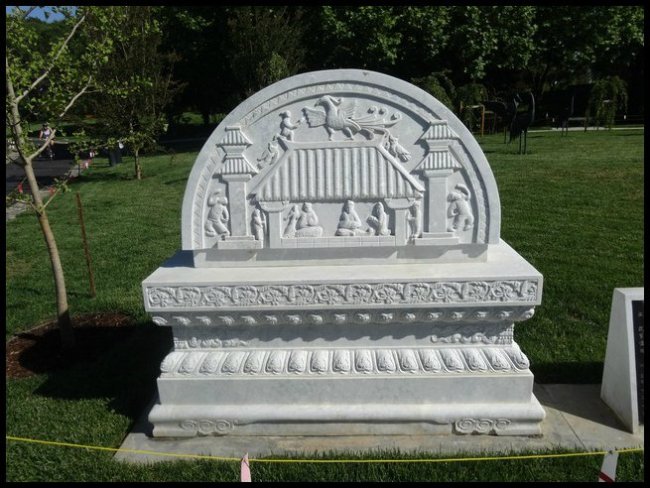
A Han Dynasty (205 BC to 220 AD) stone pictograph of the type typically displayed on walls of buildings in this period depicting scenes from both mythology and daily life. Here we see a couple enjoying various forms of merriment and entertainment offered in the palace.
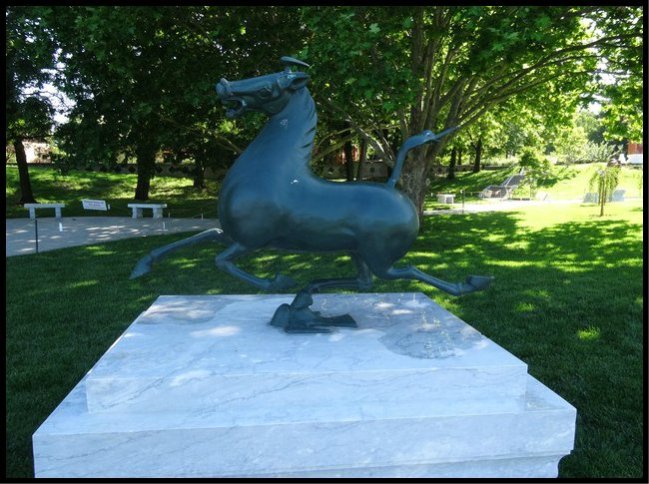
This bronze is a copy of an original Eastern Han Dynasty (25 – 220 AD) sculpture found in Wuwei County, Gansu – a galloping horse (heavenly steed) threading on a flying swallow accentuating the speed and power of the horse.
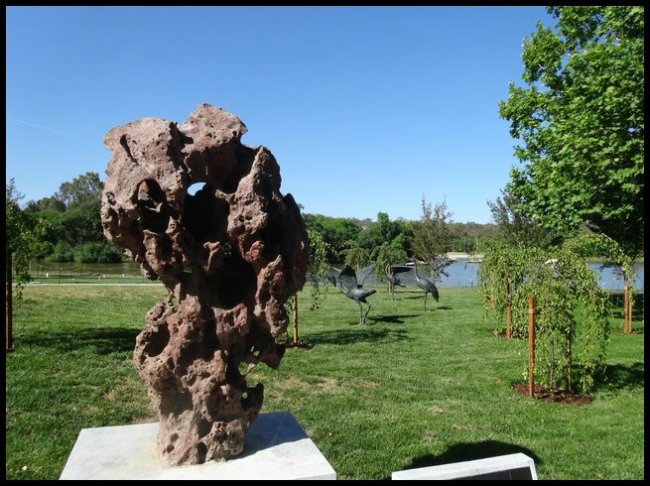
Stone of Appreciation from Tai Lake. Stone of this rough hewn type has been popular in Chinese gardens since the Tang Dynasty (618 – 907) and this piece displays the four recognized qualities of a good stone – fineness (shou), openness (tou), perforations (lou) and wrinkling (zhou).
All in all, in addition to being a nice spot for a bit of relaxation, the Canberra Beijing Garden is a great introduction to some key aspects of Chinese culture and heritage. On opening the garden the Chinese Ambassador to Australia expressed his hope that:
”Over time, the garden will grow and prosper just as the friendship between the people of Canberra and the people of Beijing is prospering.”
Chinese President, Xi Jingping visited the Garden in mid November 2014 while in Australia to mark the signing of a free trade agreement between Australia and China.
Address: Flynn Drive, Yarralumla
Directions: In Lennox Gardens.
For my next CANBERRA – INNER SOUTH review click HERE.
For other CANBERRA reviews click HERE.
 The Rambling Wombat