

During my trip to Scandinavia I didn’t spend much time in rural areas (a good reason to return) but sufficient to see a few grass roofed houses. Having lived in Ireland at a time when there were lots of thatched cottages some of which had sprouted grass due to neglect, I naturally assumed that people in thatched houses in Norway didn’t look after their roofs.
I was wrong.
For centuries, indeed millennium, sods have been used as a form of roofing in Scandinavia. In Norway such roofs are termed “torvtak”, which means “turf roof.” The sods are placed on a layer of birch and while grass is the natural cover on such roofs many are also planted with flowers creating lush and colourful gardens.
Sod roofs were used to provide insulation, maintain regular temperatures within the houses and stabilise the houses (mostly wooden) themselves. The roofs were also cheap.
By Viking and Middle Age times sod roofs had become very popular and they remained almost universal in rural areas until the beginning of the 18th century when houses became more stable and tiles superseded sods as the preferred roofing material. The arrival of corrugated iron and other modern roofing materials almost killed the sod roof.
In more recent times the sod, or as its now often called – the green, roof has become trendy again with nationalistic romantics and tree-huggers reviving the old tradition. They have also become particularly popular with a growing interest in open-air museums, and an increasing demand for ecologically sound and environmentally friendly mountain retreats and holiday homes.
Since 2000, the Scandinavian Green Roof Association has given an award to the best green roof project in the region and indeed Norway has a specific sod roof standard that defines how you must install a sod roof. I do wonder if the Vikings had such a standard and if they did what happened to it?
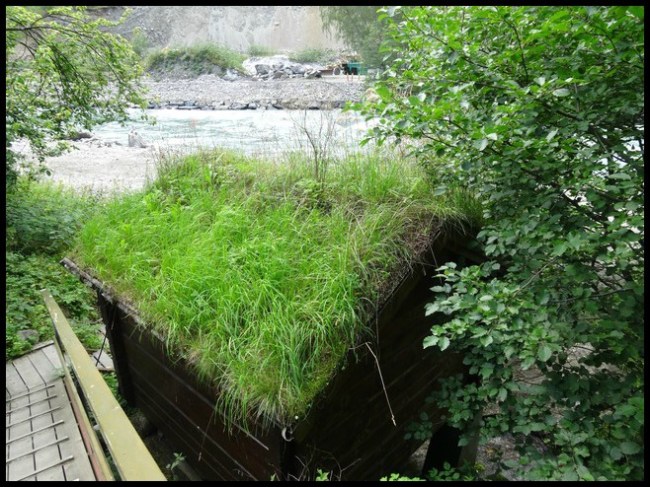
My first two photos are of sod roofs in Flåm. The first is on a building beside, and related to, the old Flåm Church and the second is on a small recreated and otherwise uninteresting mill I came across by the river as we walked to the old village to see the church.

Pictured above is the Gudvangen Fjordtell (reception centre, hotel, restaurant, etc) where we disembarked after our cruise on the beautiful and justifiably famous Næøryfjord.
My final picture was actually taken in Stockholm in the Skansen Open-air Museum.

For an interesting variation on the sod roof visit or see my separate review on New Parliament House in Canberra, Australia!
For my next Flåm review click HERE.
To start reading at the beginning of my Flåm reviews loop click HERE.
 The Rambling Wombat
Ah so that’s what they are called. We saw many of them and called them grass roof houses! LOL
LikeLiked by 1 person
You see these in Iceland too
LikeLike