
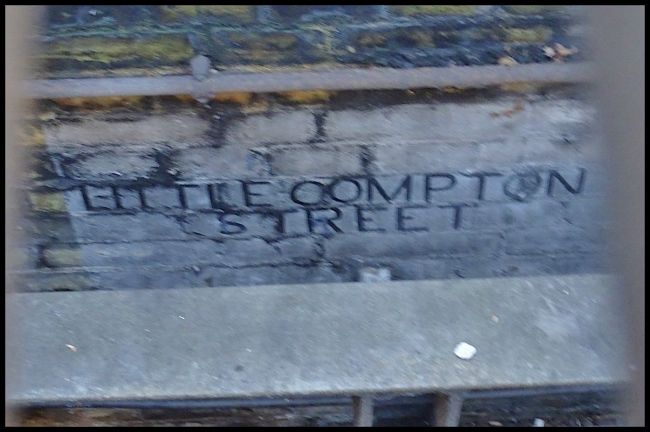
Two signs in a utility tunnel under Charing Cross Road are the only visible evidence of the existence of the former Little Compton Street. To see the signs you need to look down through the metal grating on the traffic island at the intersection of Old Compton Road and Charing Cross Road.

There are a couple of theories as to what you are actually looking at when you look through the grate. The first is that you are looking down into what was Little Compton Street while the second, and the one to which I subscribe, is that you are looking into a utility tunnel (part of the Cambridge Circus Utility Tunnels) that ran by the end of the former Little Compton Street.


In the late 1800s and early 1900s, during which Charing Cross Road (replacing Crown Street) was laid, the Metropolitan Board of Works had the foresight to start incorporating utility tunnels beneath London streets. Today this one, and other similar tunnels, carry gas mains, water mains, electric cables, telecoms cables and fibre data links. Natually having these tunnels beneath the streets significantly reduces disruptions when work is required on the services there-in.
The second theory better explains the presence of the two signs – one a stencilled sign, typically found in underground tunnels such that those working in them were aware of their location, and the second a chipped enamelled Victorian street sign which originally would have been found above ground, on the street.
As can be seen by comparing the old (left) an current maps below the current eastern section of Old Compton Street (the part east of Greek Street) was formerly called Little Compton Street. At that time Little Compton Street connected Old and New Compton Streets the latter of which has since been separated from Old Compton Street by an office block.


In 1896 Little Compton Street became part of Old Compton Street and the former street sign found its way into the utility tunnel. How it got there is unknown – perhaps an act of preservation by a thoughtful council?
Apart from being the location of the high water mark during the Great Dangaroo Flood (separate review) I can find very little information on Little Compton Street. The only other interesting snippet that I have ascertained is that after French poets Paul Verlaine and Arthur Rimbaud escaped the turmoil of the French Commune in 1871 the Hibernia Hotel at 5 Little Compton Street (renumbered as 23-35 Old Compton Street in 1899) in then bohemian Soho provided a congenial place of repose as they played out their short-lived, passionate and tempestuous love affair, fuelled by absinthe and hashish.


To be fair, it should also be said that both men wrote some of their best poetry while in London.
Karl Marx is also recorded as having frequented the Hibernia while the composer Richard Wagner is thought to have stayed there for a while in 1839.
 The Rambling Wombat
As a teenager I used to visit an underground (literally) “Theatre Club” in Little Compton St. It’s been built over now. It was dead opposite the end of Old Compton street (across Ch. X Rd.) and, at first, was turned into a kind of Plaza surrounded by shops. Eventually more Shops (Waterstones etc.) were constructed on the Plaza bringing the shop line out onto the High St and completely covering Little Compton St. for ever.
LikeLiked by 1 person
Thank you for adding your personal memory.
LikeLike
Interesting. I studied Verlaine and Rimbaud briefly when I was at uni. This was (ahem) some decades ago so I don’t remember much about them. And despite it being the U.K. capital I know very little about London. I’ve never really taken to it.
LikeLiked by 1 person
Very few Londoners would know about this either. Unlike you, I have (since childhood) a tremendous fascination with London and never tire of visiting it. My visit earlier this month was one of the longest at some 8-9 days and afforded me the opportunity to visit many off the beaten track places which I especially like doing.
LikeLiked by 1 person
This is a superbly interesting piece about a little-known aspect of London
LikeLiked by 1 person
Thank you Adam
LikeLike
Somehow I never knew (or had forgotten) about Verlaine and Rimbaud in London.
LikeLiked by 1 person
Don, admittedly I am not very familiar with the work of either but feel sure I first came across them in one of your reviews.
LikeLiked by 1 person
That’s possible. I mentioned Verlaine on my Metz page, especially, since he was born there and now the university there is named after him.
LikeLike
I knew of the existence of this unusual bit of London trivia, but have never actually seen it.
A great review as always Albert and thanks for sharing
LikeLiked by 1 person
Thank you Malcolm. Not that you know where it is you can have a look on a future visit… it won’t take much of your time!
LikeLike
Fascinating! I remember you telling me and Adam about this when we met up in the Punjab, where coincidentally I was again last night 😉
LikeLiked by 1 person
Thank you Sarah. I must say I really enjoyed our meal at the Punjab – the food and the company. I will be a place to which I shall certainly return too.
LikeLike