
When we travel we try not to book caravan parks and the like in advance, giving us the opportunity to vary plans en route. That said, park bookings make sense when you have time-specific commitments in certain places, as we had in Canberra so we have a booking there four nights from now. Prior to going into the city we wanted to spend a couple of days at Wee Jasper Reserve, a popular camping area for Canberrans along the Murrumbidgee River, so we just booked that as well. As such, we now had a couple of days up our sleeve.
My initial plan was to spend these in Gundagai, a beautiful little town steeped in history, and also on the Murrumbidgee River. But yes, Dear Reader, you have correctly guessed, the free camps there were still closed due to flooding earlier in the year. As we had been there many times before this wasn’t a big drama and we decided to split the journey to Wee Jasper by stopping at Woomargama, a place I had never heard of before, and Jugiong which has one of the largest and most highly rated donation camps in the country, as well as a noted pub!
If you are travelling anywhere near Gundagai then I highly recommend a stop there. As to why, please have a look at a separate series of reviews I have written on Gundagai (and the famous Dog on the Tuckerbox) and you will understand.
Due to a not uncommon tardy start to the day, we didn’t arrive at Woomargana (135 kilometres from Milawa) until early afternoon, This still gave us ample time to have a wander through and enjoy this picturesque and peaceful little village, just off the busy Hume Highway which links Sydney to Melbourne.
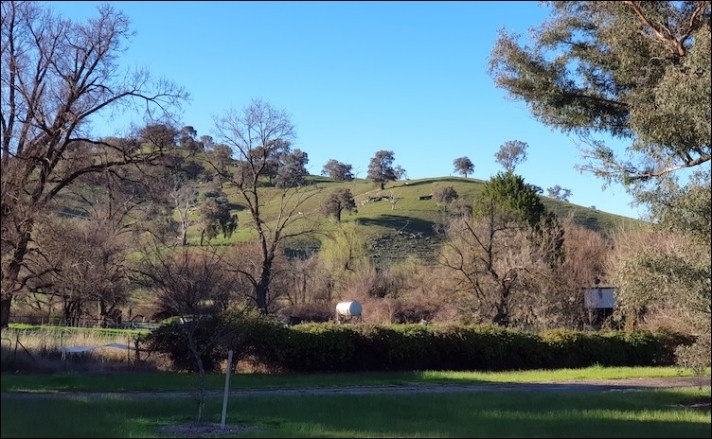
The free camp here is a small bituminised area in the centre of the village. Toilets and a drinking water tap (impossible to get to at the time of our visit due to saturated ground) are both available along with a rather damp, though beautifully green, kids’ playground and picnic area.
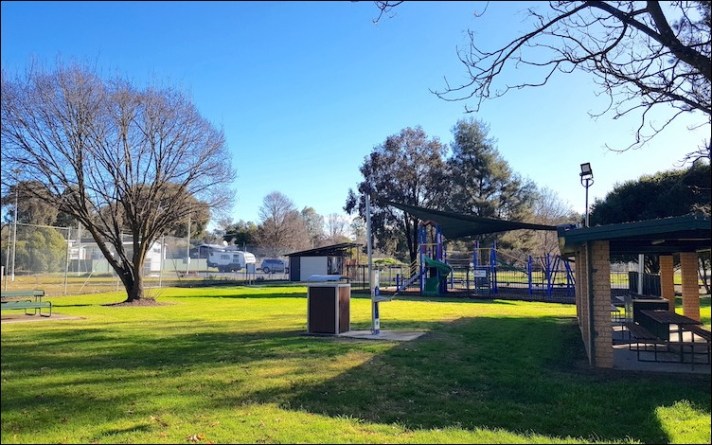
The well-appointed rest area in Woomargama, with the camping area to the rear in this picture
I wondered if the ground was as sodden in these parts when Messers Hume and Hovel passed through the shire in mid-November 1824 on their exploratory expedition across the southwestern part of the continent, from Yass to Port Phillip (at Geelong), in search of new grazing land in the south of the then colony of New South Wales, and to discover where its western rivers flowed.
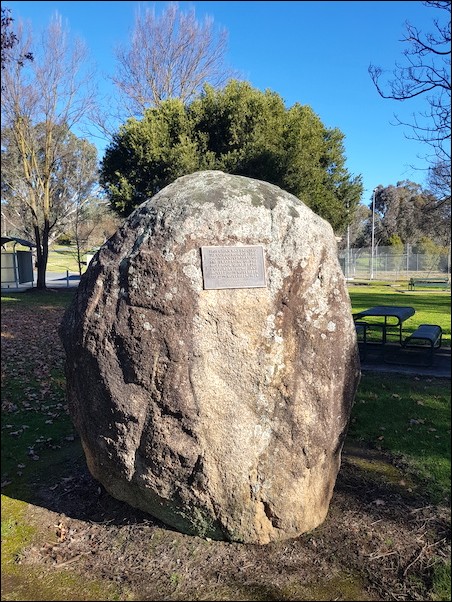
A cairn marking the 150th anniversary of Messers Hume and Hovell’s passing through the area in 1824
There was a slight outward-facing slope on the camping area which would not have presented a problem for us perfectly levelling the van, front to back, had we unhitched it from the car. As we didn’t want to do this for an overnight stop we dropped the rear of the van as much as we could and settled for a slight forward slope which worked out fine.

Set up for a very peaceful night in Woomargama. Only one motorhome joined us.
Having set the van up and eaten lunch we went for a very enjoyable stroll through the village (popn 250).
Fourteen years after explorers Hume and Hovell passed through the area Messers McKenzie and Wylde leased some land along the Woomargama Creek, then known as Dickson’s Swamp. Over time a substantial (40,000 acres) sheep/cattle station (farm) grew, as did a small village to meet the needs of workers and families associated with the station. Situated on the main Sydney – Melbourne road, Woomargama (derived from the aboriginal word ‘wombariga’ meaning native cherry) further developed as a Cobb & Co change over station and became part of a regular mail run.
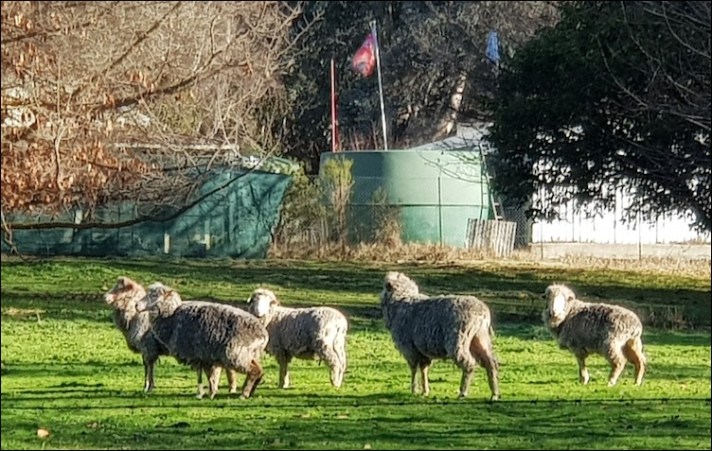
Inquisitive sheep in Woomargama
In its heyday, the village boasted a post office, general store, village hall, various churches, hotels, a public school, a dairy, a blacksmiths, a shoe shop and a timber mill.
Today, the village has contracted to a hotel/pub and a post office and the station is a ‘mere’ 6,500 acres. A solitary church remains.
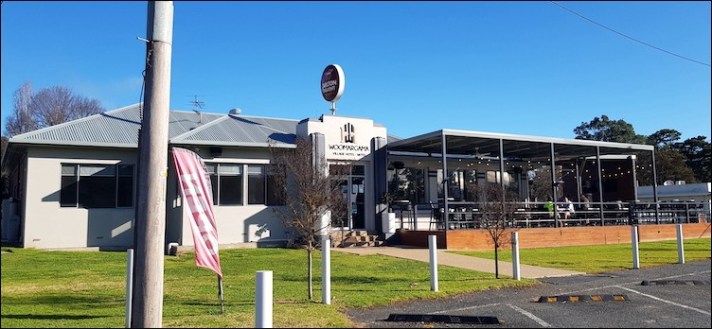
Woomargama Hotel

St Mark’s Anglican Church, Woomargama. The church holds services on a monthly basis, as it has done since it was established in 1888.


The Meeting Tree, outside St Mark’s church. Planted by the Podmore family in the 1800s, the tree became a place to meet (hence its name) for children, lovers, churchgoers and workmen. Workmen would have gathered here each morning to await their orders for the day, from the boss at Woomargama Station.

Woomargama Public School 1893 – 1997, now a private residence.
While much of the contraction of the village would have been due to the draw of brighter lights in nearby larger towns and to less staff being needed by the station, the diversion of the Hume Highway to bypass the village in 2011 would have been a substantial blow.
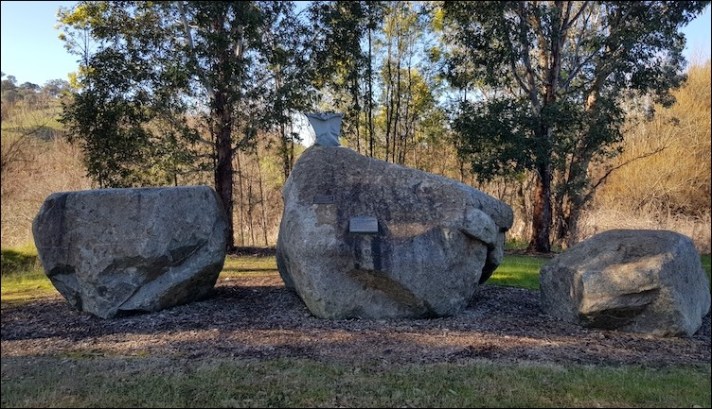
Three boulders extracted from the roadworks which resulted in the diversion of the Hume Highway to bypass the village. They now commemorate the completion of the bypass project.
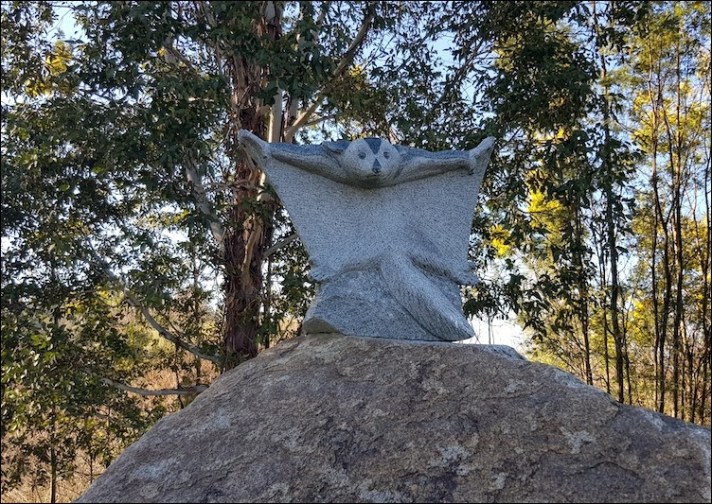
A squirrel glider – the village icon for Woomargama
Though Woomargama Station is smaller than it used to be it has, under its current ownership, hosted a number of famous guests over the years. These have included the then Governor of California, Ronald Reagan (who later became President of the United States) and his wife, Nancy, in 1973, and in 1983, the then HRH the Prince of Wales (now King Charles III) and Diana, Princess of Wales, along with the baby Duke of Cambridge (Prince William), stayed at the property during their first Royal Visit to Australia.
Sadly for it, the station was unable to pull off the big one in 2023 by having the Ramblingwombat stay. Instead, he chose to spend a delightful afternoon and night in the local car park!
The next review from my Adelaide to Canberra road trip can be found HERE (coming soon).
Should you wish to follow this road trip from the beginning please start HERE.
 The Rambling Wombat
Thanks for the history lesson. I read a book about Hume and Hovell’s expedition earlier in the year and the human element of this trip was quite fascinating. Mel
LikeLike
I always enjoy reading about minutiae of your new lifestyle as well as the places you stop 🙂 I like the flying squirrel but am surprised at the number of VIPs who’ve stayed in such an apparently ‘middle of nowhere’ spot!
LikeLike
British Royals at a caravan station somewhere in Australia, interesting detail 💥 But when will you Australians get rid of these strange emperors from the “little” island desiring not to be a real part of Europe? 🥳
LikeLike
Just to note, not all of us desire not to be part of Europe – on the contrary, many of us are still angry about that ludicrous referendum and its result!
LikeLiked by 1 person
A rather stupid decision indeed because only with a lot and diverse interventions by the European Union peace was established again in Northern-Ireland. What will be the outcome here in the future not yet clear but in Scotland people may also choose a different way than in London! Can the UK survive all these turbulences?
LikeLike