
‘Erected to the Glory of God and the honour of brave men by a grateful people.
Great War 1914 – 1918′ Continue reading “Gundagai War Memorial – Cenotaph”
‘Erected to the Glory of God and the honour of brave men by a grateful people.
Great War 1914 – 1918′ Continue reading “Gundagai War Memorial – Cenotaph”
 Gundagai is famous for its Dog on the Tuckerbox sculpture located at Five Mile Creek outside the town.
In my separate review of the sculpture I have given details of the story behind it so will not repeat the details here. Please read my Dog on the Tuckerbox review in conjunction with this review if you have not already read it.
Here on Sheridan Street, Gundagai’s main street, the Dog on the Tuckerbox story is depicted in a few aging/ flaky murals on the outside of the Gundagai Pharmacy (across the street from St Patrick’s Church). Continue reading “Dog on the Tuckerbox Murals”

Certainly for me the post office is one of the nicest buildings in Gundagai. It is a fairly simple red brick building built in 1879. I especially like the ‘swirl’ on the balcony which has an early art deco look, so either it was ahead of its time or it was a later addition to the original building.
More interesting than the building itself is that Gundagai Post Office was the base of Australia’s last mounted postie (postman). Continue reading “Gundagai Post Office and Mounted Postie”

European settlers arrived in the area around 1826 and Gundagai developed on the Murrumbidgee River flats. In 1846 a land grant was made to the Catholic Church, not in the town but to the north on the slopes of Mt Parnassus. Had the Catholics been banished from the township? Continue reading “St Patrick’s Catholic Church”

The Second Boer War (1899–1902), which ended with the Treaty of Vereeniging and the conversion of the Boer republics into British colonies, involved large numbers of troops from many British possessions right across the world. This was the last great war restricted to Empire participants and ironically Australia’s first war as a nation, following Federation in 1901. Australians made up five per cent of all Commonwealth forces serving in South Africa during the war. This was a major contribution given the size of its population. Continue reading “Boer War Memorial”

The majestic fine classical Gundagai Court House, built in 1859 (clock added in 1877), is without doubt the most imposing building in Gundagai, due both to the quality of the building itself and to its elevated site giving it a dominating presence above the town’s main street. Continue reading “Gundagai Court House”

Residents of Australia and others familiar with its hardware stores will be wondering why the main picture in a review of a photographic gallery depicts a Mitre 10 hardware store. Well, it so happens that the Gabriel Gallery occupies most of the first floor of Butcher Roberts Mitre 10 store. To get to the gallery you have to walk through the store and ascend the narrow steep stairs at the back. Continue reading “The Gabriel Gallery”
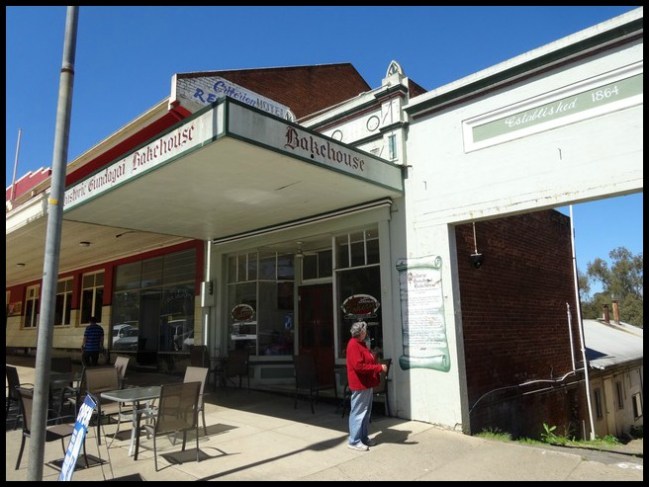
It is hard to go anywhere nowadays which doesn’t claim to have the biggest this, the oldest that, the longest other and so on and so forth. Gundagai is no exception and its claim to fame is that it has Australia’s oldest continually operating bakery – the Historic Gundagai Bakehouse, more commonly referred to as the Gundagai Bakery. Continue reading “Gundagai Bakery: “Pies and Delicious Date Scones””
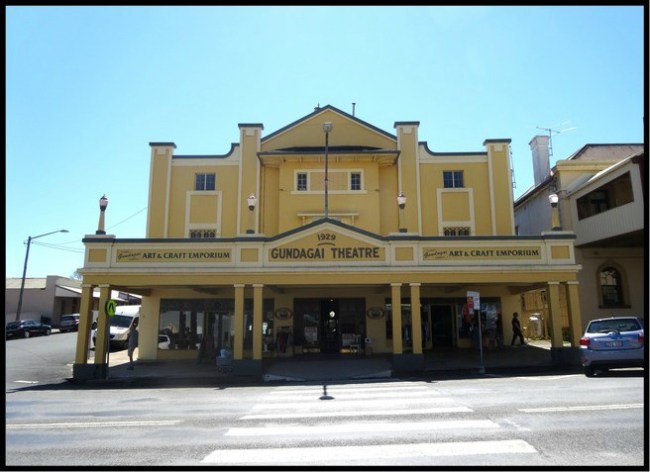
Moving back down onto Sheridan Street having view the former Gundagai Literary Institute we come across another former cultural institution – the Gundagai Theatre. ‘My what a terribly cultured place this Gundagai is’, I hear you say. Continue reading “Frock-up For The Gundagai Theatre”
 Literary Institutes (akin to Mechanics’ Institutes and Schools of Art) played an important role in the life of early (European) Australian communities. They housed libraries and reading rooms and typically hosted lectures and served as adult education centres. Essentially they were the centre of a community’s cultural activities – not unlike, though on a rather more modest scale than, the Grand Peoples’ Study House that I recently visited in Pyongyang, North Korea. I imagine I am the first person to draw a comparison between the Gundagai Literary Institute and the Grand Peoples’ Study House in Pyongyang! Continue reading “Gundagai Literary Institute”
 The Rambling Wombat