
This neo-Gothic church, tucked in between ever-rising buildings on the intersection of Pulteney Street and North Terrace, is Adelaide’s second oldest church (Holy Trinity Anglican Church being the oldest). Continue reading “Scots Church”
This neo-Gothic church, tucked in between ever-rising buildings on the intersection of Pulteney Street and North Terrace, is Adelaide’s second oldest church (Holy Trinity Anglican Church being the oldest). Continue reading “Scots Church”
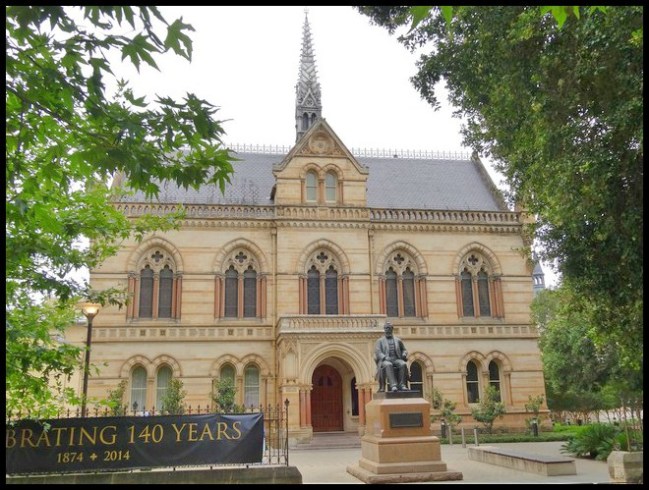
The University of Adelaide, the State of South Australia’s oldest university, was established in 1874 and teaching began with a Latin class in 1876. Today it is one of Australia’s premier universities and offers degrees in arts, science, law, medicine, music, mathematics, philosophy, languages and mining engineering. Continue reading “The University of Adelaide”
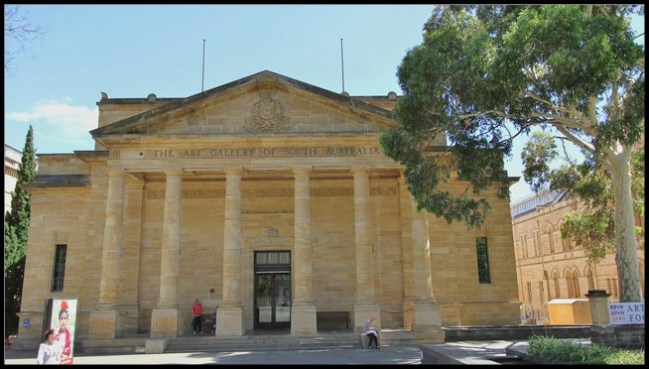
The Gallery was established in 1861 and is located next door to the South Australian Museum on North Terrace.
Except for visiting exhibitions (entry fee payable) you won’t find the work of any classical masters here. What you will find, from its stock of 38,000 works, Continue reading “The Art Gallery of South Australia”
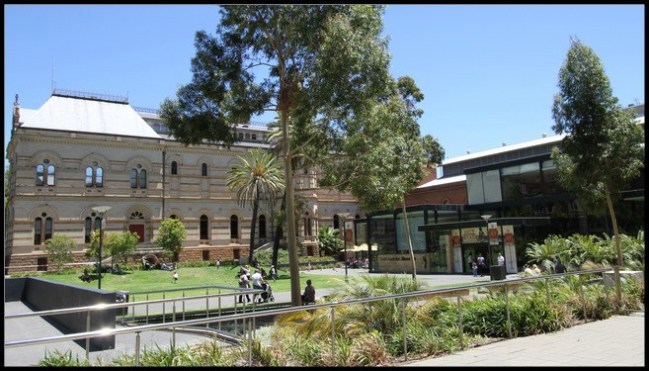
Many people think of Adelaide itself as dated, boring and a bit of a museum. It hardly any wonder then that the main museum there – the South Australian Museum is a “museum of a museum”. While museums world wide are being jazzed up and turned into interactive and politically correct experiences this museum is like entering a time-warp – a museum straight out of the sixties were stuffed animals and locked (though not dusty) display cabinets crammed with artefacts prevail. That said, it has used a more contemporary approach in a few areas – such as the exhibition on the Australian Antarctic explorer Sir Douglas Mawson which is appropriately supported by real artefacts of interest.
You are probably thinking that I don’t like the place. Far from it, I love it. Continue reading “South Australian Museum – How Museums Used To Be”

The State Library is, as the name might suggest, the pre-eminent library in South Australia and houses a wealth of material, with a particular emphasis on South Australia. Continue reading “The State Library of South Australia”

“As the falling drapery disclosed the marble representation of the poet enthusiastic cheers were given, and the band poured forth the strains of ‘Auld Lang Syne.‘“ (South Australian Register – 7 May 1884). Continue reading “Robert Burns – For Auld Lang Syne, My Dear”
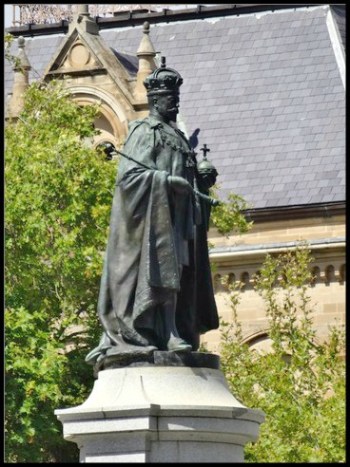 Nowadays we regularly read of the antics of the younger British Royals as if it were news. Far from it, the royals have always lived it up. Continue reading “Edward VII Erect in Full Coronation Regalia”

Migration into Australia has been, and continues to be, an emotive topic for many. Continue reading “27% Of Australians Born Overseas – Migration Museum”
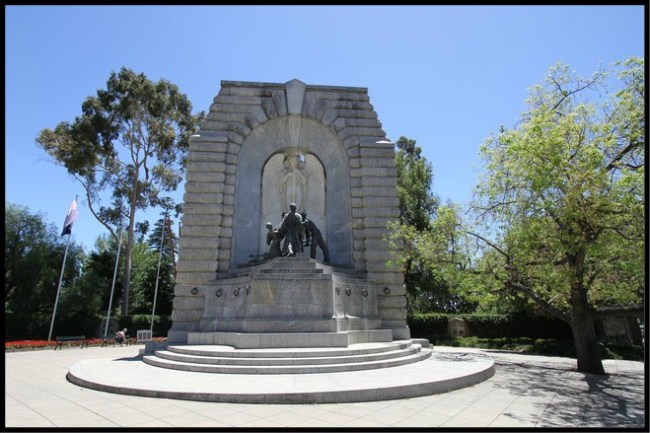
The National War Memorial has a prime corner sight at the intersection of North Terrace and Kintore Avenue and was opened in 1931 to commemorate those South Australians who gave their lives in World War I between 1914 and 1918. Why it is called the “National” War Memorial is not clear as it only commemorates South Australians lost during the War – perhaps initial intentions differed. Continue reading “National War Memorial – Lest We Forget”
 Captain James Cook is most often credited as being the person who discovered Australia, in 1770. In actual fact, Cook claimed the eastern part of the continent for Britain in that year and it was Dutch man, Willem Janszoon, who first landed on the continent on the Cape York Peninsula (in Queensland) and met with Aboriginal people in 1606. It wasn’t until 1803, almost 200 years after this initial European discovery, that someone proved that Australia was an island continent. Continue reading “Captain Matthew Flinders”
 The Rambling Wombat