Crevenish Castle

188

The remains of Crevenish Castle are south-east of the village of Kesh on the Crevenish Road, or ‘the back road’ as the locals call it – a beautiful drive in itself.

The Castle (originally called Castle Hassett) was built by Thomas Blennerhassett a native of Norwich, England. Blennerhassett secured his land here – confiscated Maguire property – in 1610 as part of the Ulster Plantation. A church, built around the same time has long since disappeared. Continue reading “Crevenish Castle”

Janus and the Lusty Man

I have to say I was rather surprised when I visited Caldragh Cemetery on Boa Island, Lower Lough Erne. For many years I have seen just close-up pictures of “Janus” and the “Lusty Man” (properly referred to as the Boa Island and Lustymore figures respectively) and accordingly, or for whatever reason, assumed them to be at least a couple of metres high. On entering the cemetery I could not see the said figures. Wandering around I happened upon them – Janus being about 73cms tall and the Lusty man about 60cm – sitting in the centre of the graveyard among random stones that mark long-forgotten dead. A nearby base – which some think belongs to Janus – would, if that were the case, increase its size to nearly 2 metres. Continue reading “Janus and the Lusty Man”

Drumskinny Stone Circle – Fermanagh’s Stonehenge!

180

There are many examples of stone circles in high bogland in North Fermanagh and neighbouring counties. Based on the recovery of artefacts, which I refer to later, in the 1962 excavation of this site it is thought to date from around 2000 BC or earlier – the early bronze age – and apparently the peak of the “stone circle era”. Continue reading “Drumskinny Stone Circle – Fermanagh’s Stonehenge!”

Irvinestown Famine Graveyard

168

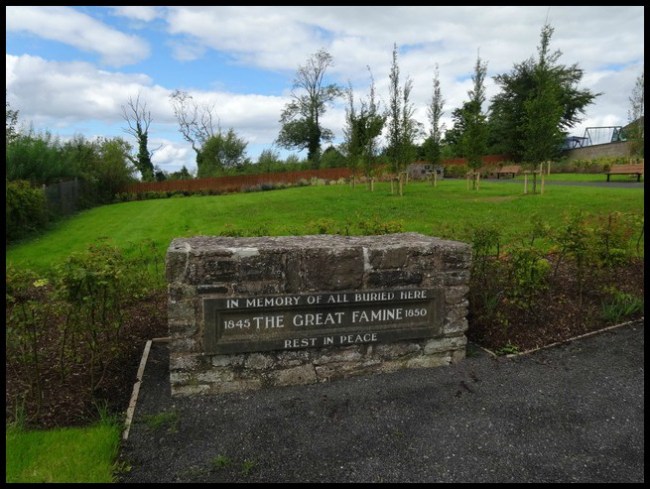
It is generally accepted that during the ten years, 1841 to 1851, Country Fermanagh lost over 40,000 people or 25% of her people due to a potato blight which lead to the famine (1845 to 1850) which reeked havoc throughout the island of Ireland. What is less clear is how many of the 40,000 died as a result of hunger or disease and how many emigrated. Of course thousands who might happily have emigrated perished, as they could not afford to leave their home areas. Continue reading “Irvinestown Famine Graveyard”

Garden of Celtic Saints

150

This is the place to come for a potted history of early Irish Christianity – from the 5th to 17th century. This history is relayed via life-sized carvings of Celtic Saints, missionaries, scholars and more accompanied by very informative labeling and information boards. Additionally, you can pick up an excellent information booklet as you enter the Garden. If there are no booklets in the unmanned Garden I understand a copy can be obtained in Mahon’s Hotel in the centre of the town, a short distance away. Continue reading “Garden of Celtic Saints”

Commonwealth War Graves – Irvinestown

145
Commonwealth War Graves – Church of Ireland

In my review of Castle Archdale Country Park I indicated that during World War II the park, then Castle Archdale Manor House and Estate were commandeered by the Royal Air Force and was a significant base for PBY Catalinas and Short Sunderlands flying boats which flew from Castle Archdale to protect Atlantic shipping from German U-boats. Continue reading “Commonwealth War Graves – Irvinestown”

Irvinestown Old Church and Graveyard

140

After about ten years into the Plantation of Ulster, Nicholas Pynnar was appointed ‘to survey and to make a return of the proceedings and performance of conditions of the undertakers, servitors, and natives planted’ in the six escheated counties of Armagh, Tyrone, Donegal, Cavan, Fermanagh, and Londonderry. Pynnar carried out his rather inconclusive survey (another had to be done three years later) between December 1618 and March 1619. Continue reading “Irvinestown Old Church and Graveyard”