
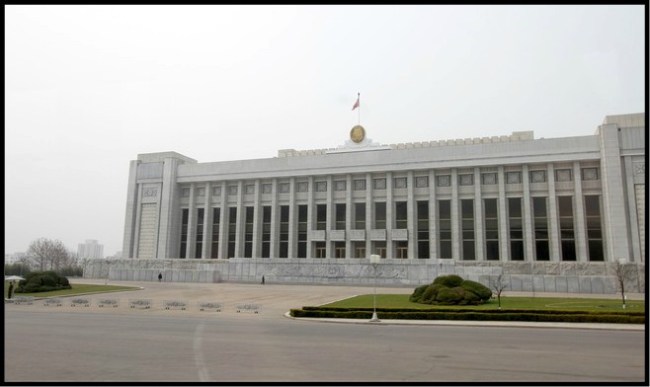
While we could admire North Korea’s Supreme People’s Assembly or Parliament from the outside we could not go inside.
North Korea is a democracy! After all, you just need to know its formal name, bestowed upon it by no less than Kim Il-Sung, now its (democratically elected?) Eternal President. It is, off course, the Democratic People’s Republic of Korea (DPRK).
Every democracy needs an elected parliament and North Korea naturally has one – the Supreme People’s Assembly which has 687 elected representatives form all around the country – proportionally, quite high for a population of around 25 million.

(Picture: Assembly members applauding the leadership for its words of wisdom – courtesy of Korean Central News Agency)
By way of detail, candidates (one for each electorate) are selected by Democratic Front for the Reunification of the Fatherland which itself is dominated by the Korean Worker’s Party which, surprise surprise, holds over 600 seats in the People’s Assembly. The balance is held by a couple of minor approved parties and a sprinkling of independents all selected by the Democratic Front for the Reunification of the Fatherland.
All citizens, 17 years and older, can stand for election and can vote. Voting is secret if you wish to vote for the person selected by Democratic Front for the Reunification of the Fatherland. In the event that you don’t wish to vote for this person you can score their name out – to do this you need to go to a separate non secret booth. Few do!
The Supreme People’s Assembly meets once or perhaps twice a year for a few days. Members receive a suit, especially tailored by the Central Party, to attend the Assembly but they do have to share a twin room at the Yanggakdo International Hotel (where we stayed) while in Pyongyang. The Assembly is basically a rubber stamp for decisions already taken by the Presidium of the Supreme People’s Assembly.
My below picture (courtesy of Korean Central News Agency/ Reuters) shows Kim Jong-un (centre) presiding over the 7th Session of the 12th Supreme People’s Assembly – watched over by giant statues of his predecessors, his father (Kim Jong-il on the right ) and grandfather (Kim Il-sung on the left).

A defector from North Korea and former delegate of the Assembly has explained its purpose thus:
“The meeting is merely a gathering of puppets to show to the world that North Korea adheres to democratic processes. All delegates must automatically lift up their registration cards and vote in favour of all motions.”
The Presidium comprises a handful of senior Workers Party members and is headed up by Kim Yong-nam – the nominal head of state – a position he has held since 1998.
In practice Kim Jong-un exercises absolute control over the country, and Kim Yony-nam is “number two official”.

(Picture: Kim Jong -un addressing the 1st session of the 13th Supreme People’s Assembly in April 2014 – courtesy of Korean Central News Agency)
Kim Jong-un is naturally an elected leader (of the Workers Party of Korea). In fact, he received 100% of votes cast with not one vote against him in the most recent election in March 2014.
This blog entry is one of a group (loop) of entries on The Rambling Wombat’s trip to Pyongyang, North Korea which I recommend you read in a particular order. I suggest you continue with my next entry – Kim, Two Kims – Mansudae Grand Monument – If necessary, go to my Pyongyang introduction entry – Pyongyang – A Capital City Unlike any Other – to start this loop at the beginning.
 The Rambling Wombat
What I find oddest of all, of the many odd things, is the almost total absence of people in your outdoor images, the whole place looks like a ghost town.
LikeLiked by 1 person
It seems much quieter in Albert’s shots, Fergy, than we saw – perhaps the time of day, perhaps the fact that we visited a few years later. I wouldn’t call Pyongyang bustling but there were certainly people on the streets (although not many vehicles and no private cars)
LikeLiked by 2 people
The lack of cars fascinates me, it really is so unusual in the 21st century. I loved Albert’s comment about the fleet of blacked out buses to shift the “Government” about. Can you imagine BoJo, Gove et al doing that? What, no limo?
LikeLiked by 2 people
The lack of cars is officially explained by the lack of fuel (as opposed to the citizenry not having the wherewithal to buy them) … caused by US lead sanctions. To be fair Kim does not partake of the buses – he has a fleet of limos (all high end European models brought in regardless of sanctions), a number of boats, a train and a plane. Many of the senior Govt members, ‘the elite’, would also have high end imported vehicles.
LikeLiked by 1 person
Isn’t it strange how sanctions only ever seem to affect ordinary people. The elites, of whatever political stripe they may be, always seem to do OK for themselves.
LikeLiked by 1 person
Totally true… they do not work and are directly responsible for the deaths of hundreds of thousands, if not millions, in North Korea and elsewhere. Needless to say I am totally against their use.
LikeLiked by 1 person
Fergy you are currently looking at posts related to my 2014 tour. Sarah has hit on the reason and yes there were massive changes by 2018 though as she has indicated Pyongyang could still hardly be described as bustling … In 2014 people went out to work and buy what they needed plus perhaps a work supported trip to the theatre or a football match…. no other reasons to be out and in any event given that the state provided housing, education, health cover, food coupons, etc people did not have any discretionary spend money. Of course this was planned and was a way of controlling people.. so while every one could in theory buy a car no one had the money to do so. By 2018, and under Kim Jong-un, things had changed significantly … most people (in Pyongyang) had mobile phones, coffee shops were springing up, restaurants were becoming social places as opposed to just a place to get sustenance, supermarkets/departments stores and stores generally offered more choices. Essentially there is a growing and more affluent middle class who are permitted (to a degree) to engage in private enterprise and thus have some discretionary spend money which they lacked even in 2104 and it is becoming ‘kewl to hang out!’. This was especially noticeable in Pyongyang but there are moves afoot in this regard in various secondary cities too.
LikeLiked by 1 person
I can’t wait to meet up with you and Sarah if the opportunity ever presents itself. I understand that these things are best discussed face to face and I would love to pick both your brains.
LikeLiked by 2 people