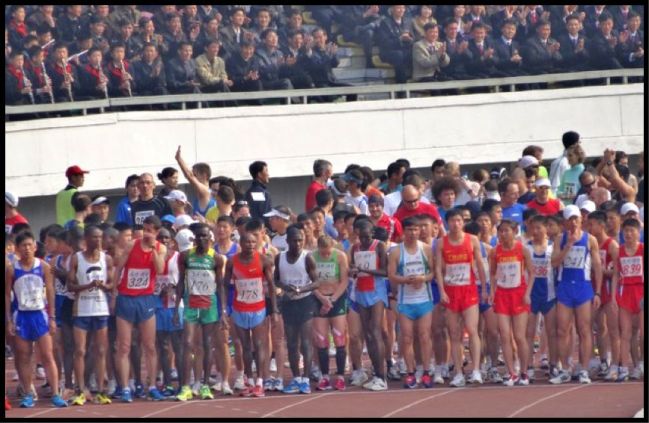
Pyongyang’s 27th Marathon (officially the Mangyongdae Prize International Marathon) was held on 13 April 2014 – the same day as the London Marathon – and for the first time in its history, amateurs were permitted to take part.
About a month or so before our trip the North Korea our tour company contacted us to see if we wanted to take part in the marathon as the date coincided with our already booked tour. Three options were available, a full marathon, a half marathon and a 10km fun run. I decided not to run – a decision I came to regret (even though run would have translated into walk).
Though the race is recognised as a bronze level road race by the International Association of Athletics Federations the major appeal for foreign runners was that it is held in Pyongyang as opposed to the fact that is is a marathon. It offered a very rare opportunity to be in the streets of Pyongyang as opposed to driving along them in a tour bus. While runners got away from their guides for a short time there were ample officials along the course such that runners did not deviate from the course and see something they should not have seen.
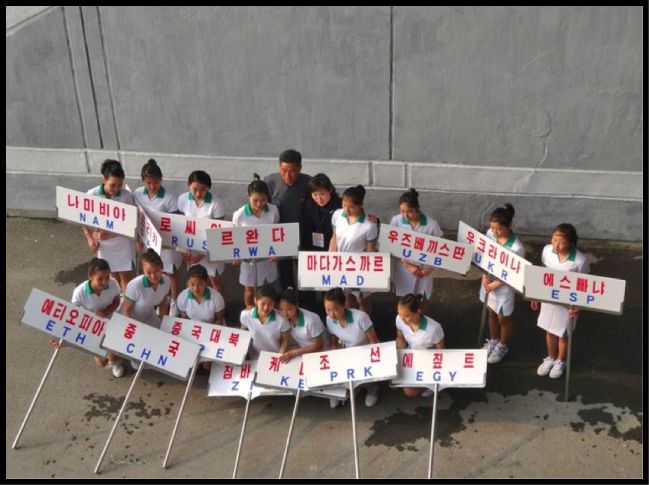
In all about 200 amateur runners signed up for the event including nearly half our tour group. This brought the total number of runners on the day to around 800 with the vast majority of the balance being North Koreans. Overseas professional runners, around 20, came mainly from African countries, though China, Russia, Ukraine, Spain and a few more were represented.
The actual running course, which we got to drive around the day before the run, is 10km long. All runs began and ended in the Kim Il-sung Stadium (except that the 10km run which ended just outside the stadium). Full marathon runners ran four laps of the course; half marathon runners, two laps; and 10km runners, one lap.
Rules around the marathon, covering things like what you could wear and not wear were very confusing and changed right to the last minute. This, while frustrating, added to the fun.
One of the last minute rule changes that upset many was that full marathon runners would not be allowed to finish if they did not do so in four hours – up from the earlier announced five hours. To ‘ease concern’ officials thoughtfully explained that slower runners could simply complete the marathon in one of the buses they had laid on! Sorta not quite the same as running into a stadium of 50,000 applauding people so many who had signed up for the full marathon downgraded to the half marathon to ensure that they would be able to finish.
One of the rules which didn’t change related to toilets. Runners were, in no uncertain terms, told not to urinate in the streets, and that running off the course was a definite no-no. Instead of the banks of porta-loos seen in other places, Pyongyang had a small number of toilets available in public buildings and restaurants with one, incredibly, on the second floor of a building.
We (runners and non runners) arrived at the stadium about an hour before the start time and mingled around outside crowd-watching for about half an hour before those of us not running were asked to go inside and assume our seats in the area set aside especially for tourists and affording excellent views. There were about 150 foreign spectators in a capacity crowd of around 50,000. I refer to the crowd and the atmosphere inside the stadium in a separate review on the soccer matches we watched while awaiting the runners’ return.
After one false start the runners left the stadium to very moderate applause from the Korean spectators and cheers from the tourists.

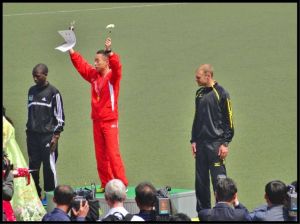
Shortly after some of the half marathon runners started arriving back in the stadium, North Korean, Pak Song-chol, won the full marathon with a personal best time of 2:12:27 hours – his third win in recent years. The arrival, into the stadium of overseas amateurs caused great excitement especially so for those who decided to engage with the crowd. Waving, running backwards, bum wiggling and cartwheels were especially well received – mainly with nervous laughter. Was all this hijinks and, heavens above, laughter in the stadium too much for the authorities? Will amateurs be allowed to run again in 2015.
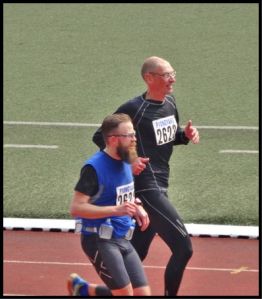
From the amateurs perspective, based on accounts from fellow travellers who ran, the experience of running through the streets, watched by inquisitive locals (tourists were restricted to inside the stadium) was a truly amazing experience, hence my regret that I didn’t run. Besides, where else in the world do you get to run a lap of a stadium, alone and to the applause of 50,000 people?
Reading some overseas media reports post the event (many of which were grossly distorted accounts of what actually happened and really annoyed me) I have to give it to the Guardian (noting that runners were not permitted to carry camera’s – actually consistent with the rules of most road races around the world) which wrote:
“Don’t worry about not having photos, we have men to shoot you,” instructed a poker-faced official to a stunned set of tourists.
This blog entry is one of a group (loop) of entries on The Rambling Wombat’s trip to Pyongyang, North Korea which I recommend you read in a particular order. I suggest you continue with my next entry – Soccer in the Kim Il-sung Stadium. If necessary, go to my Pyongyang introduction entry – Pyongyang – A Capital City Unlike any Other – to start this loop at the beginning.
 The Rambling Wombat
I can’t remember if I ever told you about seeing this show earlier this year, just before lockdown: https://vaultfestival.com/whats-on/dan-kelly-how-i-came-third-in-the-north-korean-marathon/? It was really amusing! Dan Kelly is the nephew of a friend of Chris’s which is how we came to hear about it. I’ve been hunting around to see if he’s recorded his show and published online but I can’t find it. Will let you know if I do 🙂
LikeLiked by 1 person
Would love a look if you find it.
LikeLiked by 1 person
Will let you know. Maybe Chris can find out via his friend
LikeLiked by 1 person
“We have men to shoot you”, the things that get lost in translation!
LikeLiked by 1 person