
With its portrait of Mao Zedong, Tiananmen (Gate) is one of the most recognised sights in not only Beijing but also in China and it forms a key part of the country’s national emblem.
The gate and tower were first built in the reign of Ming Emperor Yongle in 1420 and has served as the principal entry to the Imperial City through the Ming and Qing Dynasties. Many people mistake Tiananmen as the principal gate to the Forbidden City. The Meridian Gate is, in fact, the principal gate to the Forbidden City. See the final picture – a sketch of the layout of Old Beijing – on my Zhengyangmen (Zhengyang Gate) – Gatehouse entry for clarification.
Yongle’s 1420 three storey original wooden gate, known as the Gate of Receiving Grace from Heaven (Chengtianmen), was burned down in 1457 having been struck by lightening. It was rebuilt in 1465 during the reign of the Ming Emperor Xianzong. At the end of the Ming Dynsty many buildings and the gate were destroyed (1644) by invading rebel, Li Zicheng. In 1651 the gate, renamed Tiananmen – the Gate of Heavenly Peace, was rebuilt by Qing Emperor Shunzhi and today’s gate retains the basic character of this 1651 gate, though reconstructions and refurbishments have taken place on a number of occasions since, the most recent being in 1970.
Tiananmen has five arched gateways set on a foundation of white marble and stands 10 metres high. On top of this base stands a tower which brings the total height of the structure to 33.7 metres. The roof is covered with the same imperial yellow-glazed tiles found on every building in the Forbidden City. Look out for the 10 carved dragon heads (there to protect the palace) at the ends of the main roof and at each corner of the double roof.


In addition to the gate and tower, don’t forget, in your haste to pass through, to take time to admire the two huabiao (ornamental columns), four stone lions (the emperor’s watchdogs and guardians against evil spirits) and seven white marble bridges across the Golden River (Jinshuihe) in front of Tiananmen; all of which add to the gate’s already imposing grandeur.
You will notice that the central bridge, aligned with the central gate, is slightly wider than the rest. It forms part of the Imperial Way along which only the emperor could pass. Empresses, ministers, concubines and officials used the smaller side gates while commoners were absolutely forbidden to pass here or go inside the Forbidden City, hence its familiar name.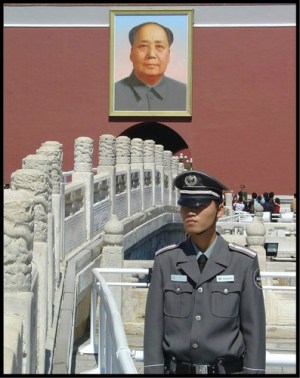
Throughout its imperial history Tiananmen was the place for issuing imperial edicts, making proclamations of state celebrations such as the enthronement of an emperor or imperial marriages and the place were sacrifices were held and prayers said before the emperor led his soldiers into battle.
It is rather ironic that the last imperial edict, announcing the abdication of the “Divinely Appointed Son of Heaven”, the last Qing Emperor of China, Puyi, on December 25, 1911, was issued from Tiananmen.
In more recent times, on 1 October 1949, Mao Zedong claimed victory over Nationalist Chinese leader Chiang Kai-Shek and proclaimed the existence of the People’s Republic of China, with himself as leader, from a rostrum on Tiananmen.
The most recent, post Qing Dynasty, additions to Tiananmen are of course the large portrait of Mao Zedong (replaced annually) and two large placards, the left one reading: “Long Live the People’s Republic of China” and the right one reading: “Long Live the Great Unity of the World’s Peoples.”
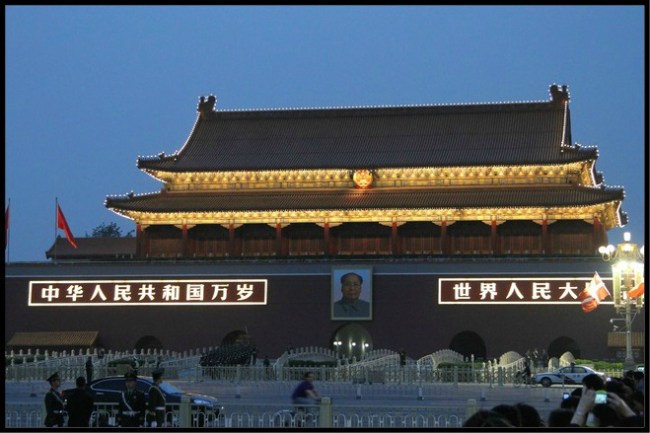
I should mention that prior to Mao Zedong’s portrait, portraits of Sun Yat-sen and Chaing Kai-shek have adorned the south wall of Tiananmen. Interestingly, for a short time following his death in 1953, a portrait of Joseph Stalin joined that of Mao Zedong on the Gate. Lest you be tempted to tamper with the Chairman’s portrait, be aware that dissident Yu Dongyue, who attacked the portrait with eggs during the Tiananmen Square protests of 1989, served 17 years imprisonment for his efforts.
Since November 1987, Tiananmen Tower has been open to the public but I have yet to go inside so won’t comment on the interior here, not having seen it.
Even without going inside there is a tremendous amount of history linked to this Gate and I cannot imagine anyone going to Beijing and not wanting to visit it.
This blog entry is one of a group (loop) of entries based on a number of trips to Beijing. I suggest you continue with my next entry – Huabiao – Keeping an Eye on the Emperor – or to start the loop at the beginning go to my Beijing Introduction.
 The Rambling Wombat
Absolutely must visit. The view from the top of the tower and look over the square!
LikeLiked by 1 person
17 years for egg-throwing is a bit harsh, in my view
LikeLiked by 1 person
No-one has done it since !!!!
Don – I had to delete (and replace) my review ‘A New Dawn – China Sees Red’ on which you commented. Unfortunately your comment got deleted in the process. Please feel free to revisit.. and comment again.
LikeLike