

While I lived in Papua New Guinea (1989-91) I attended many shows or sing sings, as the locals called them, and in this way became acquainted with numerous tribes wearing traditional dress, performing traditional dances and taking part in other rituals. The annual Port Moresby and Goroka shows were especially good for ‘tribe collectors’.
There was one very famous tribe, the ghost-like Asaro Mudmen, which never turned up at any of the shows I attended. I decided that if they wouldn’t come to me I would have to go to them. 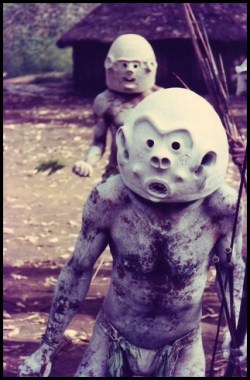 This is exactly what I did but to do so I had to book onto a tour (one of the few commercial tours I took in PNG) and in those days this could only be done via the Bird of Paradise Hotel in Goroka. I can’t recall how much the tour cost but it wasn’t cheap.
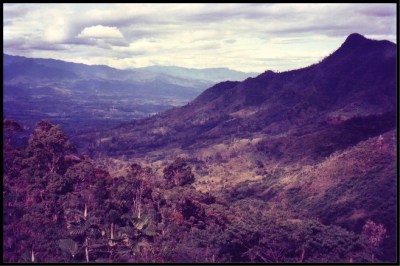
Our tour commenced with a drive, from Goroka, up to the top of the Daulo Pass to view the beautiful Asaro Valley prior to going down to the village of Komunive, home to the Mudmen, in the valley below – all up around 20 kilometres from Goroka.
As I recall, there were only 3-4 other people on the tour. Today, I read that the number of Mudmen seen is often in direct proportion to the number of kina-paying tourists – one to one. As such, it looks like we got a good deal with a two to one ratio, back in the early 1990s!
Legend has is that once, when the local tribe had been attacked, those not killed or captured fled into the Asaro River to hide from their attackers. Here they became covered in the white river mud. When dusk fell they decided to return to their village, still caked in mud – though not deliberately so. When the enemy tribe, still in village, saw the now mud caked men they fled, believing them to be spirits or the avenging ghosts of the villagers they had earlier killed.
In the longer term, believing the river mud to be poisonous, the Asaro people stopped covering their faces with it and instead made masks from various material – clay from the 1970s. Yes, at around 2cms thick they are heavy.
Some records have it that the Asaro tribemen used their ‘new weapon’ not only to ward of other attacking tribes but also to embark on a reign of terror over their neighbours, killing thousands of people. Whether this is true or not, I don’t know, but it was not something the Mudmen referred to during my visit.
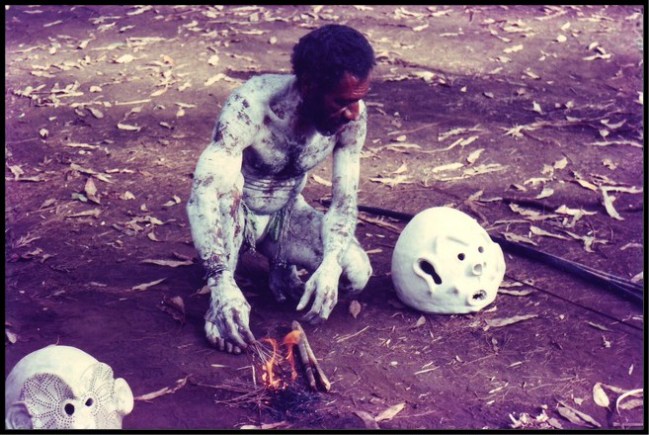
During our short village tour we were treated to war dances and a fire lighting display.
Even tough I had earlier seen pictures of the Asaro Mudmen it was still something of a shock when they appeared out of the jungle brandishing bows and arrows and spears and made straight for us. Their dance, if I might call it that, was far from elaborate. The movements were slow and haunting, because the legs of a Mudman are said to be broken, having the brittleness of postmortem bones. The leaves they carried were used to make swatting movements to scare off imaginary flies attracted by their rotting flesh.
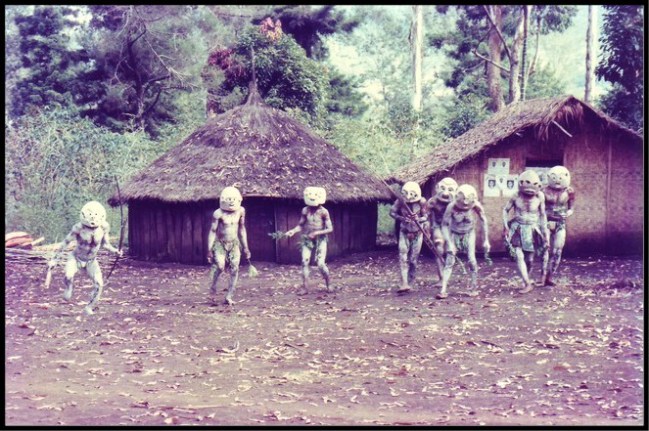
I can imagine how an enemy, which had never seen or heard of the Asaro Mudmen, would have felt on encountering these ghostlike creatures, especially in the fading light at dusk.
The legendary Asaro Mudmen’s first encounter with the Western world wasn’t until the 1950’s. They soon became a symbol of PNG, seen in newspapers, in brochures and on television, not only in PNG but around the world. They have taken to advertising all sorts of things so you should not be surprised that the Asaro Mudmen drive Toyota Landcruisers and enjoy Pepsi! In 1972 Pink Floyd recorded a track called Mudmen, believed to have been inspired but the Asaro Mudmen..
I should point out that some, though not all, anthropologists have questioned the authenticity of the Mudmen, deriding them as manifestations of colonial administration and the tourist dollar.
Regardless of their origins, the Asaro Mudmen have brought fame and fortune to Ruipo Okoroko and his Asaro clan and my brief encounter with the Mudmen, in their village, in the Asaro Valley was one of the highlights of my time in Papua New Guinea.
Address: Komunive Village
Directions: About 20 kms from Goroka (towards Mr Hagen), Eastern Highlands Province.
This blog entry is one of a group (loop) of entries based on a couple of years living and working in Papua New Guinea. I suggest you continue with my next entry – JK McCarthy Museum – Goroka – or to start this loop at the beginning go to my introductory entry – Papua New Guinea – Personal Memories.
 The Rambling Wombat
Can you please include the tribe’s hierarchy???!!!!???
LikeLiked by 1 person
Thanks for looking it. Sorry I don’t have those details.
LikeLike
Incredible! Must have been amazing to see.
LikeLiked by 1 person
An amazing sight in country filled with amazing sights.
LikeLiked by 1 person
Amazing sights!
LikeLiked by 1 person