


I have to say I was rather surprised when I visited Caldragh Cemetery on Boa Island, Lower Lough Erne. For many years I have seen just close-up pictures of “Janus” and the “Lusty Man” (properly referred to as the Boa Island and Lustymore figures respectively) and accordingly, or for whatever reason, assumed them to be at least a couple of metres high. On entering the cemetery I could not see the said figures. Wandering around I happened upon them – Janus being about 73cms tall and the Lusty man about 60cm – sitting in the centre of the graveyard among random stones that mark long-forgotten dead. A nearby base – which some think belongs to Janus – would, if that were the case, increase its size to nearly 2 metres.

Let not size detract from the sculptures. Having come to terms with that, I was actually quite taken by them both in their current location – certainly something mystical here. I set to imagining what the graveyard would look like in a low lying fog or mist – it’s that sort of place, without being creepy.
Both figures are generally thought to date from 400 – 800AD (Lusty Man being the oldest) – the early Christian period in Ireland – though it is by no means certain that either figure is Christian in origin nor is the reason for their creation known. In the event that they are early Christian, their creators certainly included older pagan features in the figures. Some suggest they are of pre-Christian bronze age origin.
The Janus figure is so referred to because of what appears to be a figure with two (pear shaped) heads with the interlacing between the heads being hair – again it may in fact be two back to back figures. Whichever it is, it certainly has no relationship to the more famous Janus – the two faced Roman God of Beginnings.
The Lusty Man – contrary to what its common name might suggest is not a stone age man with high levels of testosterone. Rather, its name derives from the fact that it was originally found sitting on its own on the nearby Lustymore Island. It was brought to Caldragh graveyard and erected beside Janus in 1939. Lusty Man may even be a female – only in Ireland!
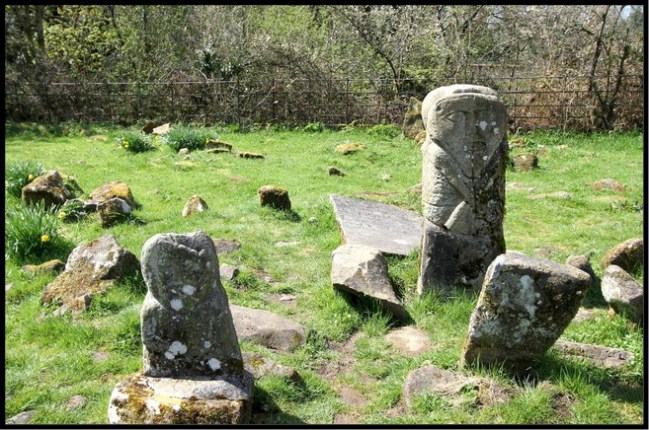
While I am explaining the names accorded these sculptures I should mention that Boa in Boa Island has nothing the do with snakes – my reader will recall that St Patrick banished these from Ireland in the 5th century. Boa derives from Badhbha, Celtic goddess of Battles. Some suggest that the Janus figure is in fact a representation of Badhbha given its location on the island.
The cemetery’s name Caldragh derives from the word caldragh which was often assigned to Irish cemeteries that were not consecrated ground (by the Christians). These cemeteries, including this one, thus might be pagan or places where unbaptised people or outsiders were buried.
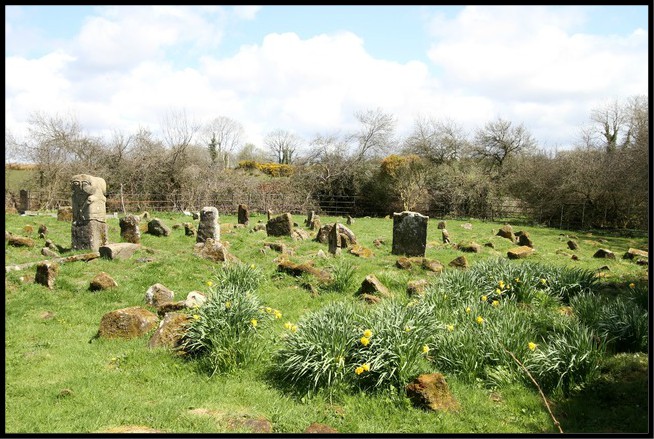
The turnoff (from the A47 on Boa Island) to the graveyard, located down narrow track, is marked with a small sign “Caldragh” and is easy to miss. Keep your eyes open – if you leave the island you’ve gone too far! Turn round and try again. Park by the farm buildings at the end of the track and enter the cemetery by a small marked gate.
Opening Time: 24/7
Entrance Fee: Free
Limited accessibility, uneven surfaces. This is a disused and overgrown cemetery.
Address: Boa Island, Lower Lough Erne
Directions: About 25km from Enniskillen. Accessible by road.
This blog entry is one of a group (loop) of entries based on many trips to Enniskillen. I suggest you continue with my next entry – Crevenish Castle – or to start the loop at the beginning go to my introductory entry – “Fare thee well Enniskillen, ………..”
 The Rambling Wombat
I remember being fascinated by these figures when you shared them with us on VT 🙂
LikeLiked by 1 person
Thank you for revisiting-:)
LikeLike