
Thankfully most of us have not lived in situations where we have been oppressed for most of our lives. We have not had our freedom taken away by tyrannical regimes, been incarcerated or exiled for crimes we did not commit, lost our loved ones without trace, been persecuted for our religious convictions or lost everything with no recompense.
Sadly this did not hold for the people of Latvia for half of the 20th century while they suffered horribly at the hands of Soviet and German occupiers.
At the end of World War I Latvia gained independence from Russia which stated in a peace treaty that it
“unreservedly recognises the independence and sovereignty of the Latvian State and voluntarily and forever renounces all sovereign rights to Latvian people and territory”.
The Museum of the Occupation of Latvia (1940 -1991) portrays life (such as it was) in Latvia and the impact of totalitarian regimes on the country during the three periods of occupation between 1940 and 1991.
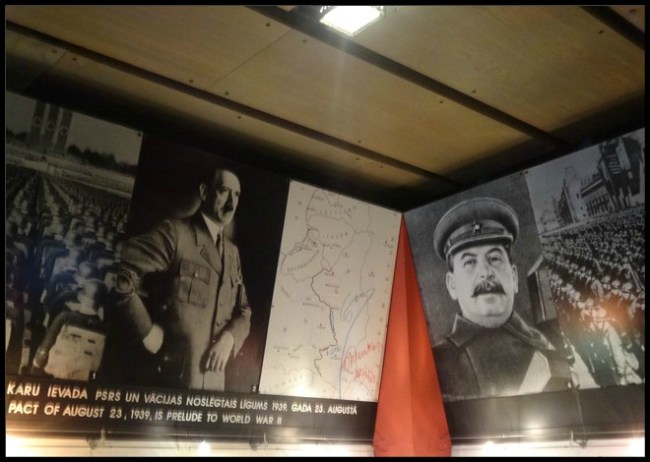
The first part of the museum shows how ‘forever’ didn’t last long and relates how Hitler and Stalin entered into a secret non-aggression pact in August 1939 whereby Eastern Europe was divided into spheres of Soviet and Nazi influence. The USSR agreed to ignore the German invasion of Poland which occurred on 1 September 1939 unleashing World War II. With the rest of Europe distracted, the USSR helped itself to Latvia and the other Baltic countries, enforcing its rule through fear, intimidation, imprisonment, torture and execution.
Exhibits go on to explain how Nazi Germany drove the Red Army out of Latvia in 1941 to ‘liberate it’ from Soviet tyranny. All that happened in reality was that the jailer had changed and, in addition to the enforcement tactics used by the USSR, Germany added one of it own – the Holocaust or the Final Solution. In the three years Germany occupied the country 65,000 Jews were murdered including 25,000 on 30 November and 8 December 1941, in or on their way to Rumbula Forest near Riga.
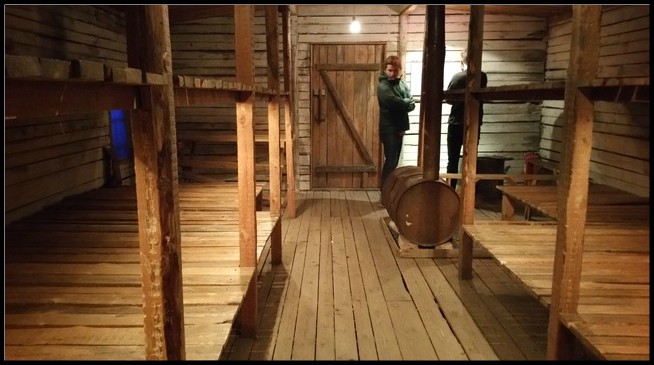
The museum then outlines how as the War ended in 1944 Russia returned as self declared liberators. Latvians anticipated that this visitation would be short-lived, expecting to rely on the Atlantic Charter of 1941 which provided for self-determination of nations to reject territorial changes made against their wishes. Sadly for Latvia, Britain and the US accepted Stalin’s view that the Charter did not apply to his ’indivisible USSR’. So commenced another 46 years of subjugation and iron fist rule for Latvia.
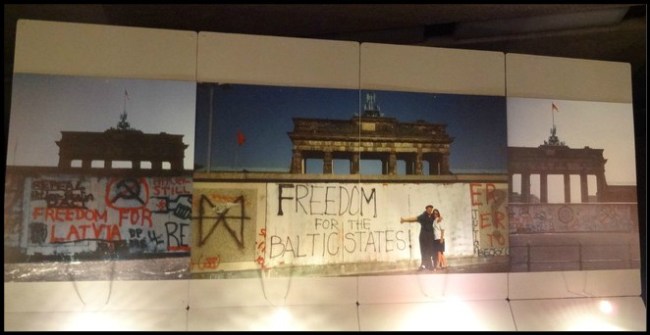
The final part of the museum deals with the relaxation of oppression under Gorbachev’s Glasnost in the late 1980’s, the rise in activity by those seeing independence from the Soviet Union and how Latvia finally gained its independence in 1991.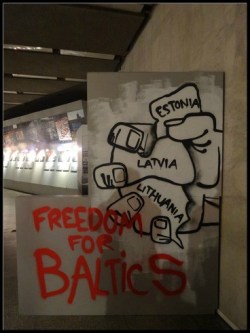
As stated on one of the museums exhibits:
‘During the periods of Soviet and German occupation, Latvia lost 550,000 people, or more than a third of its population. This is the number who were murdered, killed in battle, sentenced, deported, scattered as refugees and who disappeared without a trace’.
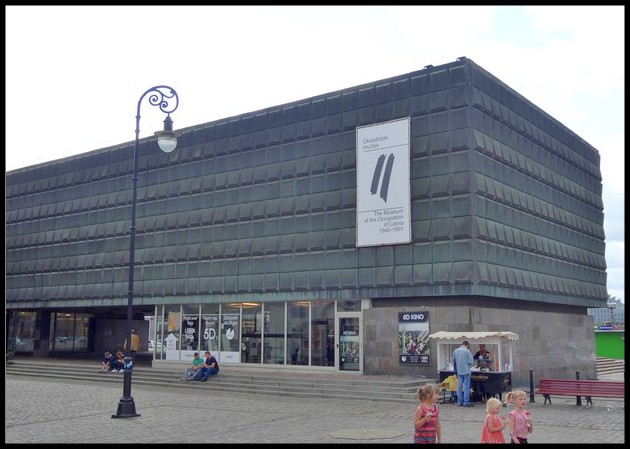
The museum’s home has got to be one of the ugliest buildings in Riga and indeed, in my humble opinion, a ghastly blight on the otherwise visually stunning Town Hall Square. Yet, it has a certain charm.
It also has an interesting history. It was built in 1970 by the Soviets as a museum to the Red Latvian Riflemen and was complementary to the Red Latvian Riflemen Monument unveiled in the adjacent square, also in 1970. For more detail on the Latvian Riflemen see my separate review – the Latvian Riflemen Monument. Promptly after Independence in 1991, the Red Latvian Riflemen Museum was closed. The Monument survived though it was re-badged.
When I visited in August 2015 the museum was undergoing a major refurbishment and exhibits seemed to be rotating between the Square of Latvian Riflemen (off Town Hall Square) and the former US Embassy building at Raiņa bulvāris 7.
The Museum’s website indicates (Jan 2016) that the main museum building has been closed for renovation since 1 November 2014 with a temporary exhibit open at Raiņa bulvāris 7. Other sources support the view that only the temporary exhibition at Raiņa bulvāris 7 is currently open (Jan 2016). Senile as I may be getting, I am absolutely sure that I visited the museum at its Square of Latvian Riflemen location in August 2015, as depicted in my main picture, and this is to where it will return when renovations are competed.
When you visit Riga do locate this most interesting, yet confronting and depressing, museum and visit it.
Opening hours
Until renovations completed – uncertain
Entrance fee
By donation – though tours are available at very reasonable prices.
This blog entry is one of a group (loop) of entries on the Old City area of Riga. I suggest you continue with my next entry – Latvian Riflemen Monument – or to start the loop at the beginning go to my first entry – SamaraH Hotel Metropole – Riga.
 The Rambling Wombat
Such is the perils that small states face.
LikeLiked by 1 person
Very true.
LikeLiked by 1 person