
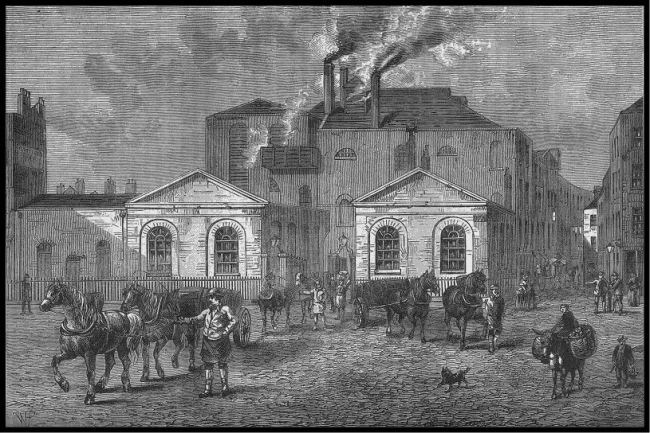
My review on the Great Dangaroo Flood introduced my reader to a memorial plaque in Old Compton Street, Soho commemorating a totally fictional flood. This review covers another great London flood which, while sounding equally fanciful, was a real event. I refer to the Great London Beer Flood.
At around 6pm on 17 October 1814 a 15 feet high tsunami of around 1.5million litres of beer unleashed itself from the Horse Shoe Brewery (depicted above in the mid 1800s), owned by Messrs Henry Meux and Co, in the St Giles district of London – the present day site of the Dominion Theatre.

In an attempt to reduce the impact of oxidation in its porter (a dark beer akin to stout) the brewery had installed oak fermentation vats of ever increasing size – larger vats having an all important smaller surface area to volume ratio. These vats held as much as 18,000 standard 36 imperial gallon barrels of beer (nearly three million litres) and like a standard beer barrel they were held together with iron hoops – which in themselves weighted tonnes. The Brewery’s largest vats were major tourist sites in their own right.
 On that fateful evening as the poor and destitute, living in slum like conditions (the infamous St Giles “rookeries”), in the vicinity of the brewery were starting to prepare their evening meals, many in their basement tenements, a vat containing 3550 barrels of maturing porter exploded causing other adjacent smaller vessels to give way too. The resultant pressure caused the back wall of the brewery to be blown out. Within seconds New Street and several others in the vicinity were deluged in beer. Two houses were destroyed with many more damaged though the worst impact of the flood – the loss of life, through literally drowning in beer – came as a number of basement tenements flooded.
Some years later an American visitor related in an article in The Knickerbocker (New-York Monthly Magazine) how “All at once, I found myself borne onward with great velocity by a torrent which burst upon me so suddenly as almost to deprive me of breath. A roar as of falling buildings at a distance, and suffocating fumes, were in my ears and nostrils.”.
Eight people lost their lives during the Great Beer Flood including four Irish immigrants who were attending the wake for a 2 year old child in one of the basement tenements.

Reports have it that another dozen or so people subsequently died of alcohol poisoning caused by consuming copious amounts of the free porter which they collected during the deluge. These and similar later reports of ‘besotted mobs flinging themselves into gutters full of beer, hampering rescue efforts’ are not substantiated by any contemporary evidence.
An article in the Bury and Norfolk Post nine days after the event recorded that “When the beer began to flow, the neighbourhood, consisting of the lower classes of the Irish, were busily employed in putting in their claim to a share, and every vessel, from a kettle to a cask, were put into requisition, and many of them were seen enjoying themselves at the expense of the proprietors.” This was not reported in any London paper (none of which were fans of the local Irish community) and was likely written by a reporter in an office in Bury St Edmunds without any first hand knowledge of the event..
Above said, I suspect a few hangovers did ensue for those partaking of the free beer.
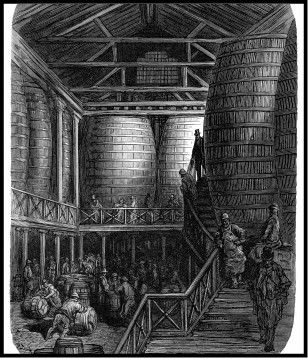
The subsequent inquest into the deaths concluded that the first vat had exploded because the rivets in a critical hoop somehow loosened causing it to slip down. Other hoops followed in quick succession. As the beer was in its final stages of production jurors agreed that the accident could not have been occasioned by the fermentation process having gone wrong, that natural process having been completed in this case; besides, an explosion due to fermentation would have caused an upwards force which would have merely blown off the flap at the top of the vat, so designed for that purpose. The jury agreed that the pressure caused by the initial vat exploding caused various other receptacles full of beer to likewise explode and the cork to pop from another vat. In all around 8 – 9 thousand barrels (upwards of 1.5million litres) of beer flooded the streets around Tottenham Court Road.
The brewery was found not to be culpable in the deaths occasioned by the beer flood. The jury returned a verdict of ‘Died by Casualty Accidentally and by Misfortune’ – in simple terms an Act of God. The brewery was able to recover excise duty it had paid on the lost beer and consequentially was able to continue trading.
Tastes in beer changed over the 19th century and the preferred “stale” porter produced in these massive vats fell out of favour such that by the 1890s the big vats were being dismantled. The oak from the vats was recycled into pub bar-tops. Quite possibly there are still pubs in London whose bars are made out of old porter vats. I throw out a challenge to my London readers to find one!
The Horseshoe Brewery moved to Nine Elms in 1921 (itself now the site of New Covent Garden Flower and Vegetable Market) and the Dominion Theatre, which occupies most of the former brewery site, opened in 1929.


I spent some time looking around the Dominion Theatre for a plaque commemorating the Great Beer Flood but found none. I have subsequently learned that all attempts by the Brewery History Society and others to have a plaque installed have come to nothing. Requests to the American owned theatre have not been responded to – I suspect related to the theatre’s association with the Hillsong Church which uses the theatre as its church each Sunday. On the other hand the Camden Historical Society, inside whose borough the site now sits, has taken the extraordinary view that “not enough people died” to make installing a permanent memorial worthwhile. While perhaps not an entirely fair comparison, only six people are recorded as having died in the 1666 Great Fire of London.
Location: Dominion Theatre – Intersection of Tottenham Court Road and Oxford Street
 The Rambling Wombat
Another great read
LikeLiked by 1 person
Fascinating!!! Great post :)) Dawn
LikeLiked by 1 person
Thank you so much. I am glad you liked it.
LikeLike