

It is amazing, in some many ways, to think that in a city the size of London with so many things to see and do that I would actively seek out and write a review on a coat hook. Well I did and here it is!
Prior to actually telling you about the hook, and I feel one of my diversions coming on, a little background or perhaps a long-winded explanation as to why there should be a Metropolitan Police coat hook attached to this particular building, is in order.
London’s (and the world’s) first traffic light was installed, at Westminster, in December 1868. The signal, based on the railway system, was a combination of a red and green light and a semaphore and came with police instructions, posted in the vicinity of the light itself.


I do like the article published in The Express on the day before (8 December 1868) the signal came into operation:-
“In the middle of the road, between Bridge-street and Great George-street, Westminster, Messrs. Saxby and Farmer, the well-known railway signalling engineers, have erected a column 20 feet high, with a spacious gas lamp near the top, the design of which is the application of the semaphore signal to the public streets at points where foot passengers have hitherto depended for their protection on the arm and gesticulations of a policeman – often a very inadequate defence against accident. The lamp will usually present to view a green light, which will serve to foot passengers by way of caution, and at the same time remind drivers of vehicles and equestrians that they ought at this point to slacken their speed. The effect of substituting the red light for the green one and raising the arms of the semaphore – a simultaneous operation – will be to arrest the traffic on each side.”
While the gas operated signal, which still required a policeman to operate it, met with some initial success that success was short lived. 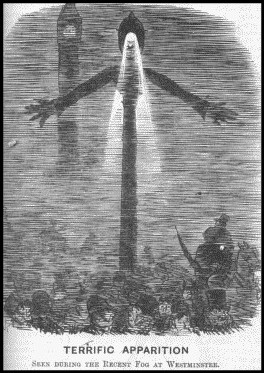 Many simply didn’t understand the semaphore aspect, others ignored it altogether, others were scared by it (Punch cartoon alongside) and it constantly broke down. Approaching Westminster Bridge a cab passenger is reported as having asked his driver what the thing ahead was. ‘Another o’ them fakements put up to wex the poor cabbies,’ was the reply.
Less than a month after its installation, in January 1869, a gas leak caused it to explode badly burning its police operator. This, ongoing breakdowns and the fact that it proved to be of little practical value in easing the flow of traffic and pedestrians lead to its removal within a few months and the good people of London once again ‘depended for their protection on the arm and gesticulations of a policeman’.
Traffic lights did not return to the streets of London until 1926 when the three-colour signal system we are familiar with today was installed along Piccadilly. While the lights themselves were electric they were still manually operated, from towers in the middle of the street. The first vehicle – activated signals were installed at the junction between Gracechurch Street and Cornhill in the City, in 1932. As luck(bad) would have it, these lights were destroyed by a gas explosion!
Back to the coat hook.
Right beside No.4 Great Newport Street, where the hook is located, is a busy six point intersection (Long Acre, St. Martin’s Lane, Upper St. Martin’s Lane, and Great Newport, Cranbourne, and Garrick Streets). Even with the introduction of traffic lights here around 1930 Metropolitan Police(men) – as they invariably were at that time – were still needed to operate the lights and to provide the public, which remained sceptical of these new fandangled devices, a bit of encouragement to comply with their directions. Particularly in summer, this point duty could be hot work and the police on duty needed somewhere to hang their heavy regulation coats and capes.
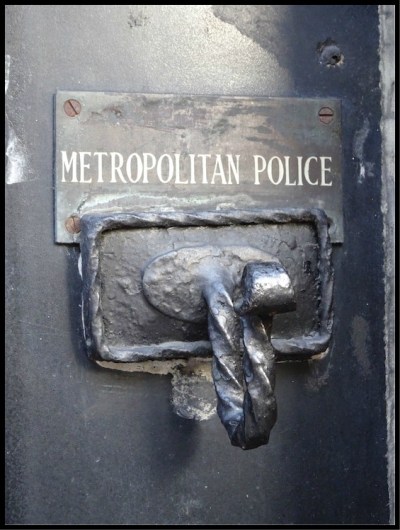 As it happened, when the lights were introduced at this intersection, No.4 Great Newport Street was undergoing extensive renovation and the workmen provided a nail for the convenience of the police on duty. When renovations were completed the nail disappeared.
A word with the owners of the property lead to the installation of this rather ornate wrought iron coat hook, replete with a small engraved plate signifying who it belonged to.
This is the only public Metropolitan Police coat hook in existence and while it has outlived the needs of the traffic police it has become an important part of London’s transportation history as well as being one of the 20,000 odd points of interest which would-be black cab drivers are expected to be familiar with for ‘The Knowledge’, the test they must pass to become a black cab driver.
A few hours after seeing this hook I visited the City of London Police Museum (separate review). The City of London Police patrol the City (or the square mile) while the Metropolitan (Met) Police cover the remainder of London. Coincidentally, in the museum I came across the coat rack with two hooks, depicted below.
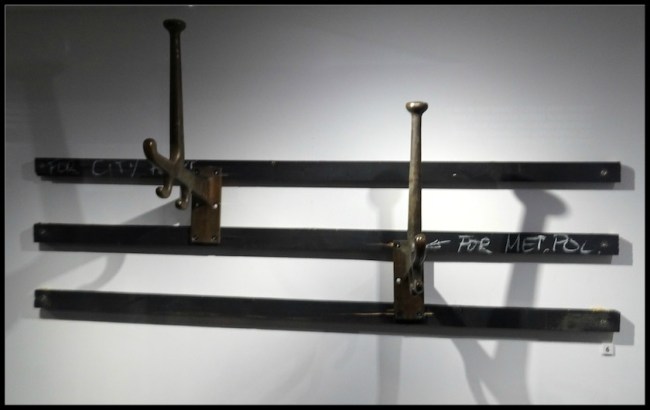
The higher hook on the left has been marked ‘For City Police’ while the lower one to the right has been marked “For Met Police”. The coat rack was originally located in a City of London police station and the markings there-on are a joke, at the expense of the Metropolitan Police, based on the fact that to join the City of London Police you had to be a minimum of 5’ 9” inches high while 5’ 7” was sufficient for the (by implication, inferior) Metropolitan Police.
There you have it, two coat hook stories for the price of one!
Location: Metropolitan Coat Hook – 4 Great Newport Street, (Leicester Square Tube.
 The Rambling Wombat
Something else completely new to me despite (again!) passing that spot hundreds of times, if not thousands!!
LikeLiked by 1 person
Maybe some glasses or new ones ! (my powers of observation can’t recall if you have glasses or not!)
LikeLike
Talk about the pot calling the kettle black! If you haven’t even noticed whether I wear glasses, despite having met up very recently (I don’t btw, except for close work) then you can hardly comment on [b]my[/b] eyesight!!
LikeLiked by 1 person
That was meant to be a bold ‘my’ – that formatting works on TP and I forgot I was elsewhere 😉 So now you can have a dig at my memory too lol
LikeLiked by 1 person
Lol – I didn’t think you did.
LikeLike
Would you believe me if I told you that I visited the City of London Police Museum the weekend that we met recently
LikeLiked by 1 person
Bet you didn’t have to share it with around 30 school kids !
LikeLike
Well I never! You live and learn.
LikeLiked by 1 person
Well now you know ! 🙂
LikeLiked by 1 person
You had me hooked!
LikeLiked by 2 people
lol
LikeLike