

The Cenotaph, a grey granite obelisk, was unveiled on ANZAC day in 1926 to commemorate soldiers from the town and district lost in World War I. Due to a cost overrun, the memorial cost £1,050, there was insufficient funds remaining in the kitty to have the names of the missing soldiers inscribed on the obelisk. Almost half of the £1,050 was contributed by spectators at the Memorial’s opening.

The memorial sat “nameless” until 1987 when funds were found to inscribe the names of the 53 soldiers lost in WWI, together with those of the 30 lost in WWII. The memorial also commemorates, without naming them, those lost in Korea, Vietnam and other wars and conflicts since WWII.

In 1996 the diorama within the cenotaph enclosure was added (together with the plaque which had previously been located in Centennial Park). 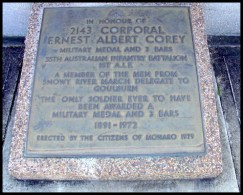 I have to say, while I have seen some excellent military dioramas (including many at the Australian War Memorial in Canberra) I have never seen one used as a memorial before. This diorama was created by local sculptor Chris Graham (who also created the beautiful mosaics on the Time Walk at Centennial Park) and the Nanny Goat on Nanny Goat Hill).
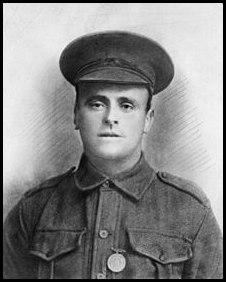
The diorama depicts the life of Corporal Ernest Corey as a stretcher-bearer in France during WWI and is based on a picture in the Australian War Memorial depicting stretcher-bearers saving wounded soldiers under heavy shellfire at Mont St Quentin during WWI.
Corey enlisted in the Australian Imperial Force in January 1916 after marching from the Snowy Mountains to Goulburn, some 200kms away, to do so. Corey went on to become the only soldier in the British Commonwealth to have ever been awarded the Military Medal and three bars (essentially four Military Medals). He won two in 1916 and a further two in 1918 for aiding wounded soldiers in his role as stretcher-bearer. Corey, who not only survived the war but lived to 1972 (81yrs old), always took pride in saying that, as a stretcher bearer, he was decorated for saving life, not taking it.

Corey’s medals can be seen in the Australian War Memorial in Canberra.
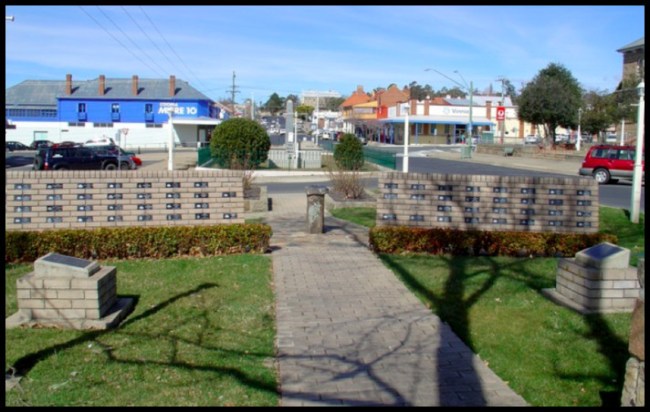
Continuing on further into Vale Street (20 metres) and again in the central reservation you will come across the Monaghan Hayes Place and various memorial walls. Monaghan Hayes was the first Cooma serviceman killed in WWI (Gallipoli, 31 July 1915). Commemorated in this area are specific individuals (including Hayes) as well as branches of the Australian Armed Forces in general.
*Lead picture – credit to Martin Butterfield – Creative Commons Attribution 4.0+
Address: Corner of Masse and Vale Street, Cooma
My next Cooma review– HERE
Return to the beginning of my Cooma reviews – HERE
 The Rambling Wombat
I like that too – very effective.
LikeLiked by 1 person
That diorama is unusual – I like it! And I’m sure it brings the point of the memorial alive for younger people much more clearly than the list of names, important though that is.
LikeLiked by 1 person
Totally agree, Sarah.
LikeLike
I’ve never seen a diorama used as a memorial before either. I’m glad to see that enough funds were found to complete the names of those who lives were lost in the two world wars. I t would be nice to see the other names in the other wars added at some point too.
LikeLiked by 1 person
Better late than never.
LikeLiked by 1 person