
I have done this circular walk a number of times and prefer doing it in an anti-clockwise direction, contrary to the recommended (signposted) route. Don’t worry you won’t get lost and it’s a great walk in either direction, I just prefer to walk the longer, less steep, downhill section first-up with a shorter steeper finish.
Either way, the 3.4 kilometres, relatively easy, walk commences at London Bridge car park, as do all but one of the walks in the southern part of the Googong Foreshores reserve. The car park is about 40 kilometres from the centre of Canberra, about 45 minutes drive.
While the walk is neither long nor overly difficult I recommend you ‘sign in’ on the register as you leave the parking area – and then do not forget to ‘sign out’ on your return.
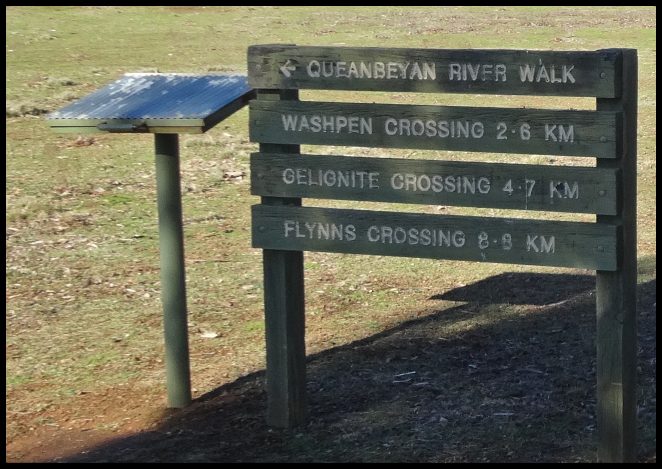
Having signed in, if you have not signed out by the reserve’s closing time park rangers will come looking for you, lest you have had an accident. Mobile phone coverage is patchy along this walk and, especially if you walk during the week, you may be the only walker/s on any particular day.
Having signed in, I made my way up a slight incline and after about 50 metres veered right, onto the management track which would take me directly to the London Bridge Homestead. The homestead is named after the London Bridge Arch, which in turn is named after a rather more famous bridge in London, United Kingdom.
The management track is well formed and meanders along, above the Burra Creek. While I didn’t see any to-day, sightings of kangaroos are common along this section, as they are along the whole walk.
After a short distance (400 metres from the car park) I came across a sign, on my left, directing me to turn left for London Bridge. I ignored this and continued on towards the homestead.

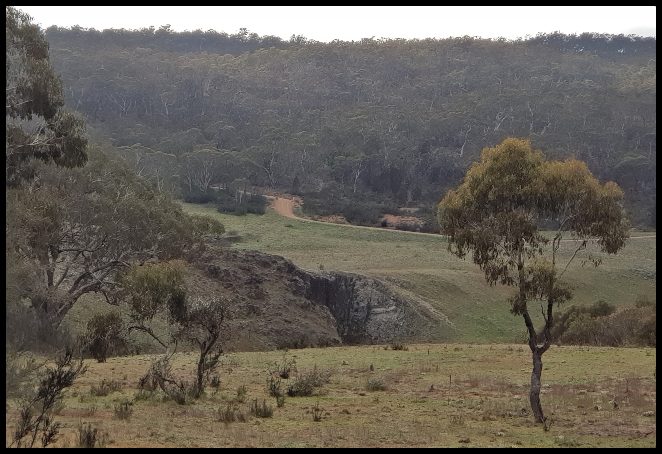
A short distance on, looking down towards the creek, I got good, though distant, view of the London Bridge Arch which I would visit on the return leg of this walk.
After a few minutes I came upon another sign, again giving me the option to turn left for London Bridge. This is the route for cyclists wishing to bypass the homestead and head straight for London Bridge, cycling not being allowed on the track I passed earlier.
Again, I carried on and very soon could see a group of tall trees down by the Burra Creek with the homestead buildings partially visible on the other bank, about 1.5 kilometres easy walking from where I had parked my car.
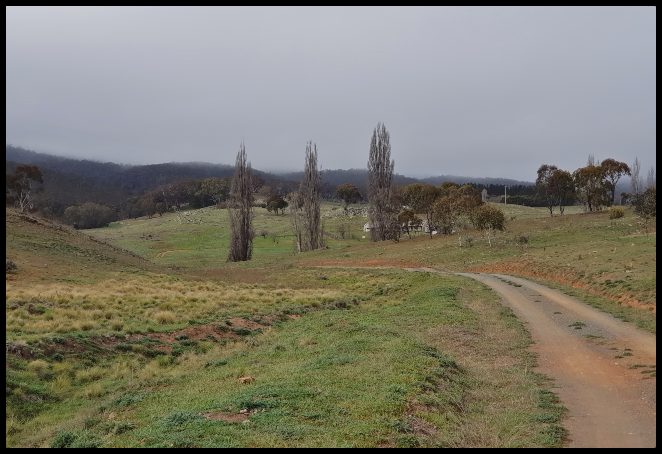
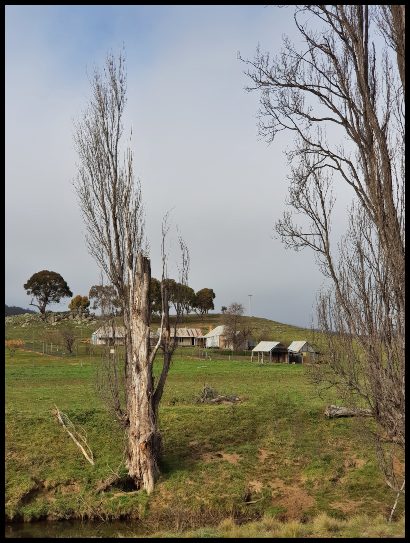
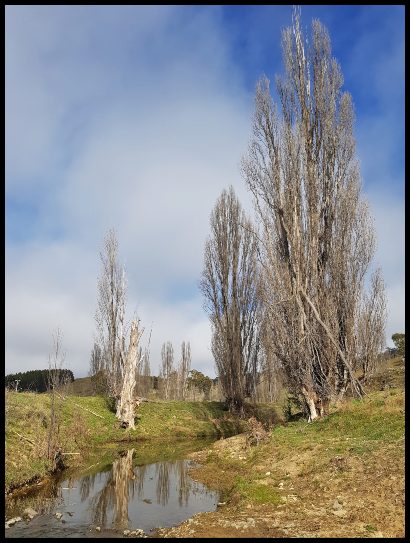
Having crossed the creek, via a foot bridge, I soon had an uninterrupted view of the London Bridge Homestead.

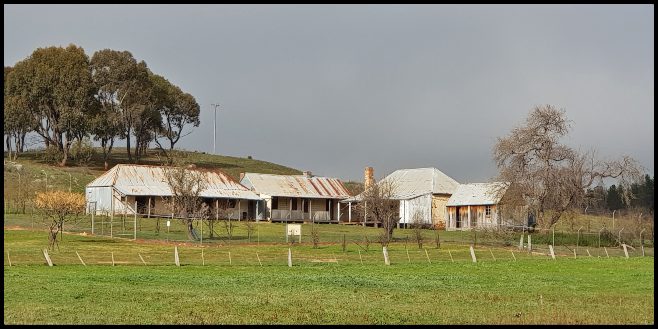
As I approached the homestead, almost miraculously, the sun broke through, clearing the early morning fog, to expose yet another beautiful Canberra late winter/early spring day.
‘London Bridge’ was one of the first European settled properties in this area and was acquired under crown lease in 1857 by John McNamara, a native of County Clare in Ireland. McNamara paid what now seems quite a lot at the time, thirty pounds, for 30 acres. However, it wasn’t long until he had extended the property into a holding of thousands of acres, establishing a very successful sheep station.
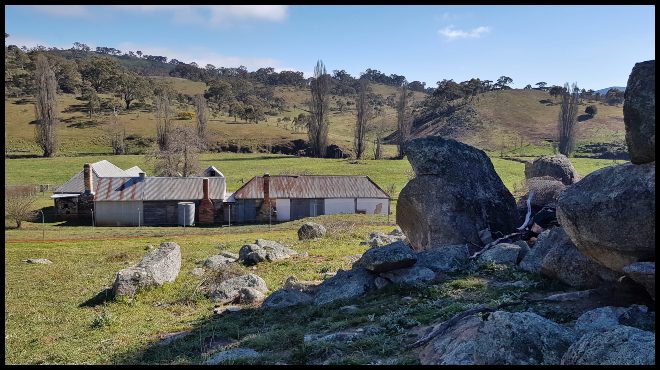
What makes this property especially interesting is the different architectural styles and building materials used in the five buildings making up the residential core of the property. While some of the outer buildings can be accessed (see below) the core buildings are located behind a high wire fence, for security and preservation reasons, and are only open to visitors on rare occasions. That said, one can get sufficiently close to fully enjoy the properties any day of the year.
The first building constructed on the property was the cottage with stone walls of about 40 centimetres thick. This was built in around 1860 using stone quarried from a nearby hill. The original shingle roof remains intact but today it is hidden beneath a corrugated iron roof to preserve it.

Like many of their era, John McNamara and his wife were prolific procreators and produced thirteen off-spring. While not all of the children lived on the property all of the time it had to be extended as the family grew. The next addition to the property was the small timber slab hut to the right of the original stone cottage. This was added at some point in the 1860s.

The largest building in the cluster was added in the 1890s, a timber and mud structure. Here the walls were constructed by nailing small split slats of timber to heavier timber frames. These walls were then filled with mud and covered with a mixture of horsehair and mud and finally whitewashed with lime.
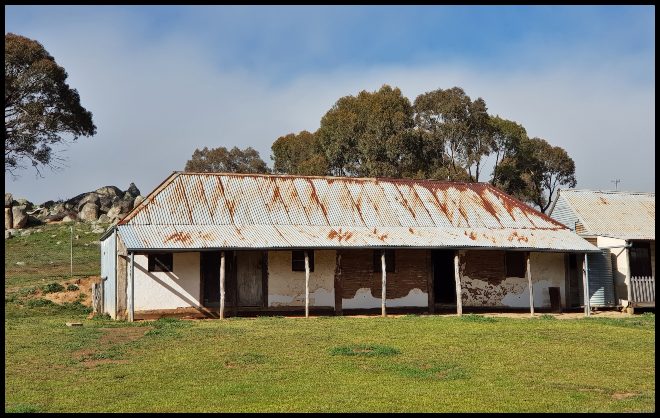
Between this building and the original stone cottage a weatherboard kitchen was constructed in the 1920s with a fibro cement annex added to the right hand side of the kitchen in 1954, completing the ensemble we see today.

While John McNamara died in 1901 the property stayed in the family until 1920 after which a couple of other families (Noone and Douglas) owned the property, then around 9,000 acres, until 1973 when it was resumed by the Commonwealth of Australia to protect the catchment area for the soon to be created Googong Dam – one of Canberra’s and nearby Queanbeyan’s main water supplies.
Near to the homestead and outside the perimeter fence there are a couple of old outhouses and bits and pieces of old farm machinery/implements worthy a look before walking a hundred metres more what remains of the property’s former woolshed.
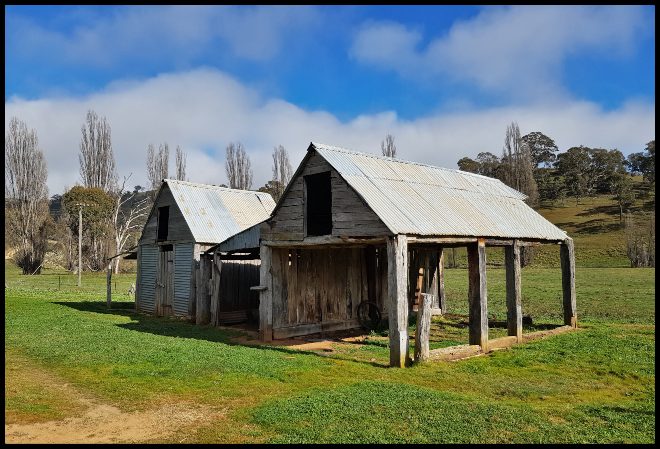


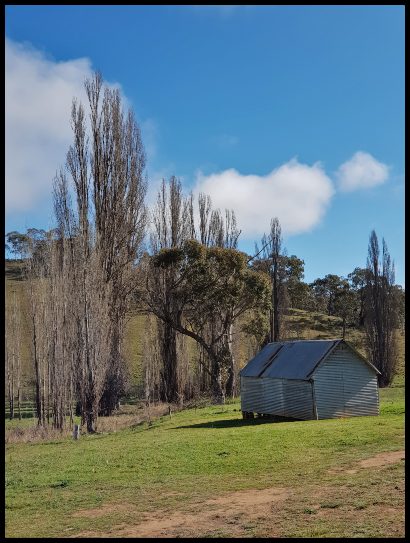
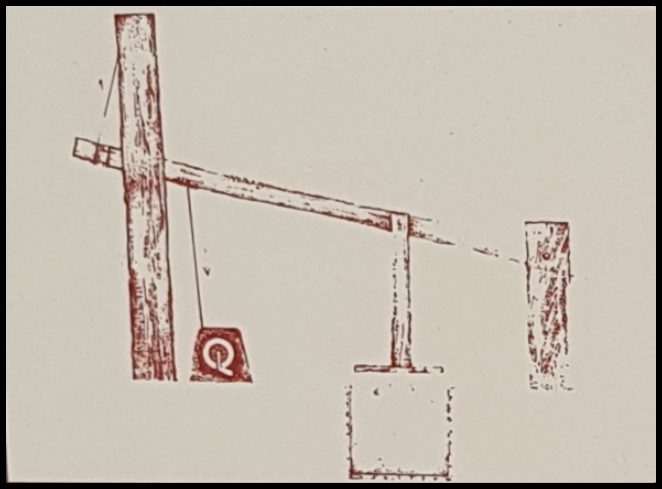
The woolshed, or rather the wooden posts that remain, dates from the late 1800s. What makes what is left especially interesting is the large upright post or fulcrum that would have carried the crossbeam of a woolpress, used to compress bales of wool in the timber lined pit below.

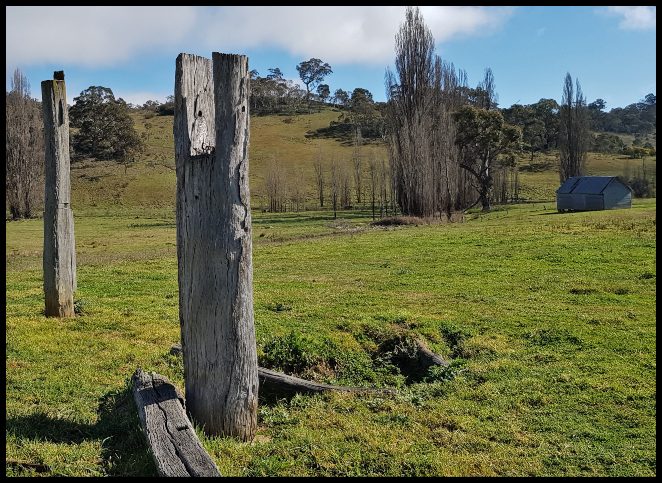
Leaving the woolshed, I headed up to the top of a small hill to the rear of the homestead, avoiding swooping magpies as I did.

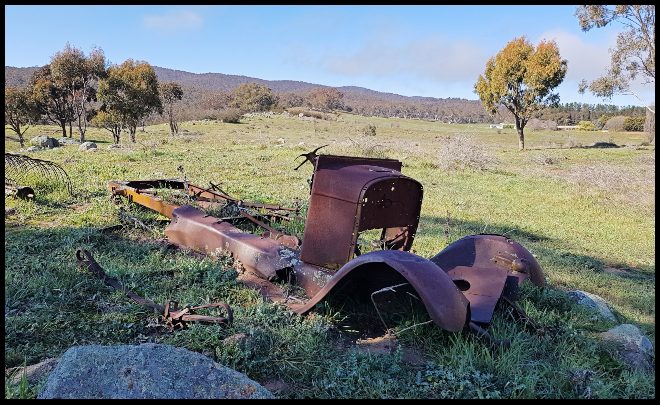
Up here, which would incidentally have made a nice picnic spot had I been so inclined, I had a great view back down onto the main homestead buildings and was also able to admire the remains of an old car and other miscellaneous farm machinery that have been dumped here.
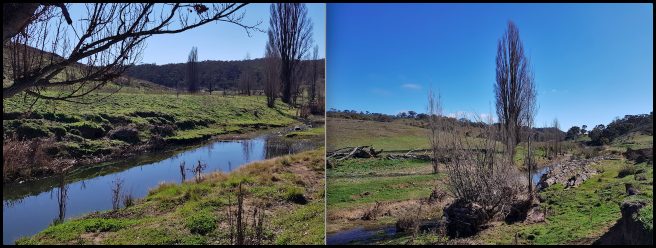
To get to London Bridge Arch from here I headed back down to the creek from which I had a good view back to the homestead, across a rocky outcrop.

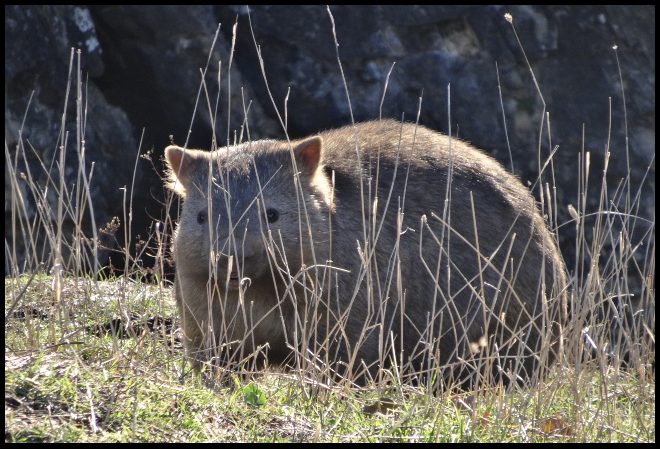
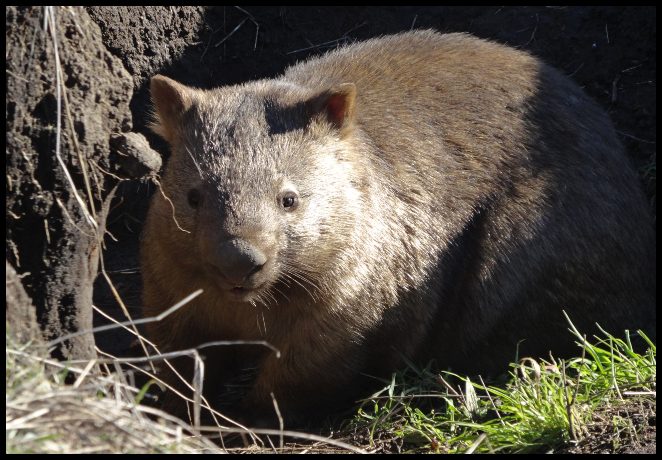
A couple of years ago, when I last walked along here I came across loads of kangaroos and wombats – sadly, nothing today. While there were lots of wombat holes the majority of them looked unused making me wonder if wombat numbers have significantly decreased in the area. I did read something about wombat mange (a mite infestation) in the area and saw evidence of a treatment programme in place. Hopefully numbers will increase again soon. The pictures below are from a walk I did here in 2016.

I continued along the creek in a north – northeasterly direction for about 300 metres before moving away from it onto a formed management track which I followed for a bit before returning to the creek and then along a well trodden path to the London Bridge Arch.


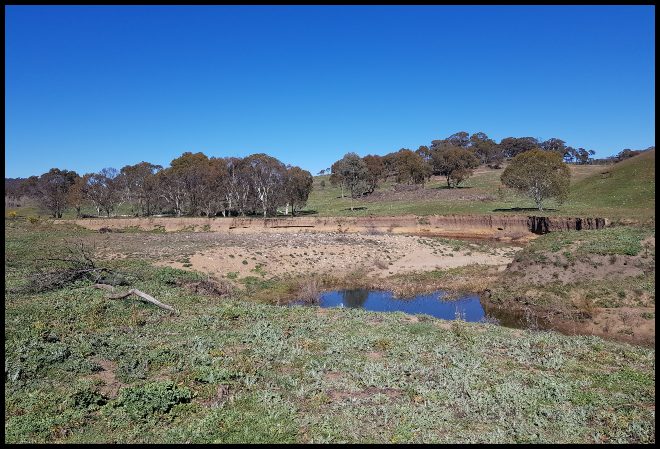

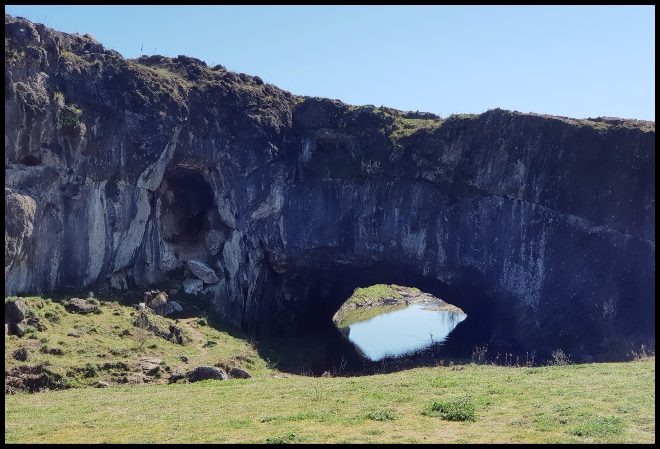
As I have provided fuller detail on the London Bridge in my London Bridge via Drawdown Crossing walk I will not repeat that information here.
At this stage you have a couple of options as to how you return to the car park.
Option A – Cross London Bridge and continue on up the hill until it reaches the management track, at which point you turn right and continue to the car park – all up about 700 metres with some nice views across the valley. This is the ‘official’ track that results in this being the 3.4 kilometres walk that I mentioned at the outset.
Option B – Continue walking along the creek from the bridge and return to the car park via Drawdown Crossing. This route is covered in my London Bridge via Drawdown Crossing walk. If you do this the total walk will be just under four kilometres.
My next Queanbeyan review– HERE
Return to the beginning of my Queanbeyan reviews –HERE
 The Rambling Wombat
Uesd to live in the homestead with my brother and mum and day my mum used milk the cows in the shed with the yard there was a hay shed next to the house to we had a kerosene fridge in the house . They used grow Lucerne hay on the flats down from the house it made lovely hay to .some times the creek used flood . But most times ok we used take Billy carts up the top of the road and run them down it was great times there
LikeLiked by 1 person
Thanks for sharing Alan, glad my review brought back this pleasant memories. It is a lovely spot.
LikeLike
Your welcome it was a great time there its good its been kepted my dad use ride his horse around mostly there .
LikeLiked by 1 person
Interesting place to visit..with the Title I thought it was London LOL 😆
LikeLiked by 1 person
An easy mistake to make 🙂
LikeLike
Interesting post.
LikeLiked by 1 person
Thank you.
LikeLiked by 1 person