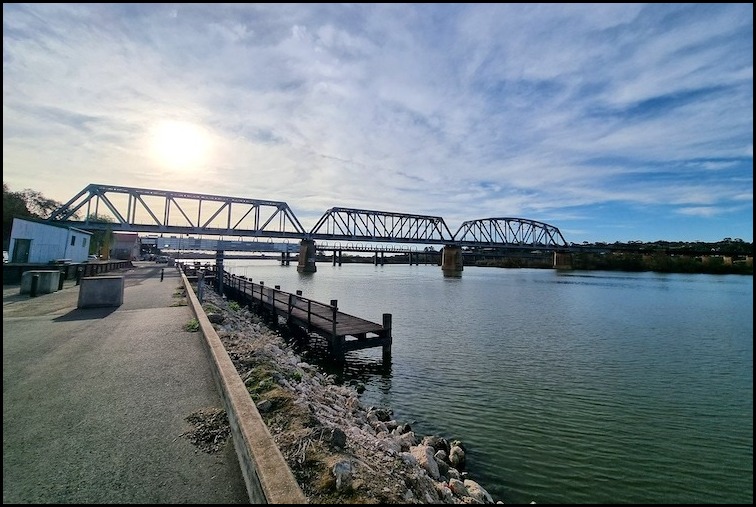
The city of Murray Bridge is situated on the lower reaches of the Murray River – the third longest navigable river in the world, after the Amazon and the Nile. It is about 80 kms from the South Australian state capital of Adelaide. Surprise, surprise its name derives from a bridge built across the River Murray in 1879. The city is a typical rural hub surrounded by a major agricultural area focusing on the dairy industry, chicken raising, pig breeding and vegetable growing. From a tourist perspective the main attractions are paddle steamer trips along the river and a visit to the nearby Monarto Safari Park.
I have written a separate review on my visit to Monarto Safari Park and unfortunately there were no day trips available on the paddle steamers when I visited. In addition to the two key attractions a walk around the city centre and along the river is worthy of ones time and that is the focus of this entry.
I started (and finished) my walk at the excellent combined visitors information/ Local Government centre outside of which is a very impressive mosaic sculpture which tells the Ngarrindjeri Dreamtime story of how the River Murray was created. The Ngarrindjeri people are the traditional aboriginal owners of the land around Murray Bridge.
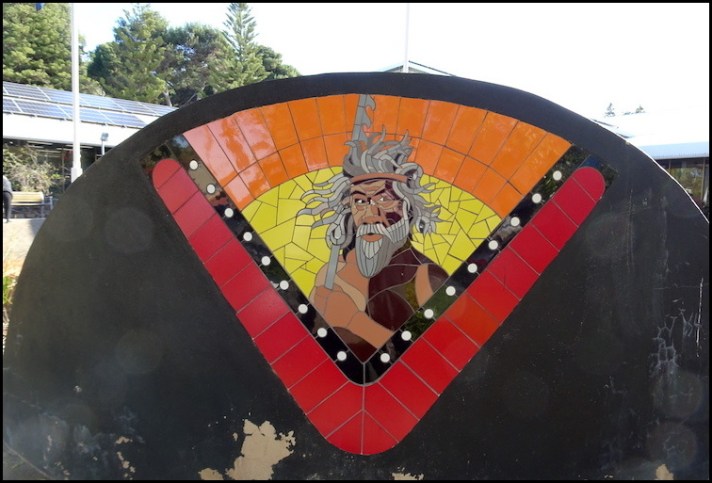
Ngarrindjeri
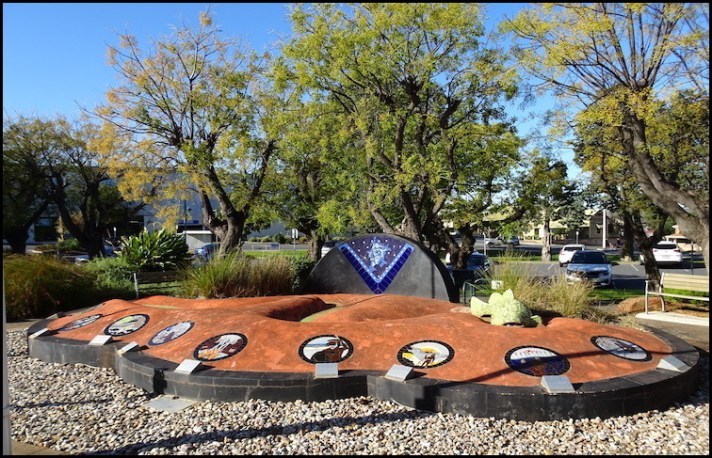
The Ngarrrindjeri Dreaming story tells how:
‘Ngarrindjeri travelled downstream in a bark canoe, in search of his two wives who had run away from him. A giant cod fish (Ponde) swan ahead of Ngarrindjeri, widening the stream with sweeps of his tails. Ngarrindjeri chased the fish, trying to spear it from his canoe. The sweeps and loops of the chase created the Murray River.’
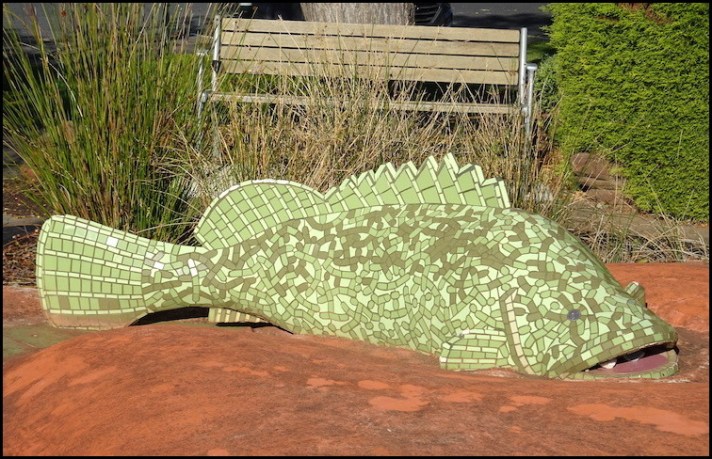
Giant cod (Ponde)


Additional mosaics illustrating the longer story.
From the visitors centre I moved on, via Seventh Street the commercial main street of the city, to Sixth Street where a number of historic buildings and a modern art gallery can be found. First up I encountered the rather imposing Town Hall building, originally deisgned by Adelaide based architects AS and FH Conrad (better known as designers of schools and churches), and built in 1911. Since then various refurbishments have occurred including the addition of the clock tower in 1953. The building has had as many uses over the years as it has had refurbishments and today it is a performing arts and function centre with the local council functions having relocated to the Local Government centre referred to earlier.
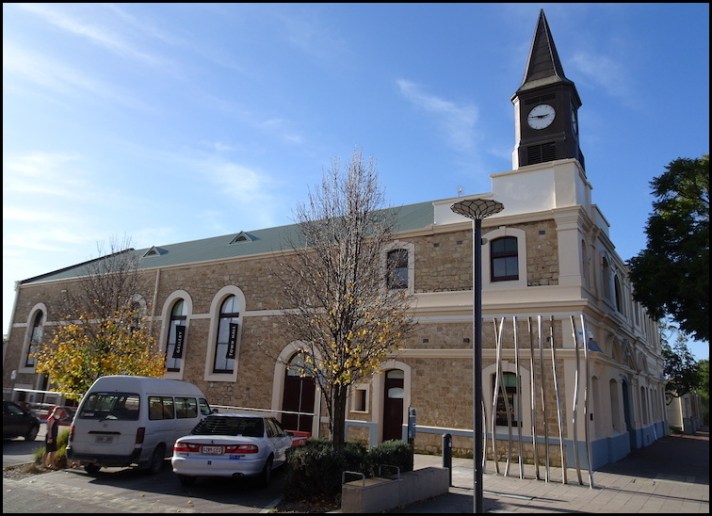
Former Town Hall
To the rear of the former town hall, on Sixth Street, is the small Murray Bridge Regional Art Gallery. When I visited the exhibits on display were the entrants for the 2023 Youth Art Prize. There was very much a focus on modern art and some pieces on display were better than others. My favourite pieces included the following:-
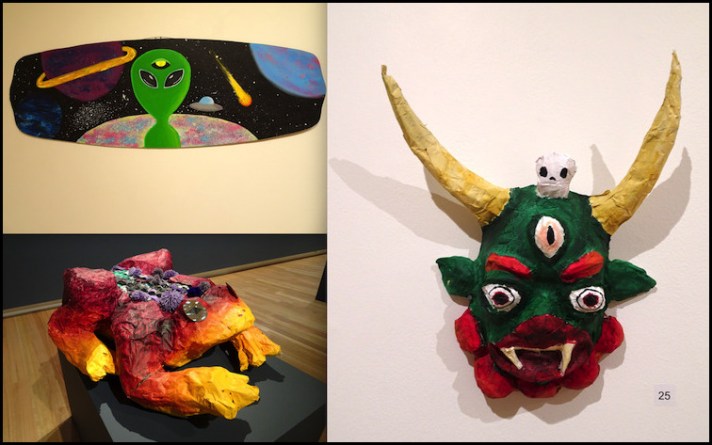
I wonder how my selection will fare, if at all, when judging takes place towards the end of August 2023.
Across the road from the gallery is the Murray Bridge Hotel, arguably the haunt of a different set of artists to those exhibiting their efforts across the street!
Originally, on the site of the hotel was Mrs Cornish’s Murray Bridge Coffee Palace, established in the late 1880s, a time when the temperance movement was particularly active in Australia. When SA Brewing bought the property in 1913 it opened the Murray Bridge Hotel which is now a heritage listed building.

While taking photographs in the street outside the hotel I was approached by a rather agitated gentleman who had just parked his car in a three hour parking spot. He was concerned that I was a parking inspector intent on photographing his number plate to return later and give him a ticket. I assured him I was not and happy that this was the case he headed into the pub, presumably intent on a session somewhat longer than three hours.
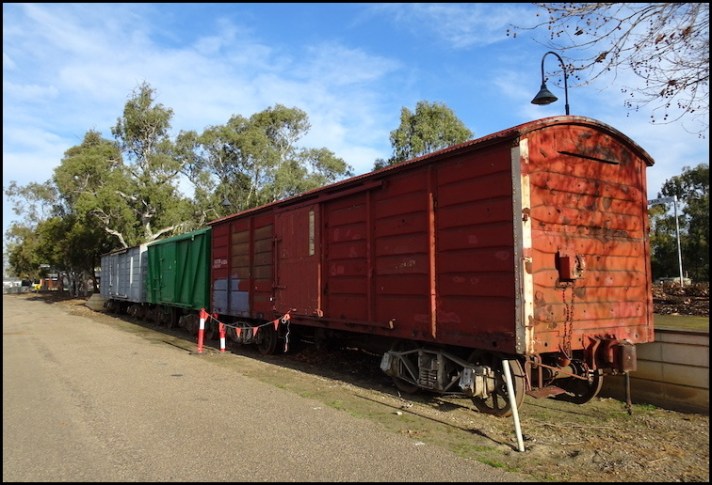
While many old pubs in the Australian Outback are struggling to survive lots, particularly those that move with the times in terms of food quality, are thriving. That is more than can be said of the Australian railway system and my next stop the local (former) railway station. Sadly, in Australia, non-commuter passenger train travel, outside a few luxury journeys well beyond the budget of most people, is pretty much a thing of the past. Freight business is not faring much better.
Following the opening of a rail bridge across the Murray River in 1879 Murray Bridge became a busy railway town being the main locomotive depot and administration centre between Adelaide and the Victorian border. By 1983 control of the railway signals and points here were handled by Adelaide and Murray Bridge faded into railway history. To-day only one passenger service, ‘The Overland’, which runs twice a week between Adelaide and Melbourne passes through (and stops) at Murray Bridge which is now an unmanned platform with the former station building (built in 1886) well and truly closed. Part of the former station is now a vibrant youth centre while the former main station building and refreshment rooms sit derelict on the platform.
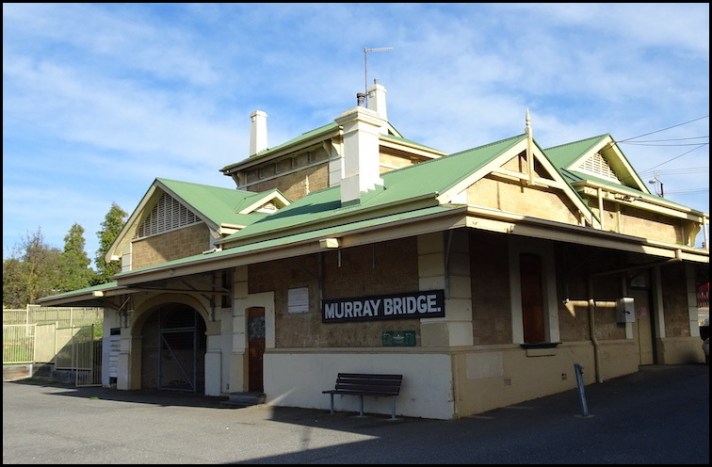
Former main station and refreshment rooms.

Part of the former station now a youth centre.
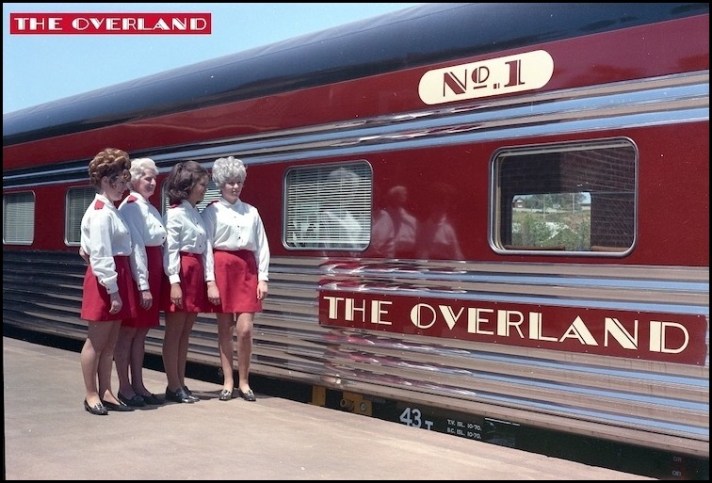
The Overland – An earlier livery – I am guessing the 1960s – I am including this picture because I like the hairdos and uniforms of the attendants! Photo credit https://undertheclocksblog.wordpress.com/.
A little further along and affording an excellent view over the Murray River and the towns two bridges is the historic Round House. Built in 1874 this unusual hexagonal (as opposed to round) shaped residence was the home of Henry Parker, superintendent overseeing the construction of the first road bridge to cross the Murray River. Since completion of the bridge in 1879 the building was used for various community purposes until bought by the city in 1988 and restored to it original condition.
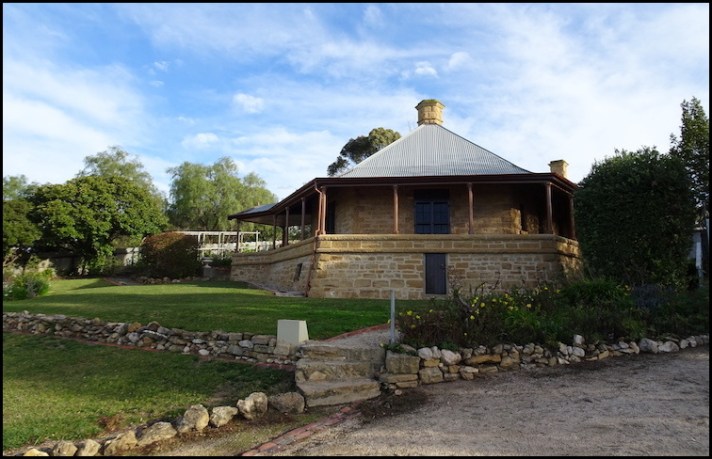
The Round House

View of the two bridge across the Murray from the Round House. The road bridge on the left currently being refurbished.

An almost identical shot to the one above taken in 2012. Photo Credit: Wikipedia User: Bahudhara.
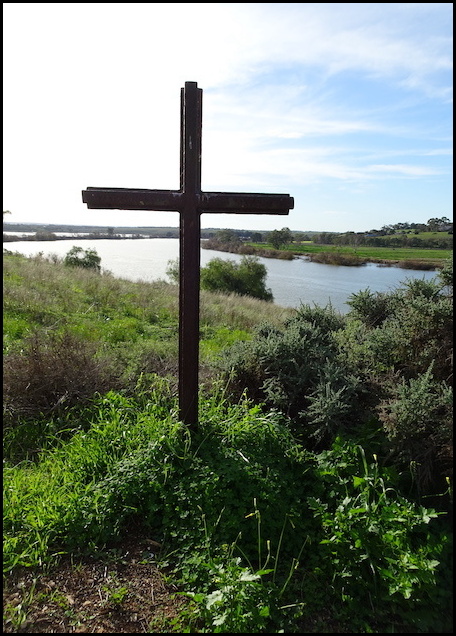
In the well tended gardens of the Round Rouse with the river as a backdrop, there is a cross, modelled from railway tracks, and various memorial plaques commemorating people who have taken their own lives. One plaque seeks that they be remembered for who they were and how they lived and not for how they died. Very touching.
The road bridge, on the left in the pictures above, was built of iron between 1873-1879 and is 603.5 metres in length. The bridge became a shared road and rail bridge in 1886 and remained so until 1925 when a separate railway bridge was built – the one on the right in the pictures above.

Bridge builders take time off for a photo. They appear to be adding the railway line, so this photo would date from 1886. The original picture source is unknown to me.

The same bridge today recalling that the railway line was removed when the seperate railway bridge was built in 1925
Having made my way across the road bridge and down to the city’s wharf precinct a little further downstream, I was able to get a few better shots of the bridges, particularly the railway bridge.
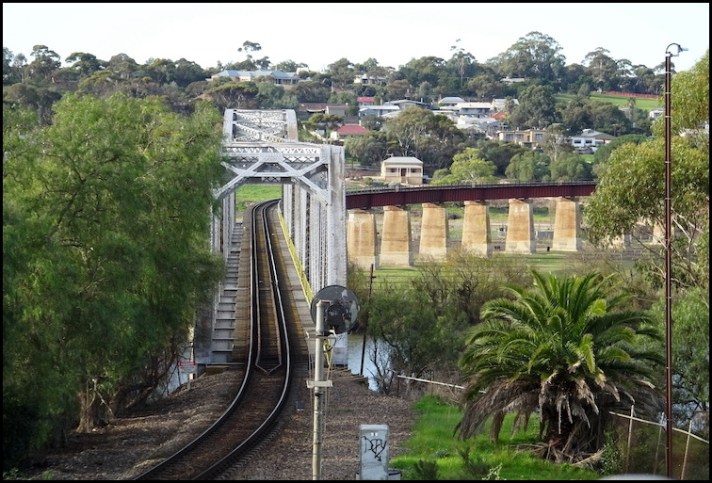

Walking along the riverside here there are a number of reminders of former times when this area was a bustling wharf, a time when the River Murray was a major inland highway for pastoralists, settlers and travellers.
At its peak, the port boasted a wharf structure about 350 metres long with two railway lines along its entire length. More than six cranes were used for the transfer of freight, and such was the volume of traffic that up to 16 trains a day would come and go.

The last remaining section of the 350 metres wharf. Currently closed due to damage in the 2022/23 floods
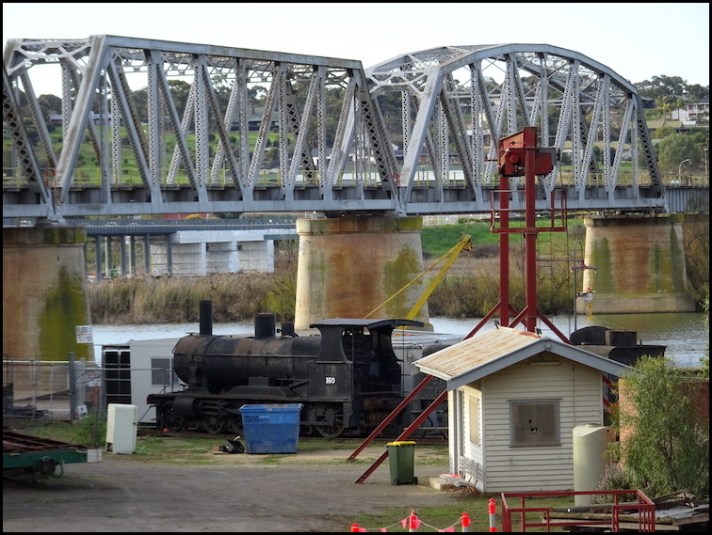
The old steam locomotive, in the picture above, was decommissioned in 1969 and affords another reminder the river’s rail history.
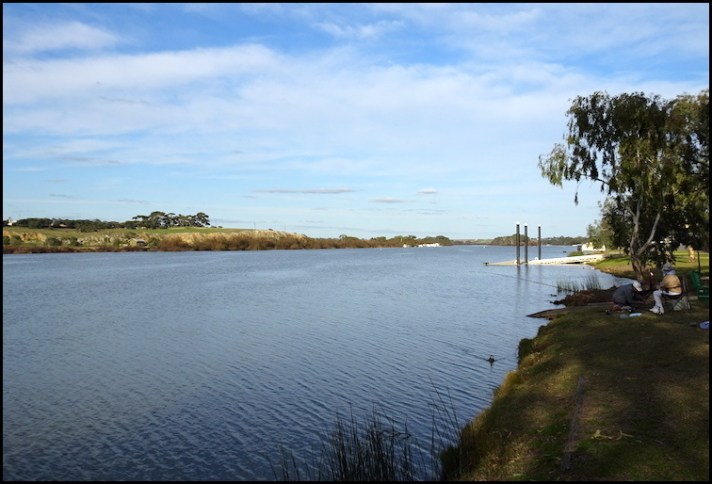
Leaving the wharf precient behind I carried on downstream through the Sturt Reserve, a modern park area with kids playgrounds, a skate park, bbqs and the excellent Murray Bridge Community Club where I dined the evening before. Today I was more taken by the views of the Murray as I wandered through the park to what would be my final stopping point, prior to a short walk back to the visitors information centre.

I started this review with the aboriginal story on how the River Murray was created and I will end it with a cautionary aboriginal warning of how the Bunyip (Mulyawonk) will get you if you foolishly swim alone in the river or take more fish from it than you really need.
“The Bunyip (Mulyawonk)
To the Ngarrindjeri people the Bunyip is known as the Mulyawonk.
Whilst the Mulyawonk Creation Story may vary from Lakalinyeri (clan) to Lakalinyeri (clan), the Ngarrindjeri Mulyawonk Creation Story in part says,
In times long ago there lived a Ngarrindjeri Korni (man) who was greedy catching far too many fish than he needed to.
The Elders were not happy with this selfish man who did not respect the Ngarrindjeri laws of fishing.
The Elders were so angry with this man that as a punishment they turned him into the Mulyawonk – a half fish, half man creature and banishing him to the river forever.
Ngarrindjeri children are told never to swim alone or to take more fish than you can eat from the river and lakes.
If you do swim alone or are greedy in taking too many fish, then the Mulyawonk will get you.
This story teaches children water safety and respect for the fish of the river and lakes.
One home of the Mulyawonk is in a river cave near Tailem Bend.
The word Bunyip has its origins from the Wemba-Wemba or Wergaia language of Aboriginal people of South-Eastern Australia.
It can be said that during European occupation, Aboriginal people warned Europeans of the dangers of river and lake swimming and that certain areas were prohibited to visit, for if you did, you would fall victim to a Bunyip (the Mulyawonk on Ngarrindjeri Ruwi (land) and Ngarrindjeri Moorundi (river).”
Today the automated Murray Bridge Bunyip can be called from its slumbers under the water via the press of a green button on the side of its cave in the Sturt Reserve – no need to swim in the river or overfish!

The Bunyip slumbers
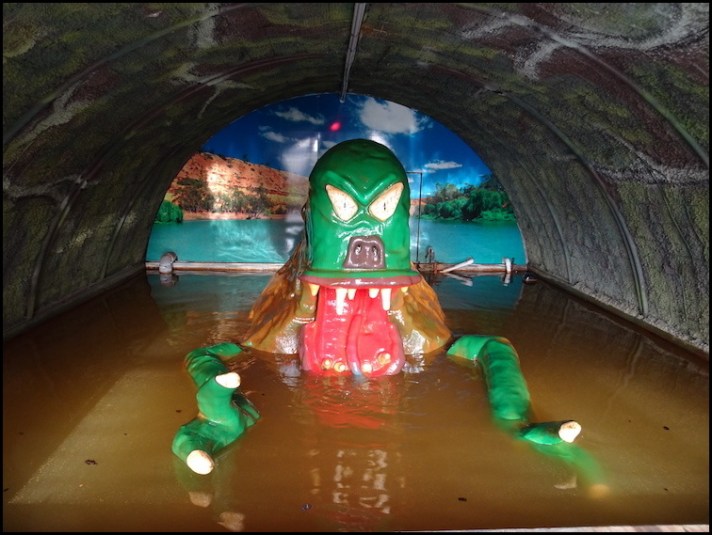
The Bunyip awakened
The next review from my Adelaide to Canberra road trip can be found HERE.
Should you wish to follow this road trip from the beginning please start HERE.


I liked the mosaics a lot. My concern about the gentleman parking is not the potential overstaying of his three hour slot as such – more what state will he be in if he spends the time in the pub and does he seriously intend to drive away!
LikeLiked by 1 person
I share your concern.
LikeLiked by 1 person
A shame about the paddle steamer but this walk looks like a fair substitute. I loved the Ngarrindjeri mosaic and enjoyed both the traditional stories. Do we know if he managed to catch the giant cod?! As for the ‘Bunyip awakened’, wow, I reckon he could scare even modern-day kids into not swimming alone!
LikeLiked by 1 person
I too love mosaics.. No idea if cod was caught! Accompanying the Bunyip’s rise is a load roar audible maybe 50 metres away and, yes according to a local lady who was there it has scared many kids though not sure if it affected their swimming habits. Kids (everyone ) in Australia loves to swim and kids are taught to swim from an early age.
LikeLiked by 1 person
The native stories and myths are stunning and interesting, fairy tales of another kind and perception of the world. In Germany we had the Grimm Brothers who collected such local telling in a here famous book. But you find of course much more in each German region which are very much different toll today. But why, the hell, do private “parking inspectors” exist everywhere in the world? Such stupidity is simply a waste of time, seemingly some people do not know how to use their free time in a reasonable and fruitful manner, what a pity and shame in general 😱
LikeLiked by 2 people
Not sure why he confused me as a parking inspector as here, to the best of my knowledge, they all wear distinctive uniforms.
LikeLiked by 1 person