
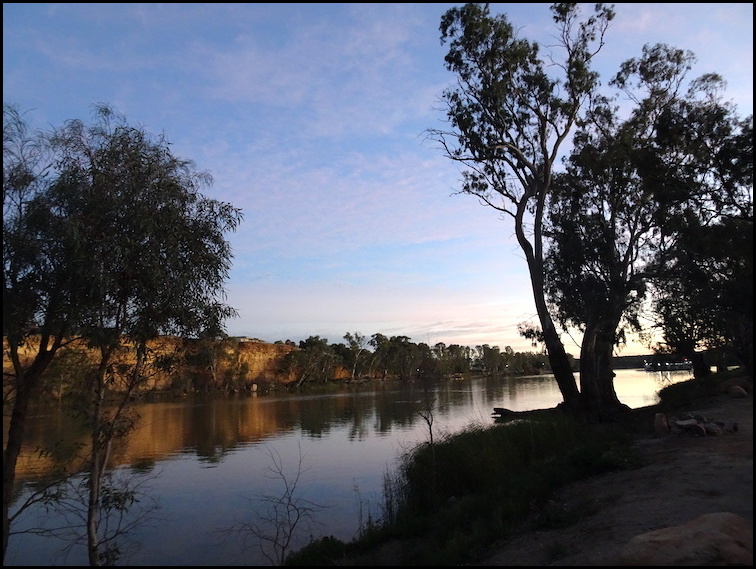
On completion of our short visit to Murray Bridge and having enjoyed walking along the river it was time to move on to Swan Reach hoping that we would snag a prime camping site right by the river.
As the mentioned in my last review there was renovation work underway on the Murray River road bridge and it was closed to traffic the day we were leaving. This meant that to empty our greywater tank at the town’s dump point, just across the river on the other side of the bridge, we would need to do a 20 kms round trip detour. Rather than do this we decided to carry the excess weight to another dump point about 40 kms along our route to Swan Reach, in a small village by the river called Bowhill.
At this point, for the benefit of my non caravanning/camping reader. I should explain (briefly) what blackwater, greywater and dump points are.
Typically when you go to the toilet in a self contained caravan what you do (ones and twos) is flushed into a tank, rather like those on an aeroplane though smaller! The contents of these tanks (typically called canisters) is referred to as blackwater. For obvious reasons there are fairly strict rules about where blackwater can be disposed off and in Australia (and most other places) this is into a dump point. In remote areas without dump points it should be buried. Given that, in addition to the obvious contents of these canisters, they also contain added chemicals to break down the contents and eliminate odours the contents cannot be dumped into septic tank toilet systems, long drop toilets, etc. These dump points that I refer to are liberally located around the country and like everything else these days there are numerous apps that identify their location.
Some newer caravans (including ours) do not require dump points for this type of blackwater as they have composting toilets and blackwater is not produced. Very briefly, with a composting toilet numbers one and two are deposited into separate sections of the toilet as produced. Gentlemen need to sit to do their number ones. No chemicals are used in these toilets. The number one container can be emptied pretty much anywhere within reason – into any toilet, by a tree, etc. In short, the number two container contains moistened peat moss and once you add your you know what to it a handle is turned to mix the two. Essentially the number two is composted and this container need only be emptied every couple of months (depending on use, obviously). At this stage the contents are sufficiently composted such that it can be bagged and dumped into any ordinary dustbin – not a recycling bin!
With that, for us, irrelevant, though hopefully interesting to my reader, explanation I move on to grey water.
When you have a shower, wash clothes, dishes, etc in a van, or indeed anywhere, you produce greywater. The rules around the disposal of greywater vary from country to country and certainly within Australia from council to council and caravan park to caravan park. Generally in Australia if it is disposed of immediately it can be run off onto the ground or onto nearby trees, flowerbeds, etc and many places, particularly where water for irrigation is scarce or non existent, actively encourage this. Other places, including the showgrounds we stayed at in Murray Bridge prohibit this and all greywater must be collected and taken off site. Our van is equipped with a grey water tank for this purpose.
Many people, when they leave sites, having collected grey water, dump it randomly by the roadside or worse, just open the release valve on their tank and let it flow out as they drive down the road. The problem is that when grey water has been stored for as little as 24 hours, it takes on the qualities of blackwater and should be disposed of in the same manner as blackwater.
In the majority of places we stay we are able to run greywater onto the ground or into nearby trees, etc. Where this is not permitted, including when we camp by rivers, etc we, were feasible, dump the grey water in a dump point. As so it was that on leaving Murray Bridge showgrounds we needed to find a dump point.
A dump point is a special hole in the ground, integrated into a towns sewage system or a tank in remoter areas, where black and greywater can be dumped. They take on various shapes and forms but the most common form is as depicted below.
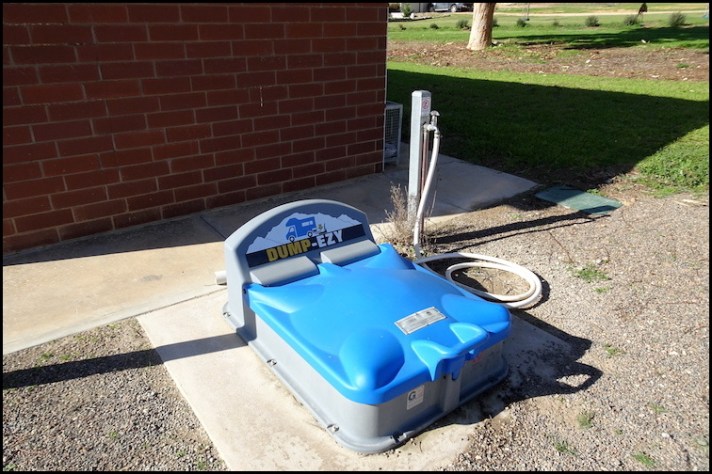
When we pulled into Bowhill the first thing we did was go to the dump point and empty our greywater tank.
While here, we had a quick look around the pleasant little village.

The Murray River at Bowhill with the first of its characteristic red cliff like banks we have come across on this trip.

The river looking downstream at Bowhill
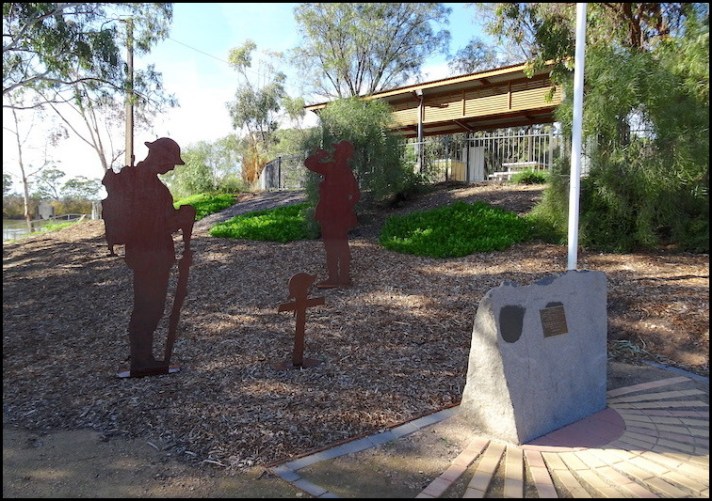
An unusual war memorial remembering those who served / died in various wars.
Just before lunch, we arrived into the only slightly larger village of Swan Reach, again on the banks of the Murray River. Based on some research, including examining the site via Google Maps satellite view, I chose the Tenbury Hunter Reserve as our potential campsite for the next few nights in the, perhaps forlorn, hope that we would snag a site right by the river and away from trees which would preclude us from being able to recharge our van batteries. I had one exact spot in mind.
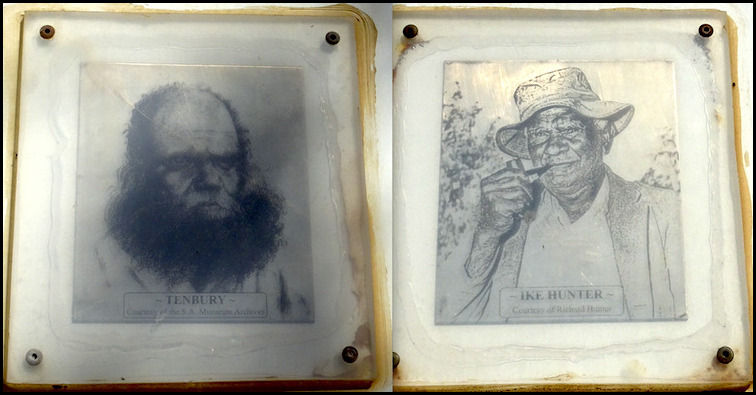
Messers Tenbury and Hunter after whom the Tenbury Hunter Reserve was named.
It was thus with some trepidation that we would not get the spot that I wanted or indeed be able to get a free spot at all that we waited to board the cross river ferry that would take us to the other side of the river where the campsite was located.
Waiting for the ferry to come from the other side I was struck by the white plaques affixed to the telegraph pole on the left in the picture below. These plaques showed the peak river levels in various past flood events. The one at the top indicated the peak water lebel in 1956 which would have been way above the roof of our 3.2 metres high caravan and the majority of the village at that time. Today a significant part of the village is high on a hill behind where we awaited the ferry. The recent 2023 flood level was indicated by the white line, just below the 1931 plaque and higher than an average car. As I mentioned on another post the 2023 floods did massive damage right along the river for over 1,000 kms and roads were closed for nearly six months with many homes and businesses lost. I can only imagine the havoc caused in 1956.

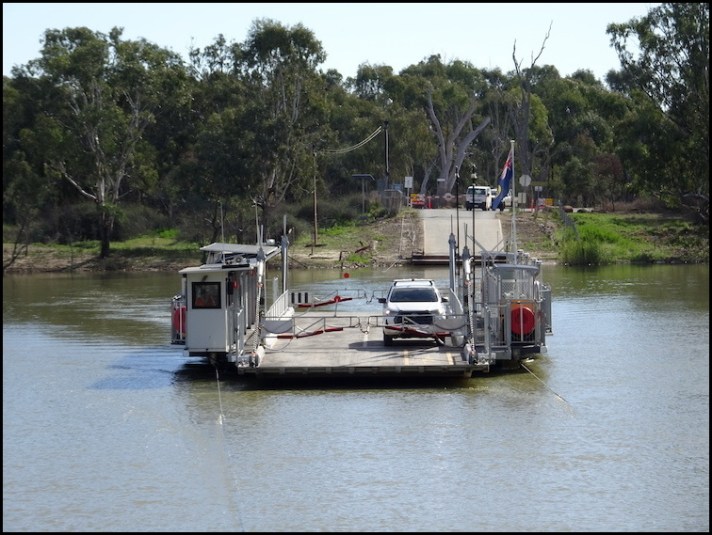
The ferry coming to get us.
The ferry is pulled back and forth on steel cables and can carry up to 42 tonnes.
There are quite a few of these ferries along the Murray River in South Australia and from a state government perspective they are seen as integral components of the road system and as such they are ‘free’ to use and run 24 hours per day, 365 days per year (subject only to river levels and conditions).

On our way across the river (actually going the other way later in the day). Unfortunately people are asked to remain in their vehicles for the duration of the crossing so I can’s show you a picture of our caravan on the ferry.

A loaded ferry docking later in the day.
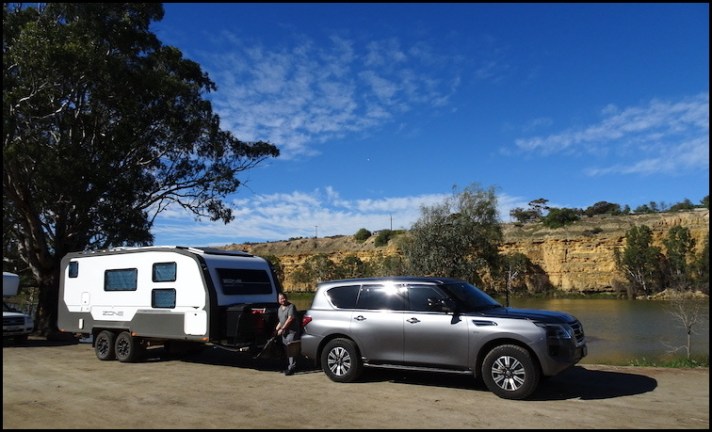
Soon we pulled into the campsite and though there were about half a dozen other caravans/campers there, low and behold the exact spot I wanted was available. Naturally we took it quickly lest someone else come in and grab it.

The perfect spot by the river
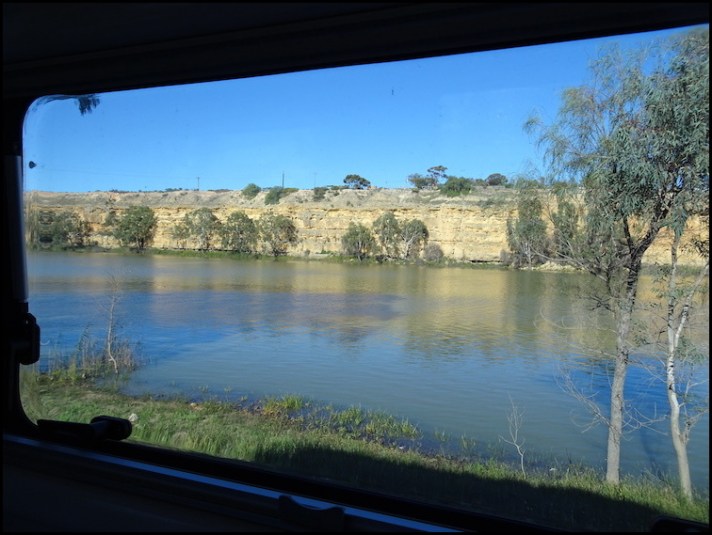
and not a bad view from our kitchen window.
The remainder of the day, we sat back and enjoyed the views from our caravan, aided by a few drinks and other sustenances. What a wonderful way to spend our 300th day rambling around Australia with our caravan in tow. Further exploration could wait until tomorrow.
The next review from my Adelaide to Canberra road trip can be found HERE.
Should you wish to follow this road trip from the beginning please start HERE.


Wow, you did secure a great spot, with a wonderful view! I was interested in all the info about how you dispose of your waste – not something I’d ever considered before 😉 And the views of the river at Bowhill are beautiful. The figures at the war memorial, or more specifically the one of the left with the bowed head, are seen quite a lot here now. My impression is that they were created to mark the centenary if the end of WWI in 2018.
LikeLiked by 1 person
We were so happy with the spot. I am glad you found the waste disposal detail interesting.. i will from time to time drop in some practical details like this which non campers may not know.. A couple of years ago I was in the dark too! I didn’t think of the 2018 link on the memorial but think you may be spot on as a few have appeared since then here too.
LikeLiked by 1 person