
Today, we took a short drive down the western side of the Murray River from Tailem Bend to Wellington, via the small hamlet of Jervois, returning to Tailem Bend along the eastern side of the river.
Our first task was to get across the river, and here, as we had done in Mannum and Swan Reach, we took the public car ferry, which is seen as an integral part of the road system. The ferry is run by the State Government, free of charge, and operates 24/7.

Just across the river we came to the small hamlet of Jervios. Jervois and the surrounding area has a population of around three hundred though based on a quick drive through I could not find any shops or really anything of interest to a traveller, with the exception of a mural on the side of the local bowling club.

The mural is an excellent reminder that Jervois is predominantly a farming community, with a focus on dairy farming, on the Murray floodplain and the gently rising ground behind it. The milk truck reminded me of my growing up, some years ago now, outside a small village in Northern Ireland. There we had a very similar truck (or lorry as they are called in the UK) collect milk from our own very modest farm.
Such trucks loaded with creamery cans, as depicted, are a distant memory in Tailem Bend (as they are in Northern Ireland), long replaced with much larger milk tankers which come onto farms and hook up to large holding tanks from which the milk is pumped into the truck to be taken to creameries, cheese factories, etc.
Prior to these trucks, in Tailem Bend milk was transported by small river boats.
In the early 1900s irrigation settlements were established along the lower Murray with one of the largest at Jervois. A dairy industry developed and for more than 20 years, from 1919 to the mid 1940s, the milk was collected by a fleet of small river boats including the Loyalty, the Union and the Co-operation and the Progress and taken, after 1922 to a new factory in Murray Bridge.
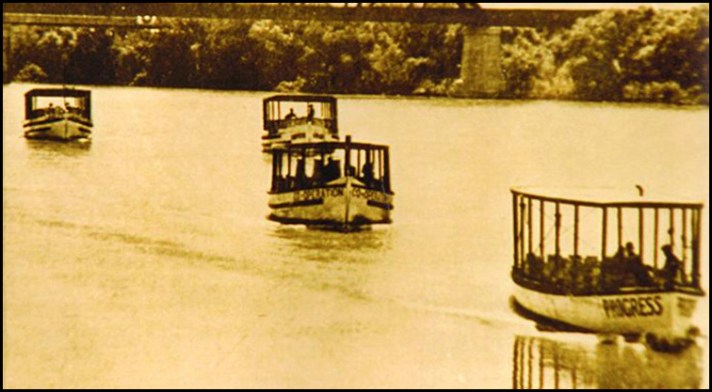
A flotilla of milk boats heading to Murray Bridge – early 20th century. Source ABC Local – Australia
The Loyalty was one of the largest vessels, having a maximum load of 357 ten-gallon milk cans. The Union (depicted below) was purpose-built with a special opening at the side to enable the easy loading and discharge of the milk cans. All boats had a wooden canopy to protect the milk from the sun.
Each launch was operated by a driver and a boy, and stopped at any wharf or landing where dairymen had left their produce.

The Union collecting milk left on the jetty by farmers.
There were two runs daily, in each direction from Murray Bridge. The early morning trip was usually from 4am to 11am, with the afternoon collection from 1pm to 7pm.
The milk boats also delivered mail and groceries and often took farmers and their families into Murray Bridge. In some cases the launches transported children to and from school.
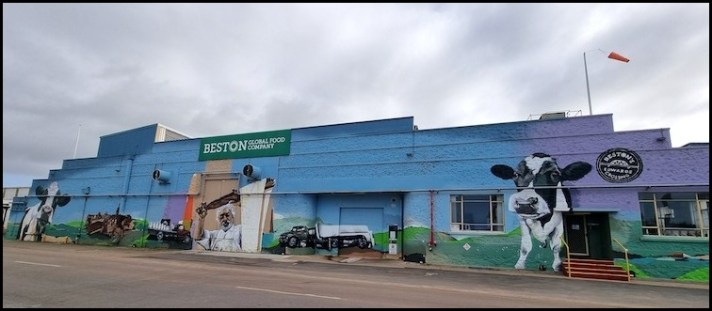
Today a large portion of the milk produced locally is sold to the Beston Global Food Company’s cheese factory located between Jervios and Wellington. Beston Global Food Company is a highly siccessful South Autralian company which exports, from this factory and one in Murray Bridge, its cheeses to numerous Asian countries, Europe and the United States.
While going into the factory was not an option we were able to view the beautiful murals on the front of the building.


Outside Wellington we stopped at the Murrundi Reserve. The reserve encompasses a wetland area of nice hectares and is all that remains of the Jervois swamp which used to be an extended wetland system between Jervois and Wellington. Nearly all of this wetland area has been reclaimed with levee banks for irrigated pasture since the 1830s with significant losses occurring with the introduction of the irrigation settlements I referred to earlier in this review.
At the entrance to the reserve was a notice board which related a couple of Aboriginal stories one of which I will relate here as it answers a query raised on an earlier entry by one of my readers.
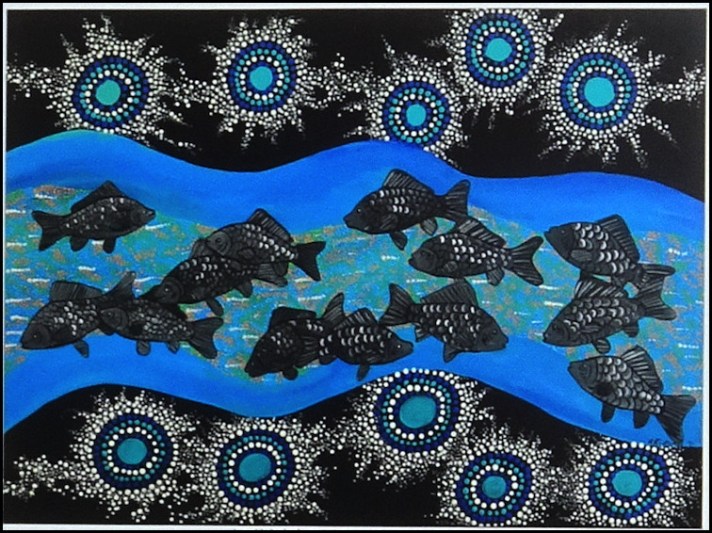
When reading Ngarrrindjeri’s Dreaming story my reader enquired as to what happened the giant cod fish (Ponde) which Ngarrindjeri had chased, trying to spear it from his canoe. Well here is the answer!
“Ngarrindjeri Creates Fish
In the dreaming of the Ngarrindjeri people, Ngarrindjeri went fishing in his bark canoe. He saw a giant Murray Cod (ponde) and tried to spear it but ponde quickly swan away downstream, creating the Murray River. Ngarrindjeri’s brother Nepili speared the Murray Cod with a spear. The two men cut up the cod to become many fish.”
Our short walk through the reserve revealed an interesting array of wetland flora, including some winter colours.

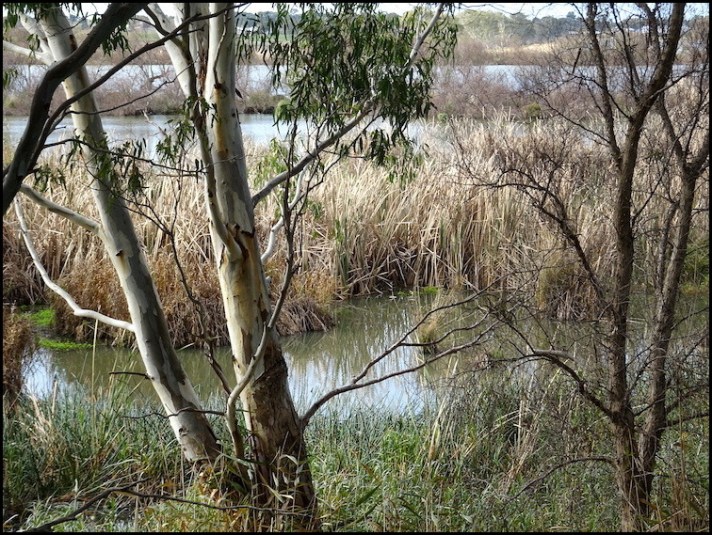

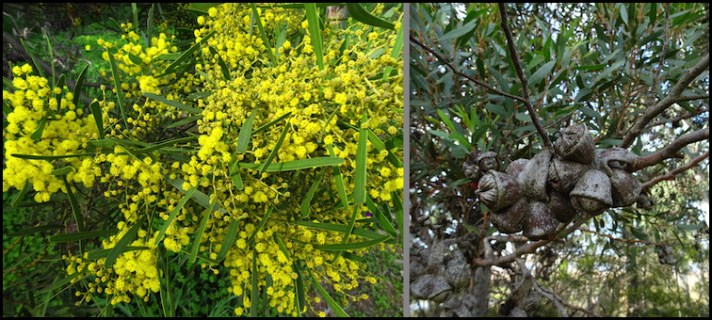
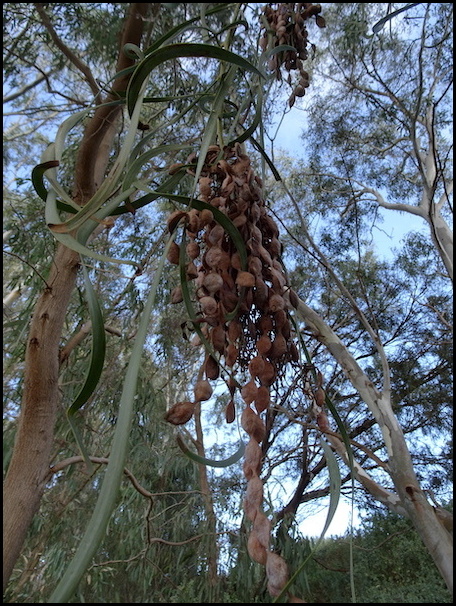

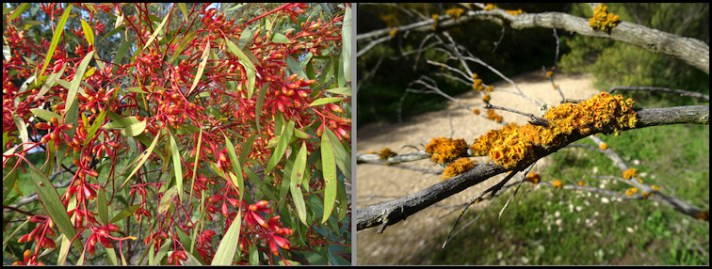
I was also lucky to sight a couple of black swans here on the river. In my entry on Swan Reach I alluded to the fact that it was named after black swans found along the river in the area. The closest I could find to a black swan there was a tyre (tire) cut into the shape of one adorning the local mechanic/tyre sellers shop. Again a couple of readers wondered if I had seen any real black swans so the picture below is especially for them.

Black Swan on the Murray River.
Black Swans are actually indegenous to Australia. An Aboriginal Dreamtime story of the black swan tells of how two brothers were turned into white swans so they could help an attack party during a raid for weapons. Wurrunna used a large gubbera, or crystal stone, to transform the men. After the raid, eaglehawks attacked the white swans and tore feathers from the birds. Crows who were enemies of the eaglehawks came to the aid of the brothers and gave the swans their own black feathers, thus creating black swans. The black swan’s red beak is said to be the blood of the attacked brothers, which stayed there forever.
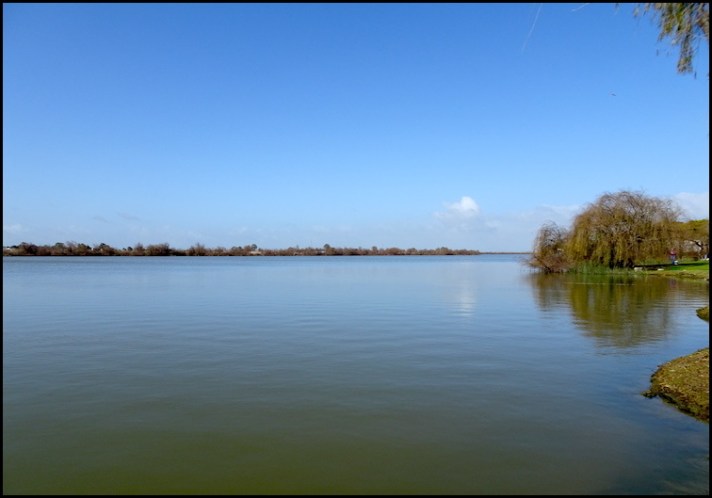
A very tranquil Murray River near Wellington, South Australia.
Wellington, just down the road from the Murrundi Reserve was a slightly bigger town than Jervios, sporting, in addition to residences and holiday units, the Wellington Hotel (licensed in 1848 and one of the oldest working hotels in South Australia), a fuel station and an old Police Station, Ferry House and Postal and Telegraph Offices which were all part of the Court House Complex which closed in 1946.

Police Station, Ferry House and Postal and Telegraph Offices which were all part of the Court House Complex – now up market accomodation and a cafe.
To-day we just passed through Wellington and took the rather full ferry back to the eastern side of the river.

Having crossed the river we soon came to the Pangarinda Botanic Garden.

The Garden bills itself as ‘”a real hidden gem of 30 ha of rare and threatened flora from Australia’s drier regions.” It is an absolute credit to the volunteers who have created this beautiful space from formerly weed infested, eroded sand drifts with a few remnant patches of native Pines.
As we spent a significant amount of time here admiring the beautiful flora I am going to add a seperate review for today which will essentially be a pictorial summary of our visit to the garden.
In the mean time, do stay with me for our last stop for today, the Wellington East Cemetery.

Prior to the opening of this cemetery, upon death, people were simply buried up on this hillside on the outside of East Wellington. The hill was unfenced and constantly trampled by livestock en route to the busy River Murray crossing, meaning that headstones and burial sites were continually being damaged or destroyed. After pressure from local residents, the government finally relented and, in April 1863, Special Magistrate EC Hughes chaired a meeting at which it was decided to take steps to enclose the public cemetery with a substantial stone wall and iron gates. Neither the stone wall nor the gate eventuated, despite substantial public money being raised.
The hillside cemetery was eventually fenced and a rather modest gate added so that later residents could rest in peace.
While around 300 people are thought to be buried here (the first, Frederick Oughton on October 9, 1847 who drowned while swimming) there are only 88 people remembered on headstones.
While all headstones represent a life or lives about which many stories could undoubtedly be recounted, I found the following headstones particularly interesting.

What attracted me to this particularly saddening headstone is the fact that the entombed, Robert John Denforld, died from drowning at the age of 49 (1890) and his youngest son was tragically lost at Gallipoli in 1915 during WW1. Alas, I assume, Robert’s son would not have been buried here with his father as, in line with the policies of the Imperial War Graves Commission, founded in 1917, the Australian government did not repatriate the bodies of its soldiers.
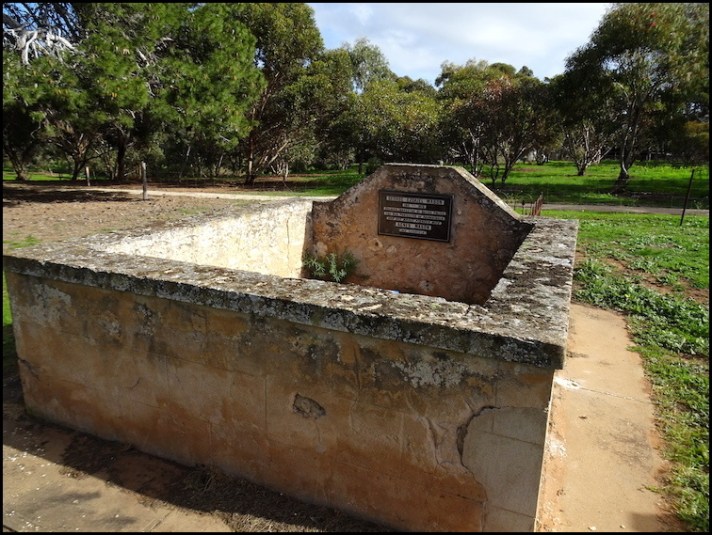
Here the headstone reads
George Ezekiel Mason
1811 – 1876
Soldier, Inspector Of Native Police
And Sub. Protector Of Aboriginals
And His Brave Pioneer Wife
Agnes Mason
(Nee Litchfield)
Following the publication of an obituary for Mr. Mason in The South Australian Register on August 14, 1876, a correspondent wrote a letter to the editor part of which read:-
“Mr. Mason was wisely appointed Protector of the Blacks on the Murray in consequence of his well-known influence with the natives; and by the great tact and kindness with firmness displayed by him in his intercourse with them he had acquired such an extraordinary amount of influence over them that, although at that time they laboured under a very bad reputation, I do not know of one instance in which a white man was killed by a black, or a black by a white, at or near Wellington; and the saving of human life was wholly and solely attributable to the presence and example of the late Mr. Geo. Mason.“
I am not sure how such a letter would go down today.
Mason was reportedly fluent in seven of the nine local Aboriginal languages and it was superstitiously believed by the elders that Mason was really a black man who had died and ‘jumped up a white man’.
To finish a lighter note, if a burial site could ever be referred to in such a way, the occupant of this grave was clearly a fan of the Port Adelaide Football Club and liked to imbibe in the odd liquid refreshment.

The next review from my Adelaide to Canberra road trip can be found HERE.
Should you wish to follow this road trip from the beginning please start HERE.
 The Rambling Wombat
Looks like a great day out! The cow murals are super (that one at the top seems to be stepping out of the wall 😮 ), the traditional painting of the river is fantastic, and I like the look of the Murrundi Reserve for a walk 🙂
LikeLiked by 1 person
It was a very pleasant trip Sarah which we took our time completing …. no hurry these days 🙂
LikeLiked by 1 person
I enjoyed the Black Swan tale Albert.
LikeLiked by 1 person
I thought it was a great story too. Gland you enjoyed it, Malc
LikeLiked by 1 person