This is day ten of our trip from Adelaide to Canberra, and we have not even hit 100 kilometres from home, with another 1,100 kilometres to go if we took the shortest route, which of course we will not be taking. We have dilly-dallied around this part of the Murray River because there is lots to see and do. Indeed, we could stay longer, but we really need to get moving. We can, and will, come back here again as it’s so close to our new home in Adelaide. Today we will head pretty much due east to the small town of Pinnaroo and in so doing double our distance from Adelaide.
Before leaving our campground in Tailem Bend, the last thing we did was ensure two of our three water tanks were topped up, giving us almost a week’s supply. I suspected that getting water in Pinnaroo would be difficult (i.e., difficult to get the van close enough to the tap – and I was right), and I knew that our stop after Pinnaroo would not provide access to drinking water.
To get to Pinnaroo, we took a short detour through Karoonda specifically to see some silo art. But before arriving there, we pulled into a public weighbridge at Wynarka to weigh our car and van. This was more of a novelty stop than anything, as the weighbridge was an old manual affair, of dubious accuracy depending on the skill of the user (me) in getting it to work correctly. Also the platform was not long enough to weigh the car and van hooked up.

Our caravan on the weighbridge at Wynarka
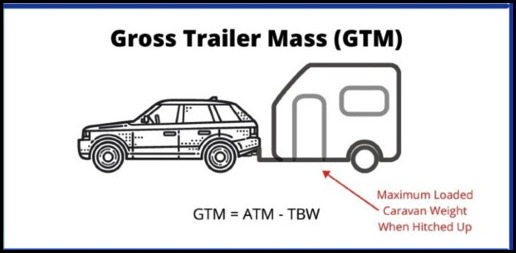
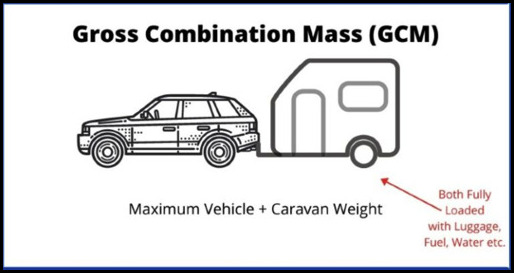
Those familiar with towing will know that there are a phethora of component weights that legally must not be exceeded. It is far from weighing the lot and being all good if its less than x tonnes. We were able to directly measure two of these – the gross vehicle mass and the gross trailer mass. Knowing these we could calculate a few other weights including the gross combined mass. The diagrams below show what these three weights are.

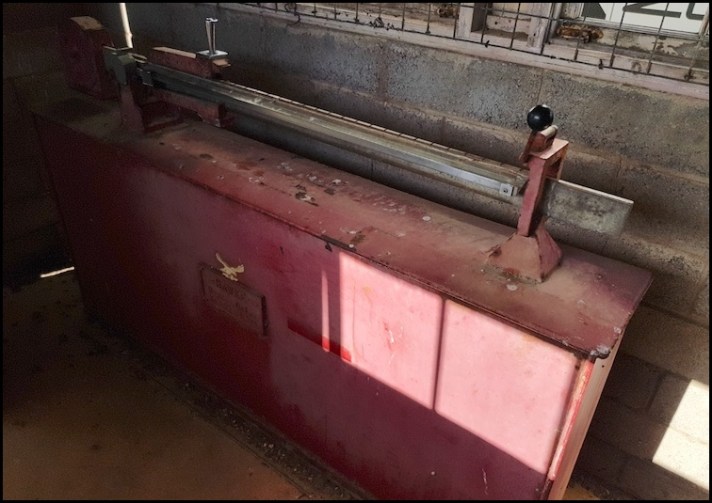
The manual scale
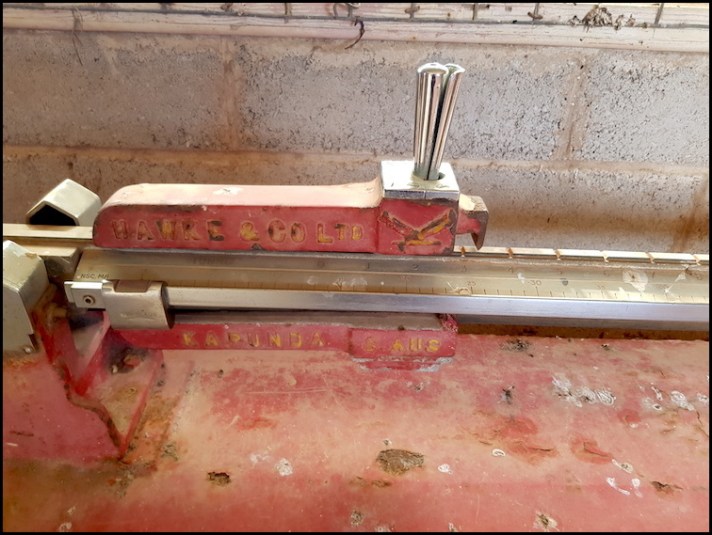
Confirming that our gross trailer mass (the caravan as attached to the car) was less than permitted.
Based on our readings we were legal on all weights measured and calculated. Phew!
While at Wynarka, we also availed ourselves of the opportunity to inspect a tree. Not just any old tree, but the tree that was planted, in 1937, on the spot where Reverend John Blacket of the Methodist Ministry conducted the first service in The Hundred of Hooper on the 5th of October 1911. The Hundred of Hooper is the name of the local area. Nearby the tree, there is an old horse cart, devoid of any identification, which I am going to assume belonged to the good Reverend.
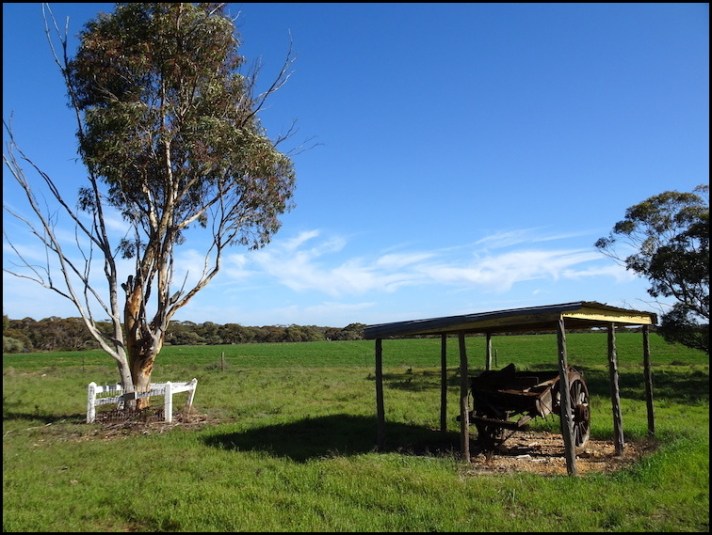
A timber and iron Methodist church was soon built at Wynarka, opening in 1913, with a replacement church being built in the township around 1971. The original church was later dismantled and moved to the Pioneer Park in Karoonda. The second church is also no longer in use as a result of the almost total demise of the town itself following the closure of the railway.
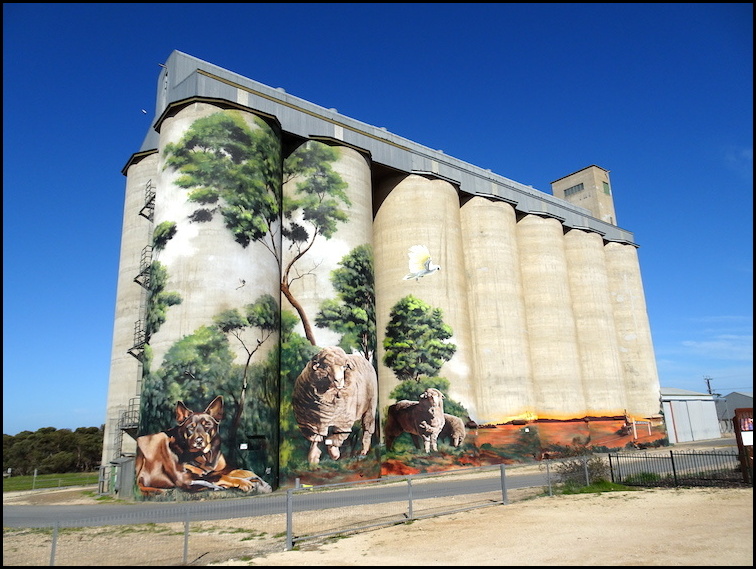
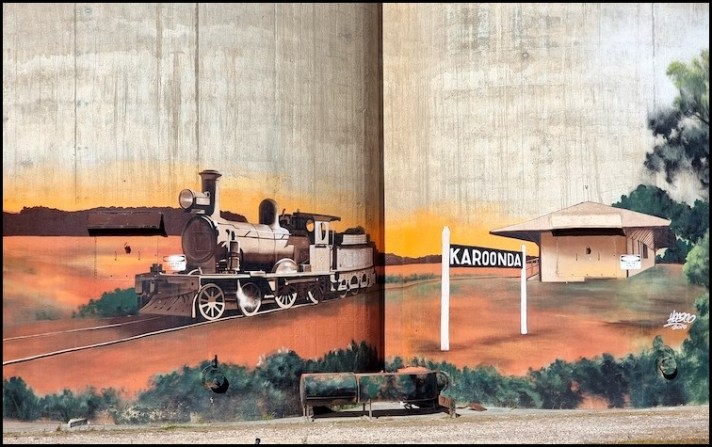
While we did not visit the Pioneer Park in Karoonda we did stop there for a while, initially drawn by the presence of some amazing artwork on the town’s grain silos.

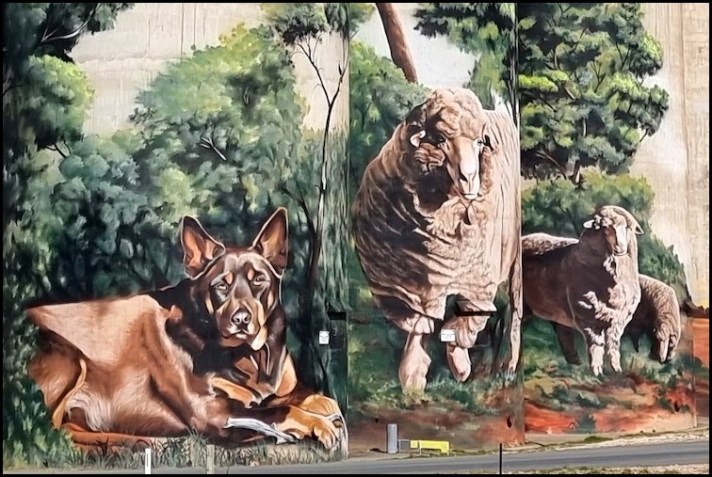
The artwork was completed by Heesco who was born in Mongolia and moved to Australia in 1999. His brief was to come up with a piece with encapsulated local Mallee life, both current and past, in a way which provided a ‘frame’ around a blank silo screen which would be used for night projections. The outcome showcases animals as a key aspect of the Mallee identity, along with the railway which was so critical to agriculture in the region.
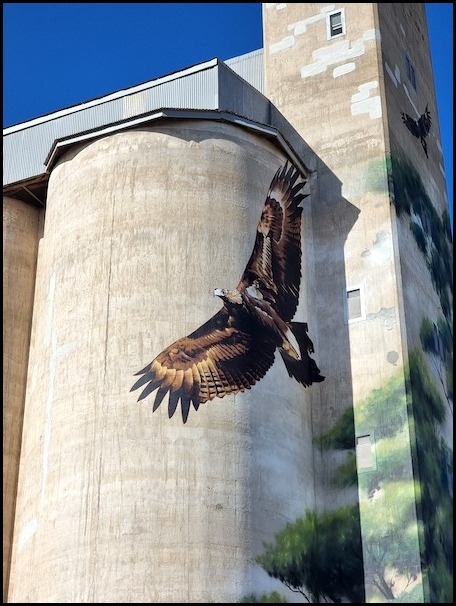
Diamond the sheep and Whiskey the Kelpie represent well known local icons, the sheep and the trusted working dog.
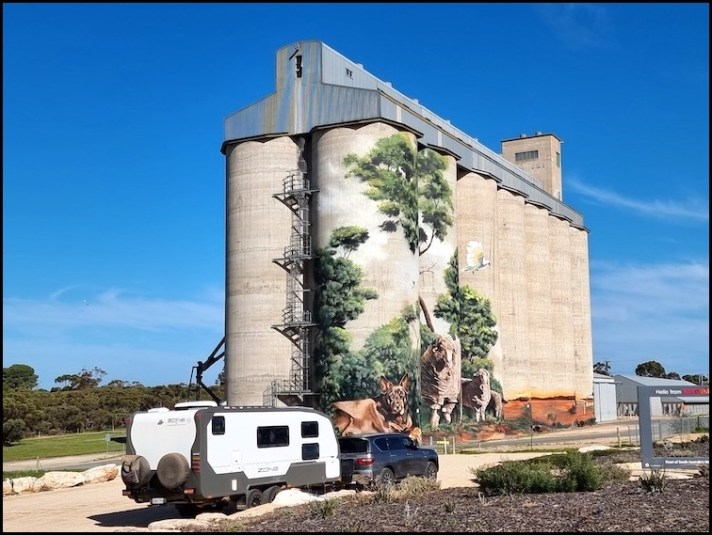
I am always amazed by the size of these silo art pieces found in many parts of southern Australia in particular. This one, as do most, dwarfed our car and caravan.
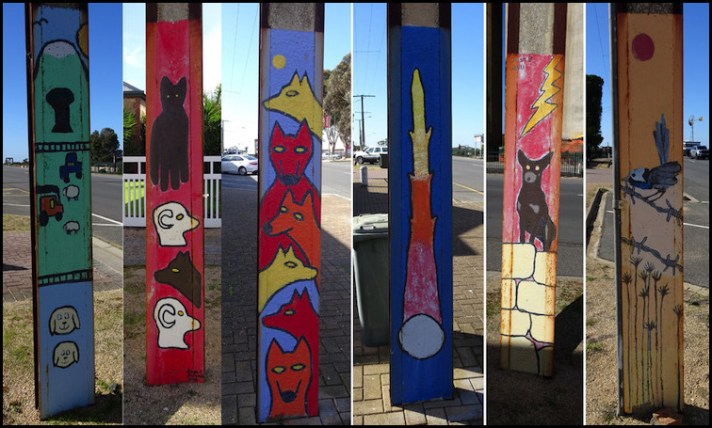
The massive silo artwork is complemented by numerous smaller pieces found on stobie poles along the town’s main street. Stobie poles are power line poles made of two steel I-beams, joined by tie-bolts, and held apart by a slab of concrete. They were invented by Adelaide Electric Supply Company engineer James Cyril Stobie, who suggested the use of readily available materials due to the shortage of suitably long, strong, straight and termite-resistant timber in South Australia.
Moving on down the main street we encountered yet more artwork. This series of six cylindrical pieces erected on former silo pads is entitled the ‘Karoonda Shuffle’.
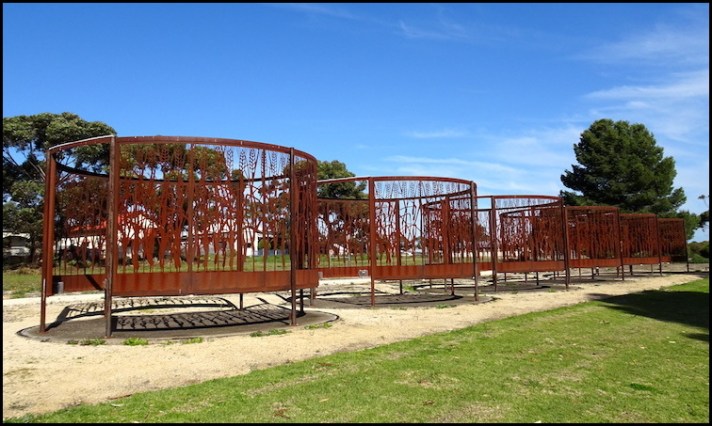

This, the accompanying signage told me, ‘is a symbolic depiction of grain crops, the backbone of South Australia’s Mallee farming…….the static structures represent the 6 months or so of the grain growing season”.
So far so good.
“They create an illusion of movement, appearing to shuffle as you pass by them ….. Take a stroll, or jog, around and through the wheat silhouettes and create your own visual experience of the Karoonba Shuffle”.
I took up the challenge and felt absolutely nothing!
Call me a Philistine if you like, but I found it somewhat easier to relate to the nearby monument to the importance of sheep farming in the area. Though not much larger than an actual ram this piece is entitled The Big Ram, making it one of Australia’s smallest ‘Big Things’.

A plaque previously affixed to the pedestal asking New Zealanders people not to climb on the Big Ram has disappeared! To my overseas reader – the reference to New Zealanders is a joke which will be understood by Aussies and Kiwis.
I also ‘got’ ‘The Centenery Walk”
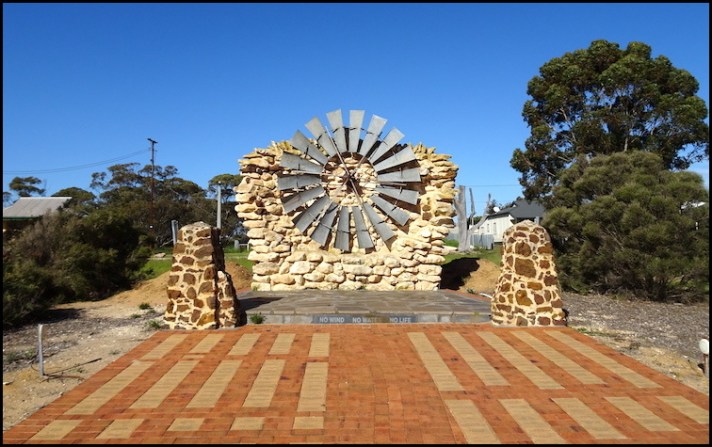
The Centenary Walk commemorates the pioneers of Karoonda and was unveiled in 2011 marking the centenary of the sinking of the first bore in the area. Without bores there would have been no water, no agriculture and no Karoonda or as the wording across the bottom of the monument states – NO WIND, NO WATER, NO LIFE. Windmills have been used for generations, and still are used, to power water pumps in rural Australia. The walkway to the monument features a series of pavers, dedicated to individual named pioneers.
The last piece of artwork in Karoonda that I feel the urge to comment on I thought was a little scary and reminded me of the Aseki Smoked Bodies which I visited in Papua New Guinea many years ago. I think it’s the hair!

This work, entitled “Where is he?”, notwithstanding its appearance, is a poignant tribute to the hardworking women of the land. It captures the struggle of rural farming families and honours their resilience and persistence. A significant part of this struggle is women and families having to cope with a growing number of suicides among male farmers, as ever-increasing occurrences of droughts, floods, fires, and other catastrophes decimate family livelihoods.
Before heading to our planned destination for to-day, I wanted to see one more thing, the Karoonda Meteorite. After searching around, I eventually located it on display in the local council office.

Not being an expert in meteorites, I will be guided by the assurance of the Australian Government’s Culture, Heritage, and Arts Regional Tourist Program that this “Stony Type” meteorite, which hit the Earth on 25 November, 1930, is of a very unusual composition. It consists mainly of silicates of iron and magnesium, iron sulphides, and a very small amount of iron-nickel alloy.
Comforted with this newfound knowledge, we headed off to Pinnaroo, which I will tell you about in my next review.
The next review from my Adelaide to Canberra road trip can be found HERE.
Should you wish to follow this road trip from the beginning please start HERE.


Wow, so many wonderful things to see here. I love the silo art and even the “Karoonda Shuffle” which makes the most of old silo pads. I also love your caravan. You must be loving this trip!
LikeLiked by 1 person
Thank you … The caravan is great .. we love it to0 .. well spec’d so not lacking in comfort 🙂
LikeLike
That silo artwork was the undoubted star of the show here it would seem Albert, and it’s things like this that makes travelling so much fun – and I didn’t fail to see your jibe at New Zealanders either 😊
LikeLiked by 1 person
Silo art is amazing – stay tuned a few more coming up.
LikeLiked by 1 person
The silo art is wonderful.
LikeLiked by 1 person
Soon you are able to publish a book, just 59 days left…
LikeLiked by 1 person
Haha but the major problem is I have yet to write about the first 296 days!
LikeLiked by 1 person
PS chuffed that you think my ramblings would be worth of including in a book though !!!
LikeLiked by 1 person
You can also start with day 297 and just continue another 10 months or so, may be a real challenge – though my first 1-year project ended after 3 months (also due to COVID19 and the diverse quite tough restrictions). Some kind of burden max always appear without warning anyhow.
LikeLiked by 1 person
Karoonda certainly seems worth the stop. I love the silo art and meteorites always fascinate me, whatever their composition!
LikeLiked by 1 person
Thanks for your feedback as always Sarah. I love the silo art too.. In fact just visited another one today and there will be another in my next entry.
LikeLiked by 1 person