
After two days enjoying the natural delights of the Pink Lakes area of the Murray – Sunset National Park it was time to move on. Today we travel to the small town of Sea Lake, via Patchewollock, and indulge in the delights of some human creations, mainly in the form of grain silo art and other artworks along the way.
After about five kilometres driving along a well tended gravel road we hit the bitumen again and very soon reached the small hamlet of Walpeup.

An excellent gravel road. They are not all like this.
In addition to a few churches, Walpeup has a golf course, a caravan park, an artificial lake for swimming, a general store and a primary school.
The primary school closed in 2015 when enrolments fell to only seven, though that was double what they were the year before. All the children then enrolled were great-grandchildren or grandchildren of one Mrs Lovitt who led a crusade against the Victorian Department of Education and Training, which announced that it planned to ‘de-staff’ the school … perhaps the new politically correct or now fashionable way of saying they were closing it. A spokesman for the Department announced that “The Department concluded the children’s academic, social, and wellbeing needs would be better met through daily interaction with other children and access to a wider range of high-quality programs.” It is always sad to see small country schools closing and it brings back memories of my own primary school, in rural Northern Ireland, which, some years after I left, suffered a similar fate, again due to unsustainable enrolments.
Anyway, I digress as we did not stop in Walpeup to savour any of these delights or to resurrect the school, but rather we stopped to admire a magnificent piece of grain silo artwork.
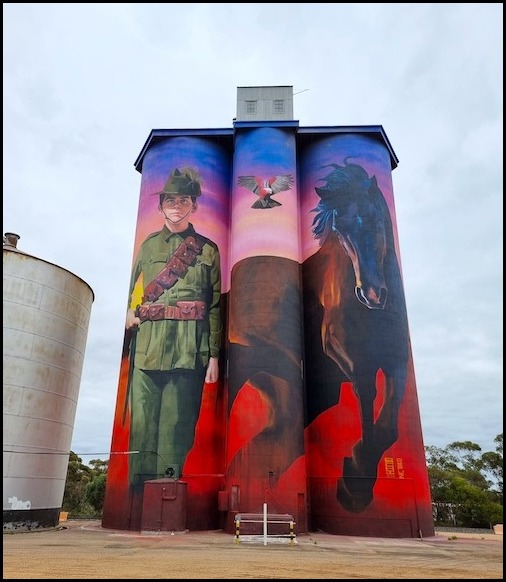
The silos were painted by Julian Clavijo and Camilo Delgado in June 2023, making it the latest in a growing number of silo artworks across Australia – an upmarket competition to , or maybe complimentary to the hundreds of BIG THINGS dotted around the country. Visiting, and indeed ticking off, silo artworks has become a passion for many, particularly ‘grey nomads’ like myself with all the time in the world. A whole Silo Art Movement has developed which encourages people to get into their cars, caravans and motor-homes and journey along what is now considered, by some, Australia’s Ultimate Road Trip.
While we travel around we visit any painted silos ( also water tanks) along our routes and we will make detours to visit others which are reasonably close to where we are travelling. Some of the artworks relay serious stories, some specifically promote local industry, argriculture or other things related to their locality (for example the one we visited at Karoonda) and some are just for fun.
This silo art at Walpeup portrays the story of Harold Thomas Bell.
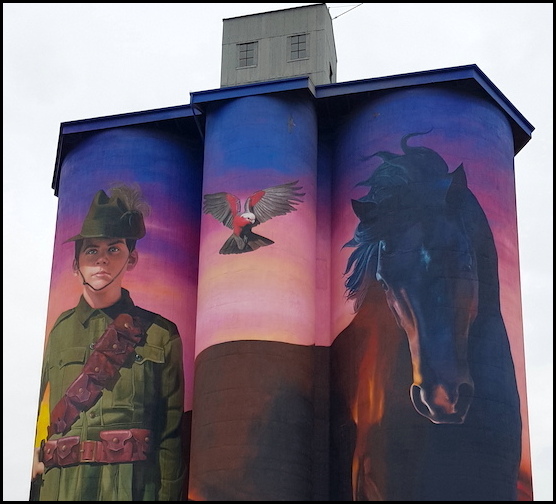
I found Harold’s story (as relayed by australiansiloarttrail.com) to be interesting as well as touching so will relay it here in full.
“Harold Thomas Bell was born in Walpeup, in northwest Victoria, in 1901. Typical of many boys growing up in the region during that era, Harold was not a keen student, preferring to spend his time outdoors – he was described as a ‘boy of the land’.
At sixteen, with war breaking out, Harold was still, very much a boy – a diminutive 5ft 4 and barely 8 stone, but he was strong and fit. He was a capable bushman, he knew his way around a rifle and had a natural affinity with horses.
As the local men began signing up to fight for their country, Harold looked on with envy. He was full of youthful exuberance and bravado and was eager to join the older boys, whose exploits he read about. Even as local boys returned home wounded, missing limbs, while others never returned at all, Harold’s desire to be part of the action never waned. One night, in the cover of darkness, he left a note on a table, telling his family he was off to try his hand at Jackarooing in Queensland but instead, like his brother before him, he headed out the front door and into Mildura to sign up for the Light Horse Regiment.
Lying about his age, name and family circumstance, Harold completed the paperwork, assuring the recruiting officer that he was 21. With a few strokes of a pen, Harold Thomas Bell, became Harold Thomas Wickham and on March 17, 1917, sixteen-year-old Harold enlisted to fight in a very adult world.
With a childhood spent in the bush, Harold proved his worth and was eventually allocated to the 4th Light Horse and on June 22nd 1917, he left Australia, arriving in Egypt six weeks later. Harold spent his time undergoing further training in Egypt, he was assigned his horse and was subsequently selected for the Hotchkiss machine gun section.
On October 28, Harold’s regiment got their orders – they were moving out. Once again travelling under the cover of darkness, Harold edged towards his fate. After a twelve-hour trek, the 4th and 12th regiments still in ‘reserve’, found themselves overlooking the town of Beersheba, where a battle raged. When the call to charge finally came, it was sudden. The sounds of thundering hooves and calls of battle filled the air as 16-year-old Harold rode into a maelstrom of gunfire.
Critically wounded when he was shot in the leg, Harold died the next day and was eventually laid to rest in the Beersheba War Cemetery.
The Army Headquarters sent a telegram to Harold’s only living relative, an uncle, according to his enlistment forms, to inform him of his nephew’s death.
Upon receiving the telegram, Thomas Bell wrote back: “I don’t have a nephew named Harold. I do have a son by that name, but he couldn’t be in the Army, he’s only 16.”
Less than a year after Harold’s death, Thomas Bell would receive another telegram, this time to be told the war had taken his other son, Samuel.”
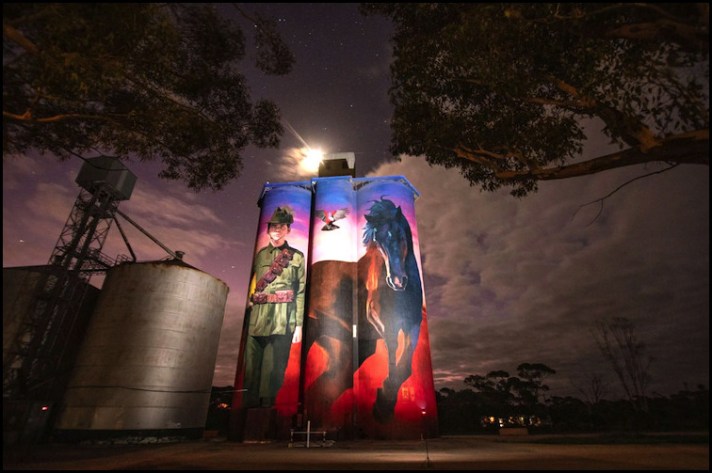
I also cannot resist including a night time picture of the artwork, again courtesy of australiansiloarttrail.com with a credit to KDog Photography. I wish it was my picture.
Leaving Walpeup we headed south to Patchewollock, a small wheatbelt town with a population of around 150, on the edge of the Mallee region. The odd sounding name is derived from two Aboriginal words, ‘putje’ meaning ‘plenty’ and ‘wallah’ meaning ‘porcupine grass’ thus ‘the place of plenty porcupine grass’.
The primary reason for visiting here was to view another silo art instalation.

This artwork (see also my main picture above) was painted by Fintan Magee, a Brisbane artist whose father emigrated to Australia from Northern Ireland in the early 1980s – just like yours truly did a few years later.
The painting was completed in 2016 and aims to depict the strength and tenacity of the local people. As part of his research, Magee booked a room at the local pub (perhaps not surprising given his Northern Irish ancestry!) so he could immerse himself among the local community and get to know it. After some time, he decided that he wanted to paint a local sheep and grain farmer, Nick ‘Noodle’ Hulland. He chose Hulland because he saw him as a symbol of the local farmer, exemplifying the no-nonsense, hardworking spirit of the region. The faded blue ‘flanny’ (flannelette shirt) portrays an image of the archetypal Aussie farmer, while his solemn expression, sun-bleached hair, and squinting gaze speak to the harshness of the environment and the challenges of life on the farm. Also, very conveniently, Hulland was tall and lean, a frame that would easily fit on the 35-metre high grain silo.
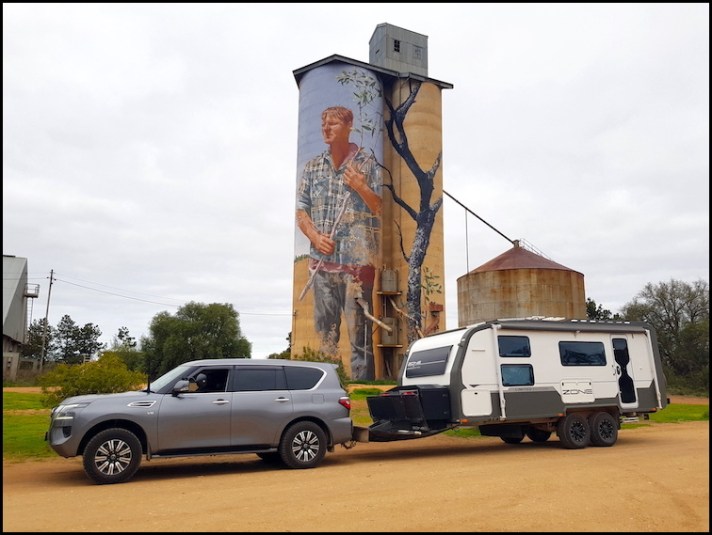
An attempt to depict just how big these silo artworks are.
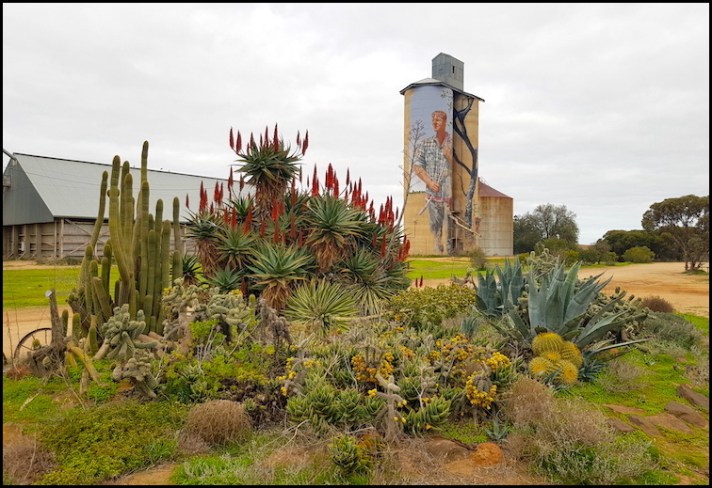
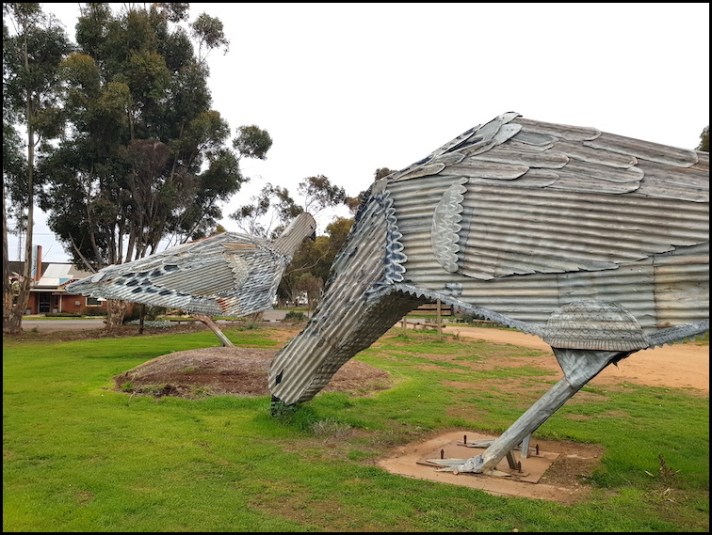
Earlier I suggested that silo art could be seen as competing with, or complementing, the hundreds of BIG THINGS dotted around the country. Well whichever it is Patchwollock has taken a bet each way and has both. Down the road from the silo art are a number of BIG mallee foul.
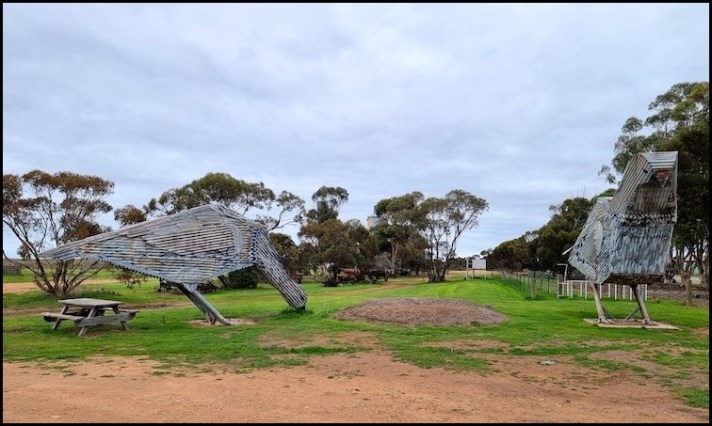
Two corrugated iron mallee fowl sculptures created by artist Phil Rigg in 2013
In my review on Monarto Safari Park I provided some detail on these birds and, in particular, their rather odd breeding habits so I won’t repeat that here. I hasten to add, less you wonder based on the next picture, that I am not an outcome of these rather odd breeding habits!
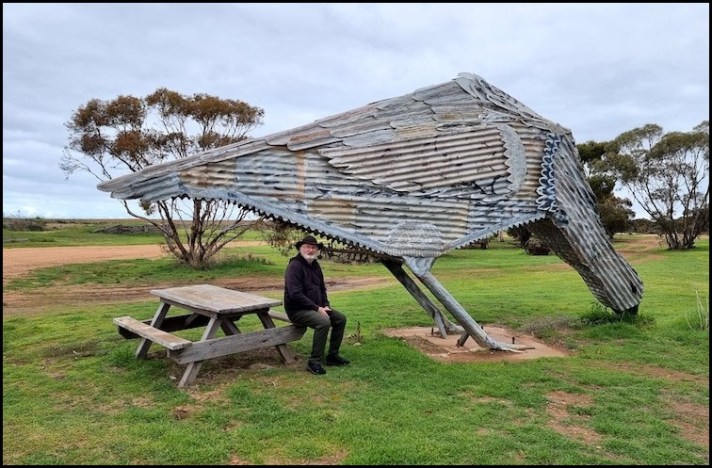
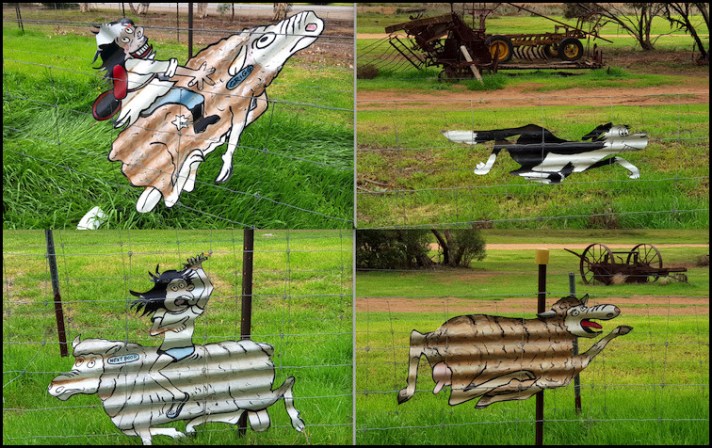
Nearby the mallee fowl, along what looked like a chicken racing track, I came across these fun creations. Another interesting use for corrugated iron.
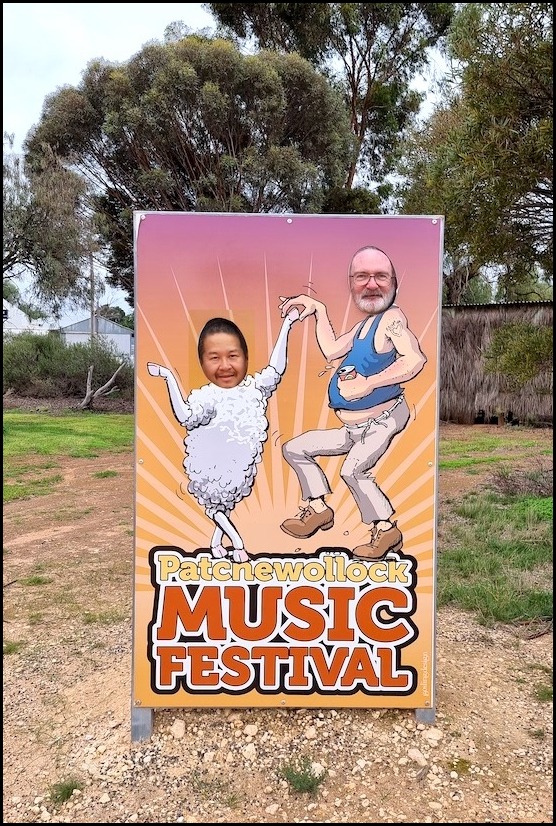
And who do we have here enjoying themselves at the Patchewollock Music Festival?
Besides the artwork the town itself looked pretty dead, outside the pub that is. Are the curtains for real?

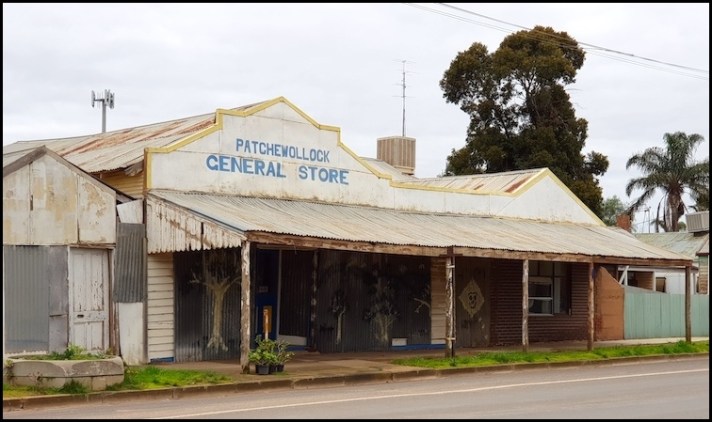
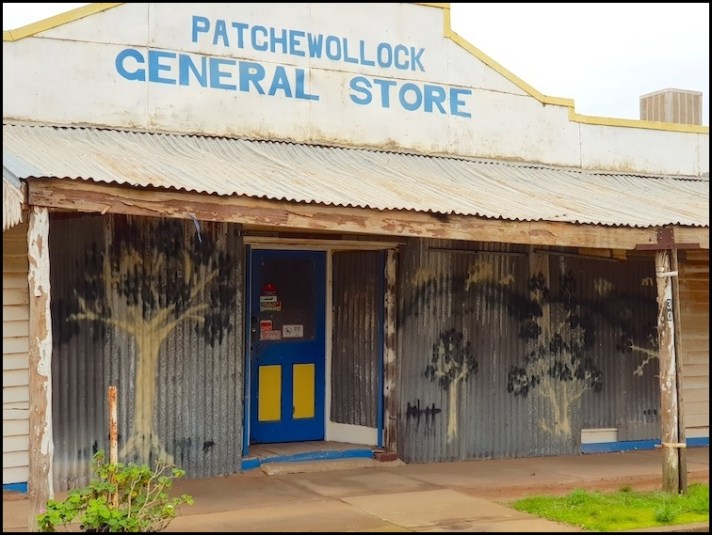
The general store looks like it has seen better days
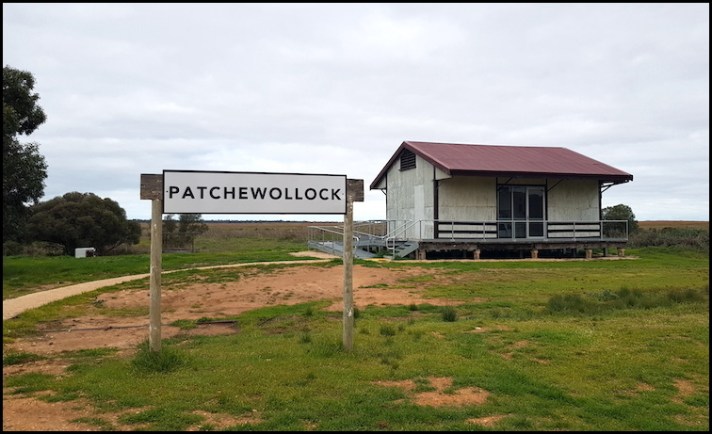
and the railway station closed in 1986 with the line being ripped up shortly thereafter.
With nothing further to titillate us here we moved on to Sea Lake where we booked into the town’s Travellers Rest Caravan Park, the only option here, for a couple of nights.
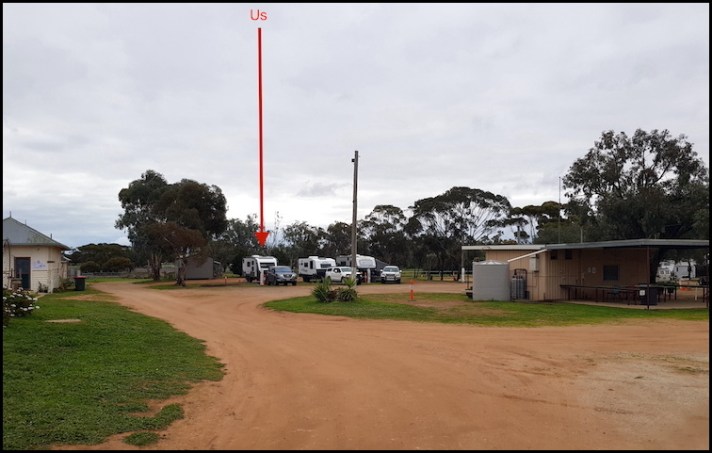
We spent the remainder of the day washing clothes and taking a quick look around the small town. I will cover the latter in my next post, along with our visit to another silo art installation and another pink lake. I know you cannot wait, but patience please!
The next review from my Adelaide to Canberra road trip can be found HERE.
Should you wish to follow this road trip from the beginning please start HERE.
 The Rambling Wombat
Wow, these are both so impressive! A sad story though that inspired one. However I had to laugh at your comment on the shot of you with the duck and the two of you at the music festival 😂
LikeLiked by 2 people
Thank you Sarah. I’m am glad I provided you with a bit of a giggle.
LikeLiked by 1 person
Such a sad story about the young soldier, one repeated many, many times unfortunately. On a lighter note, I am impressed by your moves at the music festival, ha ha.
LikeLiked by 2 people
Thank you Ananel. 😀
LikeLiked by 1 person
Cool murals in the outback 😎
LikeLiked by 2 people
Thank you.
LikeLike