
Between Kerang and Lake Boga (about 40 kilometres north of Kerang) lie over fifty lakes of varying size, some with water, some dry. Collectively the lakes are referred to as The Kerang Lakes and today we visited a small number of the more accessible and thus more popular of these lakes.
Amongst The Kerang Lakes are some of Victoria’s most popular recreational lakes attracting thousands of visitors each year to engage in all manner of activities including water skiing, jet skiing, powerboat racing, canoeing, bushwalking, bird watching, shooting and swimming.
It is worth noting that the tourist literature does not promote a drive around the lakes as something to do in itself. Having done just that the reason becomes obvious – the area is very flat and most of the roads, though not all, are not sufficiently close to the lakes to make for an especially spectacular drive. That said, throw in a bit of walking, a few historical titbits and some artwork and we had a very pleasant morning exploring the lakes area.
Our first stop, less than ten kilometres out of Kerang, was the Reedy Lakes group where we did a couple of short walks giving us a look at Middle Reedy Lake and First Reedy Lake (commonly just called Reedy Lake) together with a couple of indigenous sights of significance.
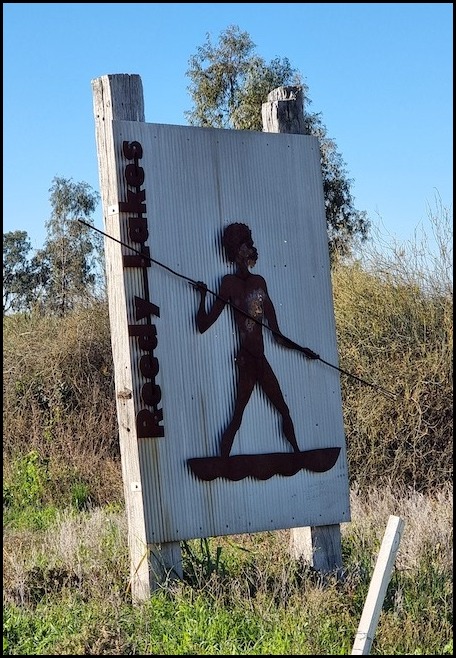
Both ‘walking tracks’ which we took were pretty much unmarked and poorly maintained but as we were only covering short distances this didn’t really matter except that plodding through the bush/ uncut undergrowth would have increased our risk of snake bite had it been summer. As we visited in winter this was not really an issue and indeed the unkempt appearance of the place gave us a better feel for how Messers Burke and Wills would have found the general area* when they camped here on the night of 4 September, 1860, in the early stages of their trek across Australia, via a south to north route (Melbourne to the Gulf of Carpentaria).
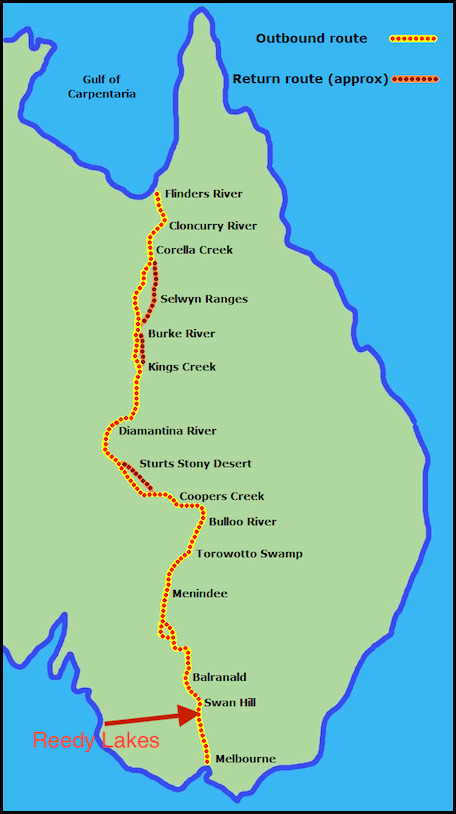
Burke and Wills’ expeditionary route 1860-61
It is not known for certain if Burke and Wills made it to the Gulf but there is evidence that they were within a cooee thereof (that is within reach or near, for my non Australian reader). Sadly, both explorers died on the return journey. I felt fairly confident that a similar fate would not befall us today as we followed their 2,900 kms oneway trek for about 400 metres, weaving through a section of River Red Gum wetland.

River Red Gums by Middle Reedy Lake
*While Burke and Wills, if they visited today, would see some similarities to the time they visited the whole lakes area was highly modified in the early 1900s with lakes connected, wetlands expanded or contracted, waterways separated, new channels and weirs created, etc to form an invaluable irrigation system which is still used to supply water to local farms today and to regulate water levels in the recreational Lakes Charm and Boga and Kangaroo Lake to the north. In addition to increased pasture production for sheep, beef and dairy farming the irrigation system makes possible a wide range of horticultural activity including viticulture, citrus growing and stone fruits such as peaches, plums and apricots.
We started our exploration with a short walk to a bird hide and then along the edge of Middle Reedy Lake.

The path to a bird hide – the only easily identifiable path we encountered

A view of the wetlands from the bird hide

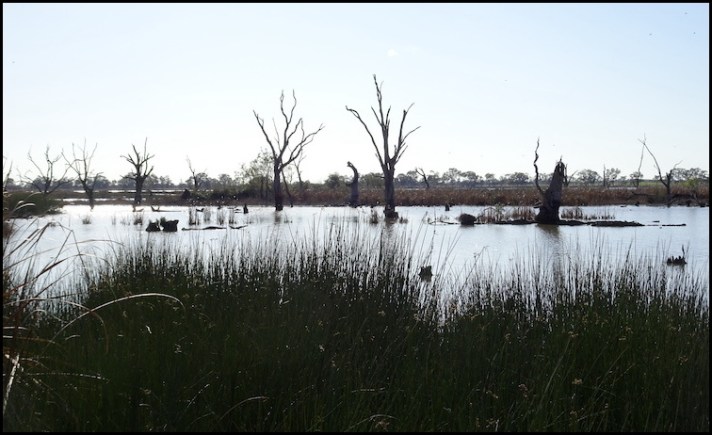
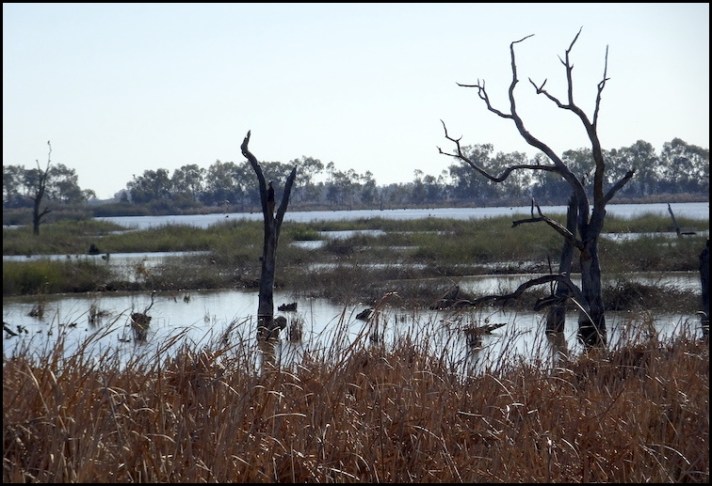
Each spring around 200,000 straw-necked, white and glossy ibis breed in the reed beds of wetlands around Middle Reedy Lake. This makes these wetlands the world’s most populous ibis rookery. The wetlands are also home to thousands of other waterbirds, including egrets, spoonbills, kites, harriers, sea eagles, grebes and heron.
Alas, we were a little early for the ibis breeding season but did spot many of the other birds seen here, managing to get a few pictures of some of them.

Herons in flight

Black swans and ducks

Heron
In earlier times the Reedy Lakes area provided food and shelter for a number of Aboriginal groups. As we moved across to have a look at the much larger First Reedy Lake, now a popular fishing area, we came across a scar tree and an earth midden area, providing evidence of this earlier Aboriginal settlement.
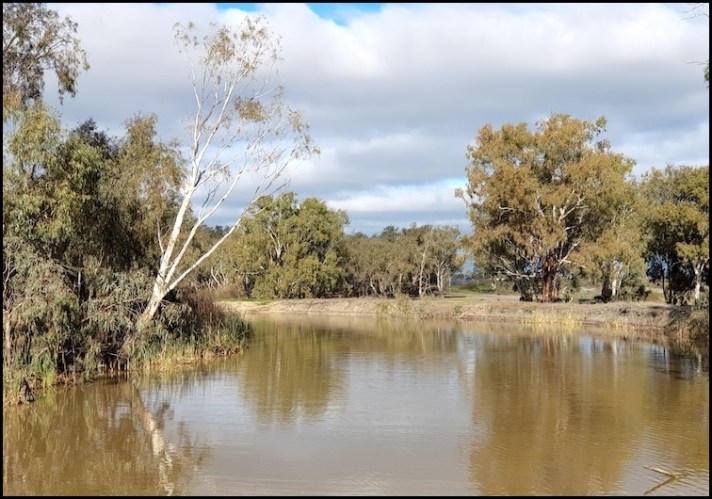
A (man made, I think) channel connecting Middle Lake Reedy with First Reedy Lake

Scar tree
Scar trees are, as the name suggests, trees that have been scarred – via having sheets of their bark removed. These bark sheets were used to make canoes, shields, or containers as required at the time. The existence of scar trees, generally eucalypts, especially Box or Red Gum, which are typically over 200 years old, is often the first sighted evidence to archaeologists that Aboriginal people used to live in a particular area.
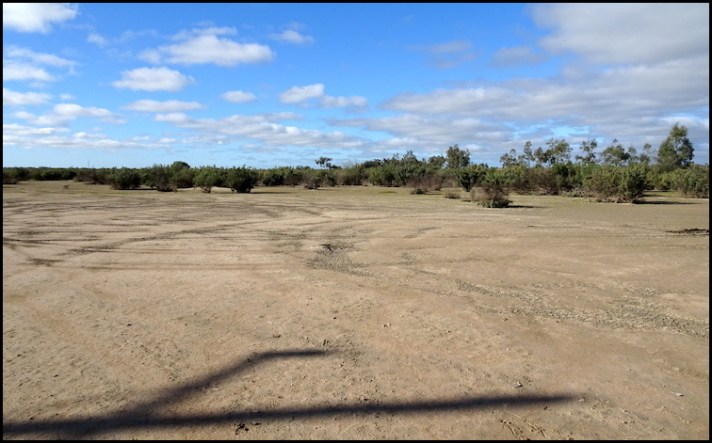
What remains of an earth midden area
Aboriginal people often cooked their food underground in earth ovens. These ovens were pits lined with heat retainers such as clay balls or stones on top of which a fire was lit. Once the heat retainers were hot, the fire was extinguished and food was placed on top. The pits were then filled in and left until the food was cooked.
Over time, these pits, with added debris from cooking and other domestic activities, developed into low-lying mounds (middens) which were then often used as camping locations during floods, with some becoming burial sites.
Leaving Reedy Lakes and heading northwards towards Lake Charm we passed many of the farms relying on the irrigation scheme referred to earlier, including vineyards owned by Brown Brothers Winery, one of Australia’s largest and a favourite of mine which we would visit later on this trip.

A Brown Brothers vineyard near Lake Charm
As we approached Lake Charm we were welcomed by an early display of wild spring flowers.
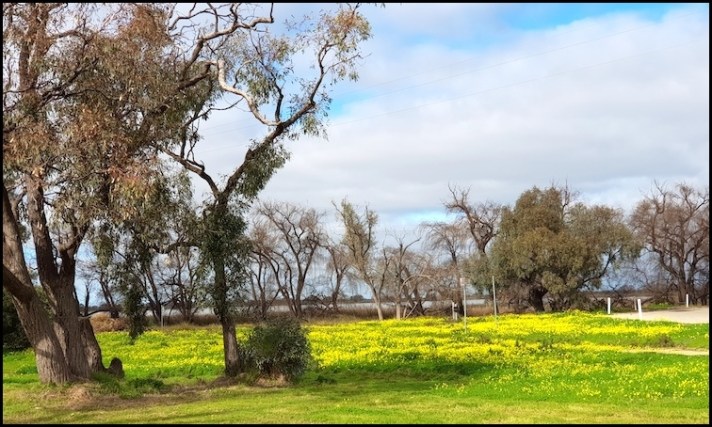
Lake Charm is a large freshwater recreational lake popular for water sports including swimming, water skiing, bird watching, fishing, and kayaking. The lake regularly hosts the Victorian Ski Racing titles as well as Victorian point score events. The lake is especially noted for its large redfin with the Redfin Fishing Classic drawing anglers here on an annual basis. Today, we took a short walk along a small section of the picturesque lake’s foreshore before moving on to Kangaroo Lake, another of the region’s popular recreational lakes.

Lake Charm
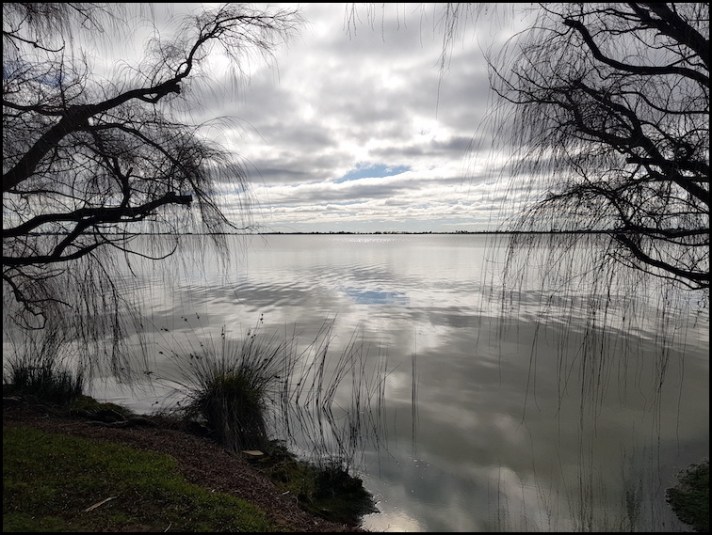
Lake Charm
We accessed Kangaroo Lake by way of Gorton Drive, named after former Australian Prime Minister, John Gorton, who was born in the area in 1911.
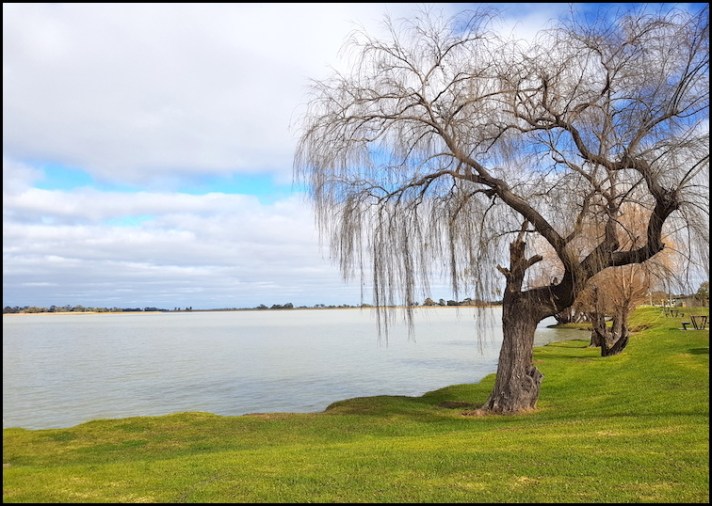
Kangaroo Lake

Kangaroo Lake
Moving on our next stop was Lake Tutchewop, one of the lakes in the area that typically dries out in summer though it was pretty much full when we visited, due to a particularly wet first half to 2023. What intrigued me and why we visited the lake was the advertised existence of Bathing Boxes – by a normally dry lake?
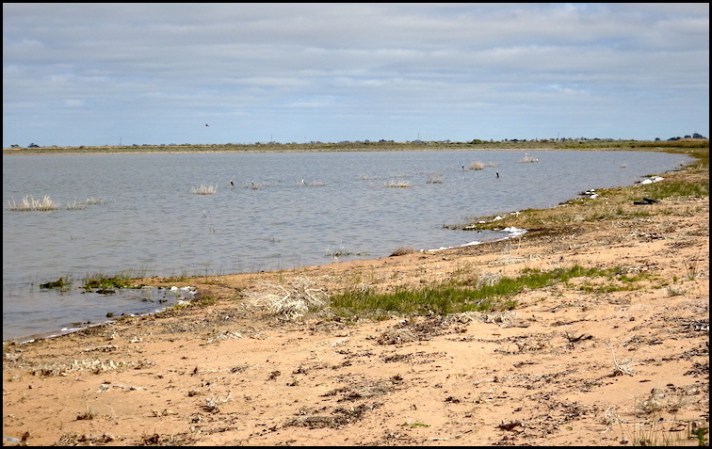
Lake Tutchewop
Lake Tutchewop was formerly the region’s most popular lake. It was the only lake with a sandy beach.
The lake became known as the ‘St. Kilda Beach of the North’ after early settlers formed the Lake Tutchewop Athletic and Aquatic Club in 1928 and bathing boxes (dressing sheds) were erected and willow trees were planted along the sandy beach.
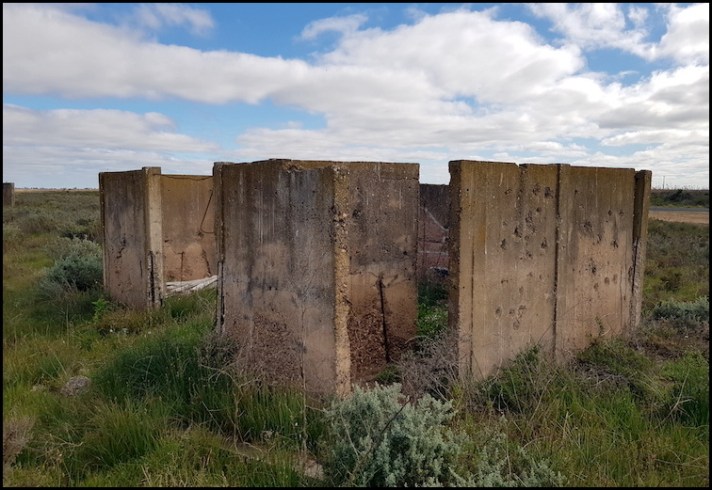
Lake Tutchewop bathing boxes
I don’t know if the boxes were ever colourfully painted as is the custom with these things. They certainly look a lot cruder, though sturdier, than the more colourful boxes found at St Kilda, Melbourne (Brighton Beach). In addition to the boxes, a running track was set down between the lake and the road and a pier and a diving board were erected. The 20-acre area became Tutchewop Park.
An inaugural carnival was held here on New Year’s Day 1929 attracting over 600 people. Carnivals were then held each New Year’s Day for eight years with people coming from Kerang, Swan Hill, Ultima and Deniliquin.
The carnivals, and indeed all activity around the lake, ceased in 1936 when a water commission decision de-commissioned Lake Tutchewop and bypassed it with a large channel. In 1968 the former freshwater lake became a salt disposal basin for the Barr Creek and today is seldom used, other then by ornithologists. With no water in the lake during the summer the bathing boxes fell into disuse.
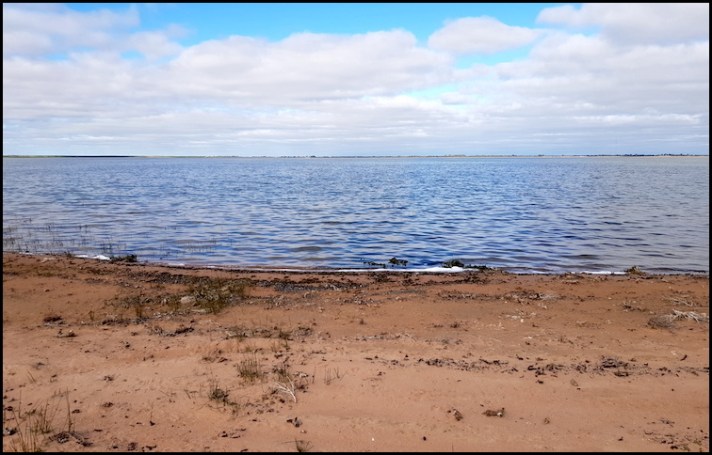
A rare view of Lake Tutchewop with water lapping the sandy beach
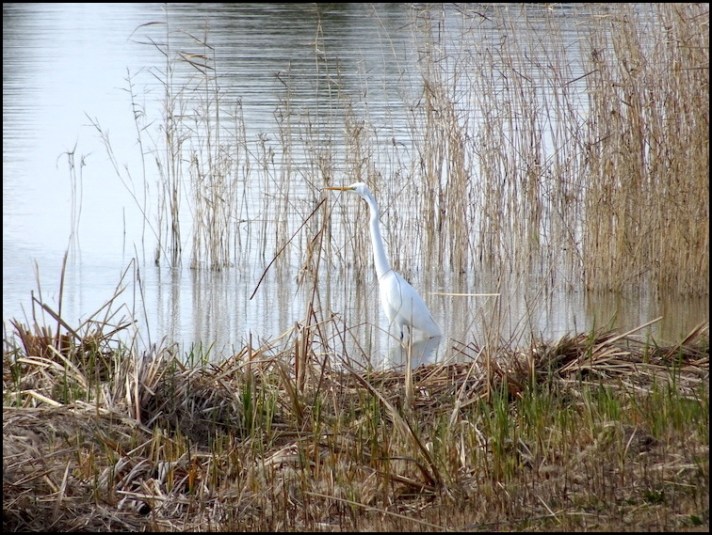
A great egret (heron) standing about one metre tall
By this stage, our tummies were starting to rumble and lunch was beckoning. Accordingly, we only made a brief stop at Lake Boga, perhaps the most popular recreational lake in the area and by which a small township has developed.
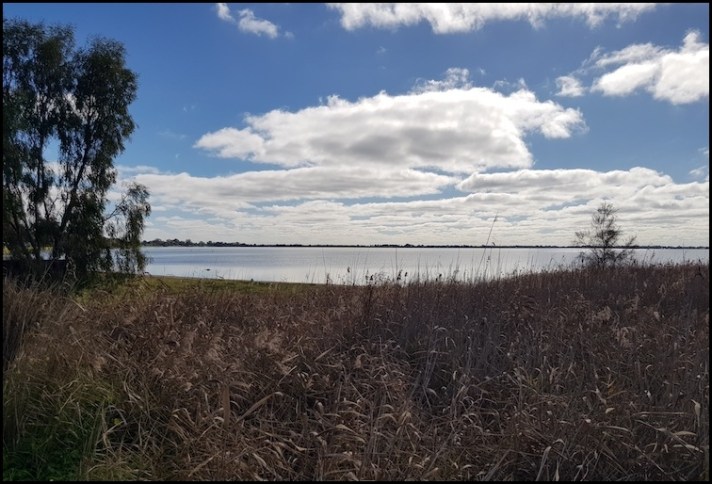
Lake Boga

Lake Boga
After taking a quick look at the lake, I spent a few minutes admiring the Lake Boga Story Wall. The wall is a collection of stunning mosaics created by the Australian artist, Zhou Xiaoping.
The Story Wall was crafted in 2000 and is one of six national symbols of reconciliation in Australia, aimed at bringing diverse sections of the community together to share their histories, cultures and experiences.
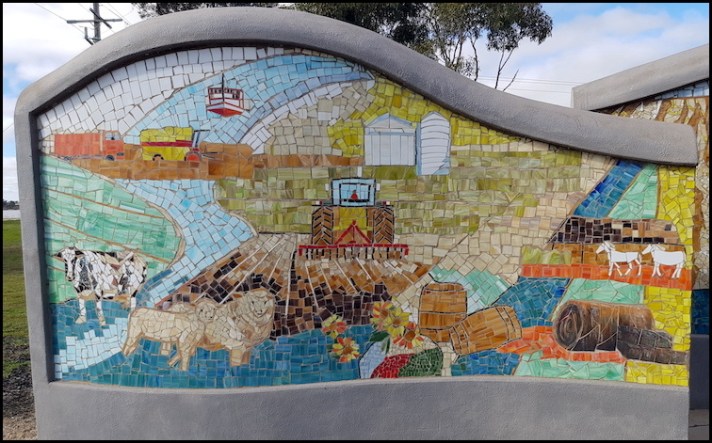
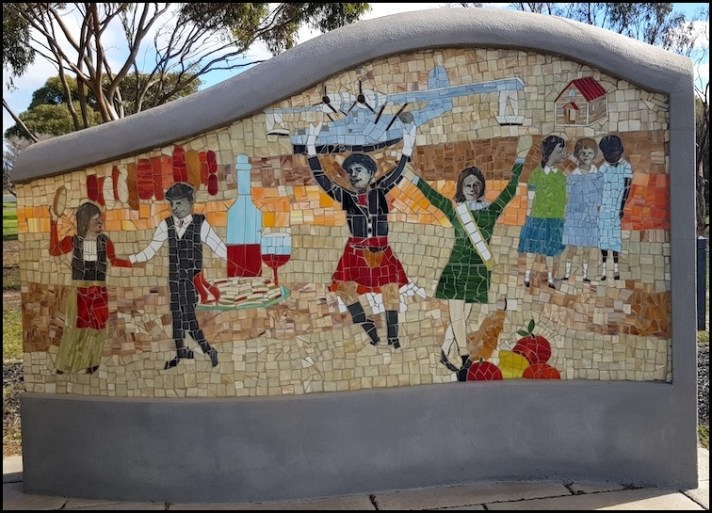
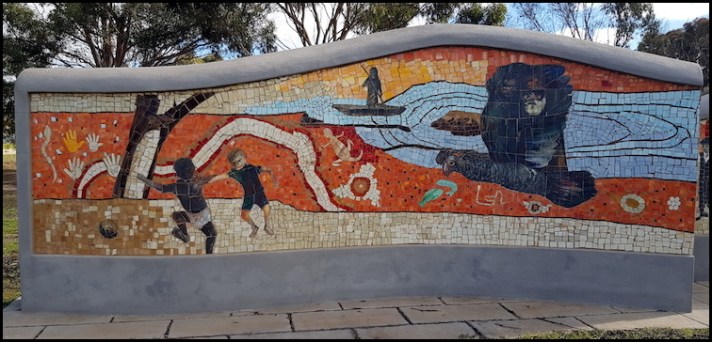

In his work ‘the artist has incorporated the essence of the region – the land, the water, the people, depicting their cultures, histories and ways of working, onto this stunning hand cut glass mosaic sculpture’.
For lunch, we headed north about 20 kilometres to Swan Hill, a substantial regional service centre and port on the Murray River. Here we dined at the local KFC – enough said!
Our plans for today (and indeed this trip) did not include spending time exploring Swan Hill and its environs but I could not resist a brief stop to snap a picture of The Giant Murray Cod, to add to my collection of BIG Things.
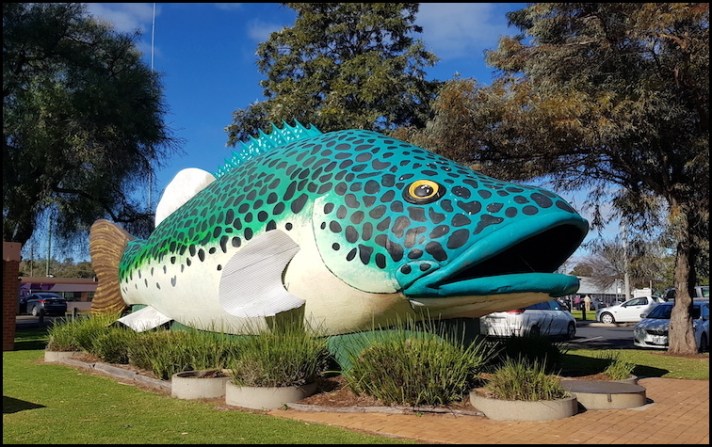
Affectionally known as Arnold, the Giant Murray Cod measures 15 metres long and 5.2 metres wide
Picture taken, it was time to head back to Kerang. Rather than take the direct route back down through the lakes area we crossed the Murray River at Swan Hill, into New South Wales, and returned along the northern side of the river. Disappointingly, the road, gravel for a large part, ran inland and away from the river. Ah well, one can’t have everything.
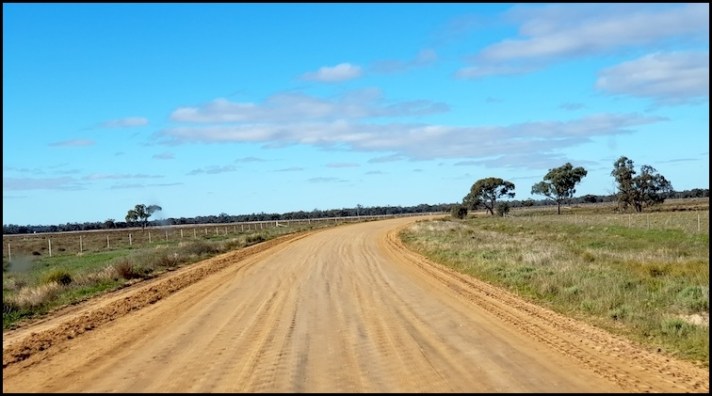
We crossed the Murray River back into Victoria at the small townships of Murrabit. The bridge here is one of the oldest on the Murray River, having opened in 1926. Originally a rail and road traffic bridge it became road only in 1964 after the railway closed

The central section of the bridge can be lifted so that paddlesteamers plying the river between South Australia and Echuca can pass under. From here we continued on to our camp in Kerang.
The next review from my Adelaide to Canberra road trip can be found HERE.
Should you wish to follow this road trip from the beginning please start HERE.


Some of those lift bridges were built by Sir John Monash weren’t they?
LikeLiked by 1 person
Indeed they were, this one included!
LikeLiked by 1 person
I see some Highland dancing going on in that mosaic wall!
LikeLiked by 1 person
You do indeed, Anabel, along with an Irish dancer and many other nationalities. Typically, in Australia when people talk about racial integration and fostering relations between peoples they refer to Aboriginals v v the rest. There is much more to it than that. As you may know, Australia is a very racially diverse country with many coming here of their own volition but equally many coming to get away from war and other troubles in their native lands. Thankfully the vast majority of these immigrants integrate well into the diverse and cosmopolitan society we have today. This is not to say they abandon their customs, languages, food, etc .. Far from it. These cultures and traditions are generally well-shared and celebrated.
LikeLike
One of my aunts and her husband were £10 poms but it took them quite a few years to settle as they came back and forward. Never lost their Scottish heritage as you say. She died last year in Brisbane.
LikeLike
Sorry to hear of the loss of your aunt. I enjoy going back to NI and certainly have not lost my heritage but could never return for good, have very much settled here. When I lived in PNG and Fiji (combined about 6 years ) I used to go to Burns night every year … a very big night of Scottish expats in the islands.
LikeLiked by 1 person
Pretty lakes and the scar trees add to the photogenic nature of the landscapes 🙂 I love the story wall and Arnold made me smile!
LikeLiked by 1 person
Thank you Sarah, I am glad I brought a smile to your face.
LikeLiked by 1 person