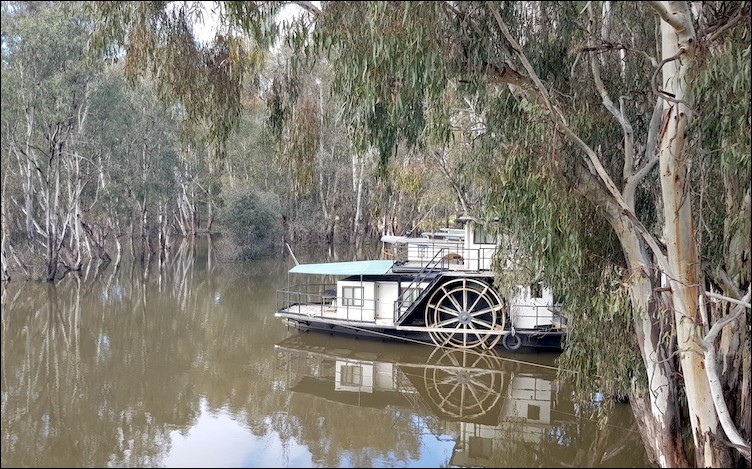
With the Winter Blues Festival behind us, we decided to have a wander around the town of Echuca and in particular visit the old port area, now a tourist precinct with numerous vestiges reminding the visitor of the town’s rich history as a major port on the Murray River.

Echuca Old Port area – now a tourist precinct.
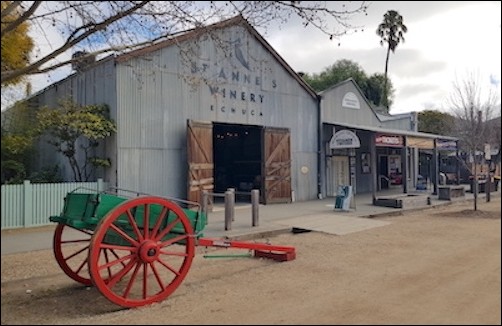
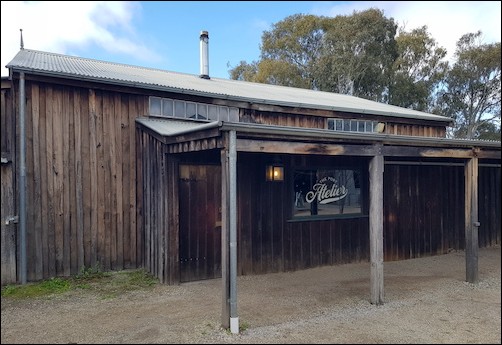
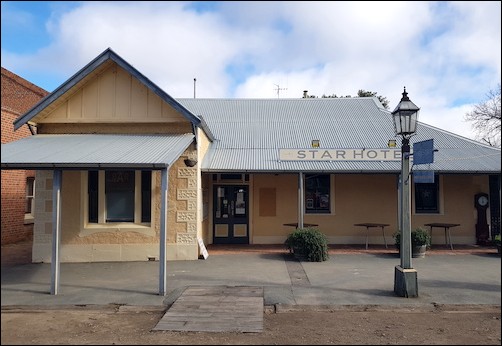
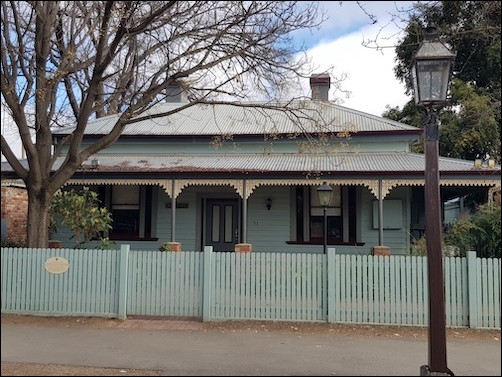
In its heyday, Echuca had 78 hotels, none more notorious than the innocuous looking Star Hotel (bottom left above) which was originally built as a private residence. The Star had an underground bar so that patrons could escape the heat and later a tunnel that led from the bar out to the back alley so drinkers could escape any raiding police after the hotel lost its licence in 1897.
Echuca, on the banks of the Murray River, can trace its roots back to a convict, Henry Hopwood who first arrived in the area in 1849. In 1833 Hopwood, born in Bolton, England, had been sentenced to 14 years transportation (to Tasmania) for ‘receiving stolen silk’. For good behaviour, he was given a Ticket of Leave in 1835 and became a policeman. He quickly stuffed things up by getting too friendly with his employer’s daughter and was sentenced to complete his 14 year sentence at Port Arthur after which he came to the Echuca area. Interestingly, Moama, across the river was founded by another convict, James Maiden who had been transported to Australia in 1834 having been convicted of stealing silverware and candles.
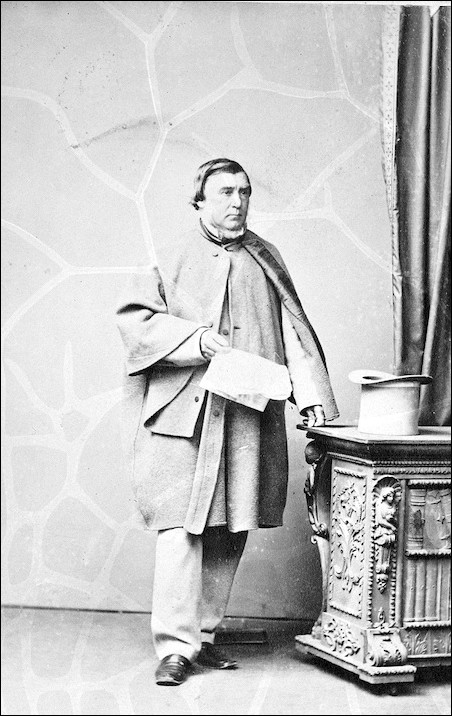
Former convict, Henry Hopwood.
Hopwood initially settled on the Moama (NSW) side of the Murray River where he was employed at a boiling down works. Boiling down was the term used in Australia for the process of rendering the fat from animal carcasses to produce tallow which was then turned into soap and candles for domestic use. By this stage, James Maiden, now also in Echuca/Moama, was doing quite well and would have been in a position to buy candles from Hopwood’s works as opposed to stealing them, as was his wont in England.
Not content with being an employee, Hopwood was soon (without official sanction) running a punt across the river and had built a rough timber slab inn. In 1853 he moved across the river and settled on the site that would later become the heart of Echuca. The following year he brought into service ‘a punt of superior construction’. Alas, his ‘superior punt’ was nothing compared to the punt system his arch-competitor (though apparently good friend) Maiden was operating upstream so he supplemented his arsenal with a pontoon bridge, correctly anticipating an increased movement of livestock. This left Maiden for dead. Close to his pontoon bridge he soon opened the Bridge Hotel, the modern reincarnation of which still operates on the same site.
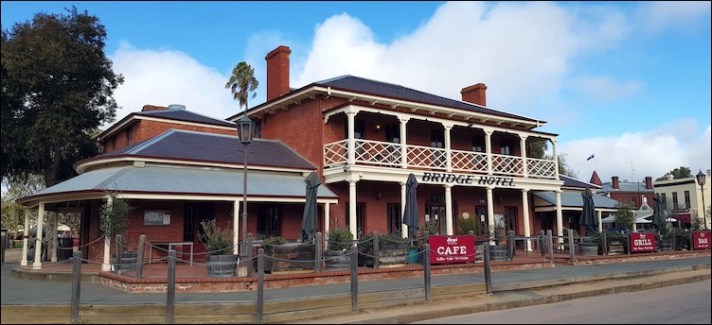
The Bridge Hotel Echuca.
In the following years, he worked tirelessly to expand the town, his own wealth and his legacy and by the time of his death in 1869 there existed a thriving port town where a few short years earlier there had been nothing. As is still often the case today, Hopwood’s empire-building was expedited by ingratiating himself with the right people. In 1857 his political chums had passed ‘An Act for making and maintaining a Bridge over the Campaspe River at Echuca’. It allowed only, ‘Henry Hopwood … to take and demand for a limited period a moderate toll on all persons, animals and vehicles passing over the said bridge.’
To Hopwood the Act was a licence to print money, something he literally did soon after when he printed his own notes, known as ‘Hopwood’s Shin Plasters’ and used them to pay his employees. These notes were redeemable at his river crossings, his store, his blacksmiths and at his hotel.
Wanting to ensure his place in the hereafter, Hopwood was a regular churchgoer and today the local Uniting Church (then Presbyterian) sports a Henry Hopwood stained glass window while a plaque, in his memory, has been placed on the pew where he prayed for absolution. While I doubt if the church would have been open anyway it was undergoing renovation when we visited so a look inside was not possible.
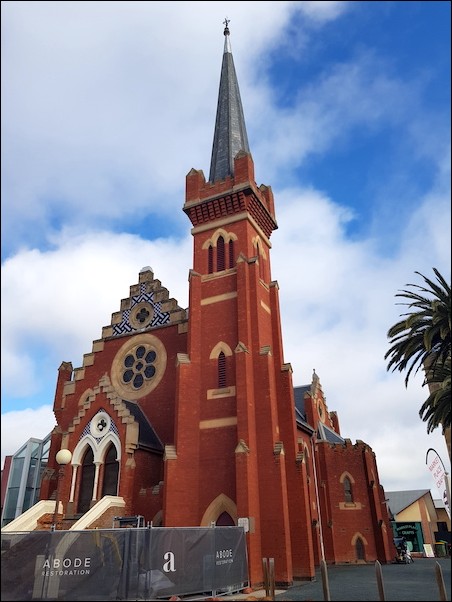
Echuca Uniting (formerly Presbyterian) church.
Built between in 1865 and 1867, from River Red Gums felled and milled locally, by the Victorian Railways/Public Works Department, the Port of Echuca Wharf was crucial to Echuca’s development. At the time of building, it was Australia’s third largest port, after Sydney and Melbourne. The wharf was extended by 332 metres (to 1.2 kms) in the 1880s and played a pivotal role in the country’s burgeoning wool industry allowing more efficient river transport to replace the cumbersome bullock carts that plied the bad or nonexistent roads. The river provided access to the sheep stations in the Riverina and Darling districts allowing the shipment of wool-clip from as far afield as Wilcanania and Bourke to Echuca from where it was dispatched by train, which arrived in Echuca in 1864, and sea all over the world.
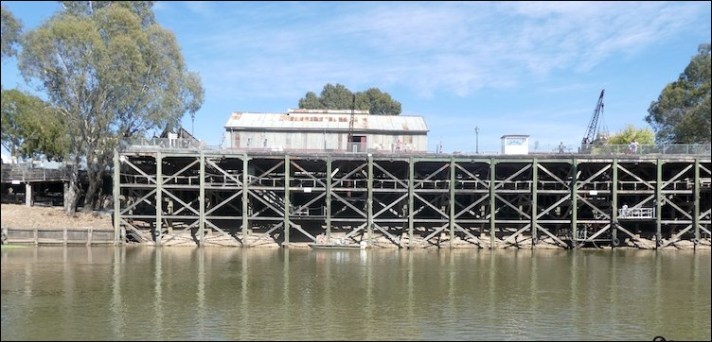
What remains of Echuca Wharf today. (Picture credit https://coralwaightravel.com/).
About 80% of the then unused wharf was demolished during World War II to compensate for a shortage of timber during the war period.

The railway siding at the Port of Echuca.
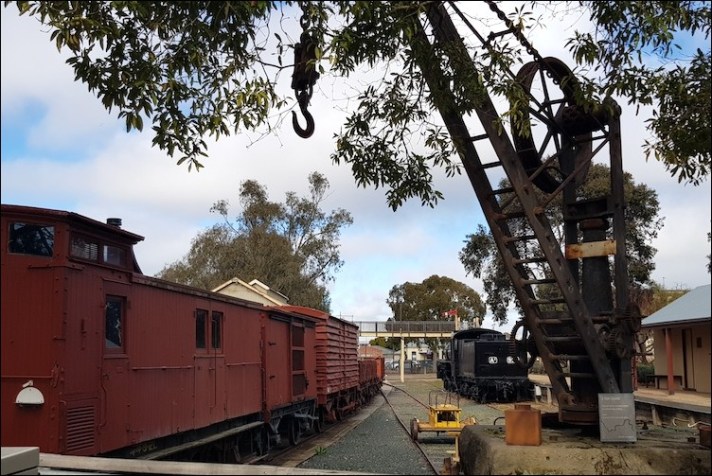
A crane with a hook used to move bales of wool from barges onto trains for onward transport to Melbourne and beyond.
As mentioned in earlier reviews, the river also played an important role in transporting logs (local Red Gum) to the numerous sawmills in the region, one of the most prominent of these being the Arbuthnot Mills at Koondrook which I wrote about in an earlier review. The logs were originally brought to the river bank by bullock-drawn log buggies which were also used to move them around the sawmills. Over time, certainly in the sawmills, the bullocks were replaced with steam engines before the whole set-up was replaced with tractors and such like.

The Alison barge.
Until the late 1950s logs were transported to sawmills on wooden river barges such as ‘The Alison’ which was the last barge to bring logs to the Evans Brothers’ sawmill, here in the port area. The river barges were retired when trucks became available and the road network was expanded and improved.

The Alison.

Bullock-drawn log buggy used to haul logs to the river for barge transport to the sawmills.

‘George’, The Ruston & Hornsby engine owned by the Evans Bros Sawmill, bringing a log into the mill.

These remnants of the Evans Brothers’ sawmill are now a working exhibit at the Port Discovery Centre. Red Gum timber from the sawmill was mainly used for shipbuilding and railway sleepers.
For many years, Echuca was the main shipbuilding centre for the river transport industry. At its peak, the town supported 8 sawmills and turned over up to 240 paddlesteamers a year. Some of the boats built in Echuca are still in operation hauling tourists up and down the river. These include the PS Adelaide, the oldest wooden-hulled paddlesteamer still operating anywhere in the world. While the PS Adelaide was not in town when we visited a replica of the paddlesteamer sat outside the very informative Port Discovery Centre.
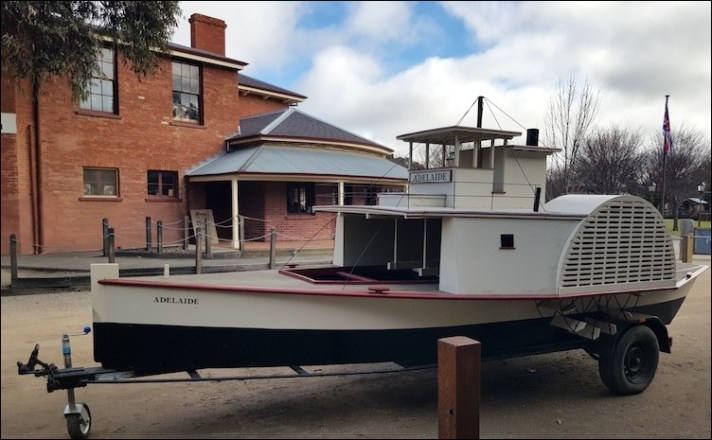
A model of the PS Adelaide.
Also still in operation, and also based in Echuca hauling tourists instead of towing outrigger barges laden with Red Gum logs, is the PS Alexander Arbuthnot which was built in the shipbuilding wing of the Arbuthnot Sawmills in Koondrook. It was the last paddlesteamer built as a working boat during the riverboat trade era on the Murray River.

PS Alexander Arbuthnot.
The preserved remains of another paddlesteamer, the PS Success, which was built in Moama in June 1877 reside in what is known as ‘The Success Yard’ at Port Discovery Centre.

The preserved remains of PS Success.
The Port Discovery Centre, in addition to its outdoor attractions, some of which I have referred to, has an excellent little museum tracing the history of the town, the port and the river.
The museum is home to a number of paddlesteamer models. That of the PS Pevensey immediately caught my attention. That name rang a bell with me.
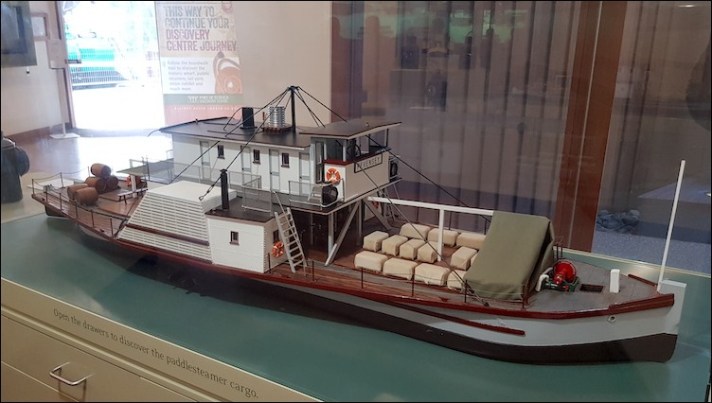
A model of the PS Pevensey.
The Pevensey was built in 1910 and was one of the largest towing and cargo paddlesteamers on the river. It was known as the ‘great Clydesdale’ of the river and was named after a sheep property on the Murrumbidgee River called Pevensey Station – a station I passed by every year, for over twenty years, on my annual trips from Canberra to Adelaide.
A couple of other exhibits that I found especially interesting were a collection of old paddleboat rudders including those from the PS Adelaide and the PS Pevensey together with a mural painted by Yorta Yorta (local Aboriginal grouping) artist, Stuart Hearn depicting how Dhungala, the Murray River, was created.

Paddlesteamer rudders.
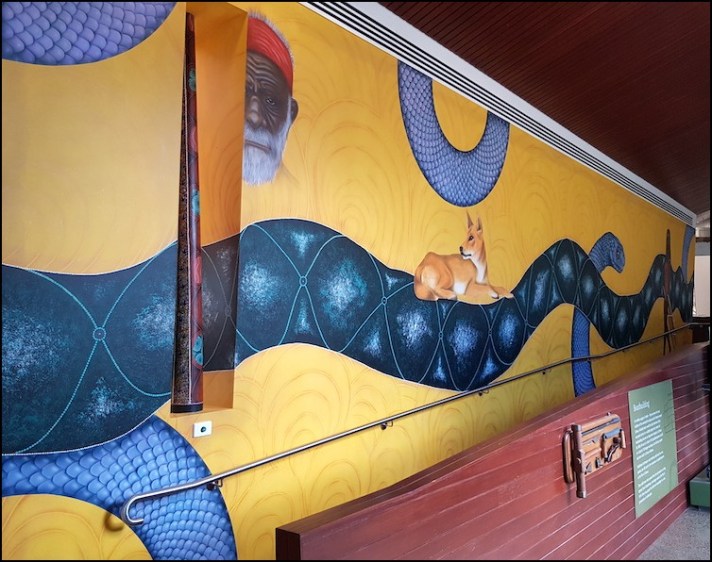
Aboriginal mural depicting the creation of the Murray River.
After lunch in one of the few eating establishments that were open (most had decided to shut up shop to rest after the busy festival weekend!) we wandered around the remainder of the town area admiring many more old buildings prior to going on a grocery shopping expedition, to stock up on provisions for our onward travels.
A few of the more interesting buildings were:-
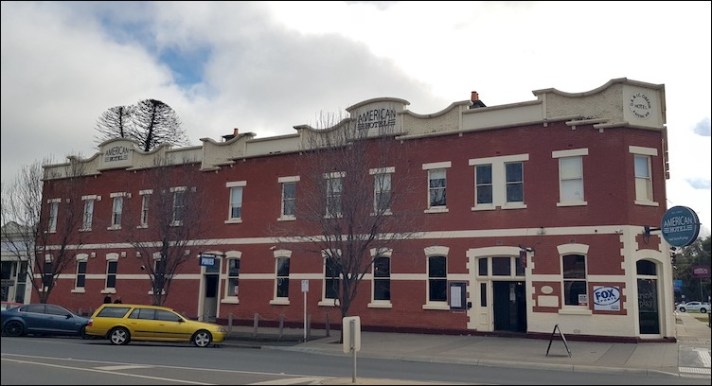
The American Hotel.
The American Hotel is one of the town’s oldest hotels, though together with a number of other hotels it claims to be the oldest in town. Apart from its menu having ‘an American bent’ I have been unable to ascertain why it was, and is, called the American Hotel. The only thing I can think of (pure speculation on my part) is that the name may relate to the fact that paddlesteamers with shallow drafts were first used in the 1820s along the Ohio and Mississippi rivers. Perhaps US ‘consultants’ came over to advise Australian builders and were housed here, leading to the hotel being referred to as the American Hotel. Incidentally, the American paddlesteamers were adapted from rear wheel vessels to mainly side wheel vessels in Australia.
In a recent refurbishment of the hotel old recycled timbers from the original Port of Echuca Wharf were used for ceiling beams, furniture and bar benchtops.

A charming Queen Anne style house, built in 1903.
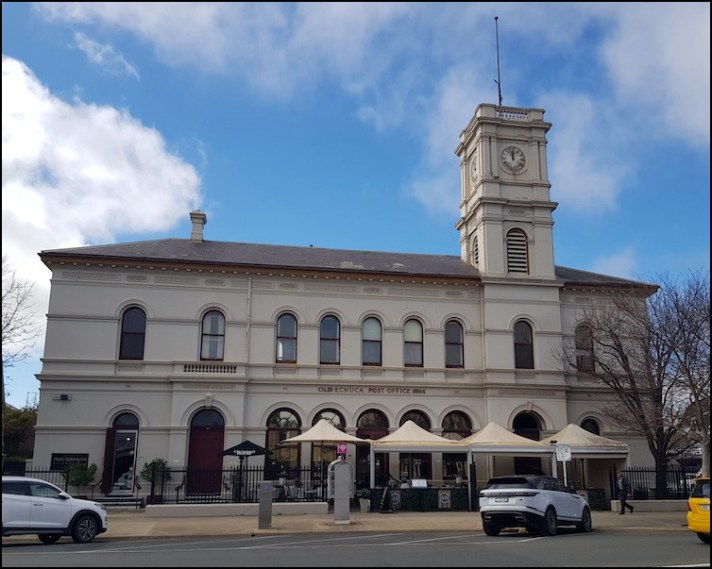
The town’s former Italianate style Post Office and clock tower, erected in 1877.
Rather than include pictures of the aisles of Woolworths’ supermarket, delightful though they were, I will leave my reader with Echuca’s ‘latest news’ as relayed by a billboard outside a local confectionary store. An old one, but a good one……….

The next review from my Adelaide to Canberra road trip can be found HERE.
Should you wish to follow this road trip from the beginning please start HERE.
 The Rambling Wombat
Interesting to read how a town like this came to be established and to thrive. I like the old buildings, especially the Queen Anne house (charming, as you say) and the paddlesteamers – but the Alison looks like she’s seen better days!
LikeLiked by 1 person
Thank you Sarah
LikeLiked by 1 person
Hopwood sounds quite a character. I suppose a lot of transported convicts did well if they were used to living on their wits.
LikeLiked by 1 person
Yes, many convicts did very well in Australia.. in fact, they built it! While many of them would have been sentenced to a few years, in reality, transportation meant life as once released few could have afforded to return home and opportunities here were generally far better for these people than back home anyway. Even among people who worked to save for a passage back home, few would have gone as by that stage they would have settled into life here and had families etc etc.
LikeLiked by 1 person
It’s a great part of the river, isn’t it? I really like the history, the turns in the river, the paddle boats. You’ve captured so much of Echuca.
LikeLiked by 1 person
Thank you so much.. it is a beautiful area.
LikeLike
A wonderfully informative account of this interesting town, and so well written Albert. Are we on the upgrade now?
LikeLiked by 1 person
Thank you, Malc. Yes on upgrade and went back to clean white background. The only thing you should notice is no ads in my posts (that is if there were any before).
LikeLiked by 1 person
Thoroughly painstaking history with a good range of photographs old and new
LikeLiked by 1 person
Thank you Derrick
LikeLiked by 1 person
I Think your ramblings are terrific I thoroughly enjoyed this one about Echuca – have wanted to get there forever to visit all the olden day history. SO thanks for providing all of this as well as the terrific photo., Cheers Michelle
LikeLiked by 1 person
Thank you for looking in. I am so pleased you enjoyed this post.
LikeLike